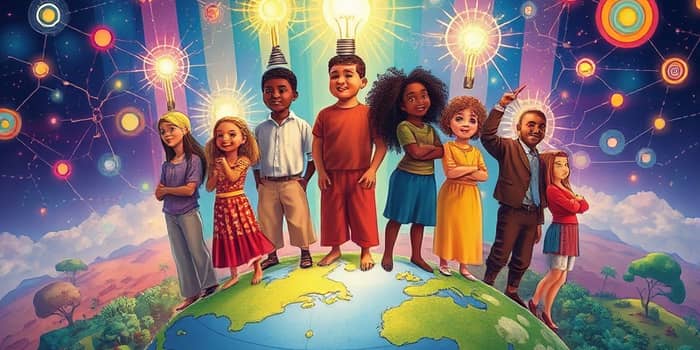
Human potential is the boundless possibility that resides within each individual, waiting to be cultivated, nurtured, and shared. It encompasses talents yet to be discovered, capacities waiting to be refined, and aspirations ready to be realized. When we understand the economic and social structures that enable growth, we can transform personal ambition into collective prosperity.
In this exploration, we will define the concept of human potential, examine its economic underpinnings, delve into its multiple dimensions, and outline practical strategies to help readers unlock their own capacities. By weaving together theory, history, and actionable insights, we aim to inspire a deeper appreciation for our shared journey toward growth.
Economic Foundations of Human Development
The evolution of human potential is inseparable from economic thought. From Aristotle’s idea of wealth as a means rather than an end, to Adam Smith’s observations on the division of labor, and Karl Marx’s focus on human capacities, economics has long grappled with what enables people to flourish.
Modern frameworks, pioneered by Nobel laureate Amartya Sen, shift the focus from gross domestic product to the evolving and culturally mediated capacity of individuals and societies. Sen’s Human Capabilities Approach emphasizes that true progress involves expanding people’s freedom to pursue lives they have reason to value.
Concrete statistics highlight this transformation. In 1800, global average daily income hovered around $3. Today, it approaches $33. In the United States, daily income rose from $33 to $140 over the same period, reflecting a dramatic surge in productivity, innovation, and knowledge exchange.
Dimensions of Individual Capacity
Human potential unfolds across multiple, interdependent dimensions. Understanding these facets helps individuals and organizations target their efforts for maximum impact.
• Cognitive: The realm of intellect, creativity, and critical analysis. Brain plasticity research shows that we can refine our thinking patterns throughout life.
• Emotional: The core of empathy, resilience, and self-awareness. Developing emotional intelligence enhances relationships and leadership abilities.
• Social: Collaboration, communication, and community engagement. Strong networks amplify individual contributions for collective benefit.
• Physical: Health, motor skills, and overall well-being. A sound body nurtures a sound mind, creating a foundation for sustained growth.
When we nurture these interwoven elements, we tap into our multi-dimensional cognitive emotional physical attributes, allowing us to pursue meaningful goals and societal advancement.
Collective and Societal Perspectives
Individuals thrive best in societies that invest in human development. The United Nations Development Programme identifies six pillars for collective well-being:
- Equity in education and healthcare for all genders and backgrounds.
- Sustainable livelihoods and resource fairness within planetary boundaries.
- Productive participation through inclusive economic policies.
- Empowerment of voices in political and social decision-making.
- Cooperation and community engagement for mutual enrichment.
- Security against sudden loss through robust safety nets.
Addressing inequality, discrimination, and limited access to healthcare and education is not merely a moral imperative—it unlocks latent potential on a societal scale. When individuals feel safe and valued, they contribute more creatively and collaboratively, fueling virtuous cycles of growth.
Modern Contexts: Technology, AI, and Education
In the twenty-first century, technology reshapes how we learn, work, and connect. Artificial intelligence automates repetitive tasks, freeing humans to focus on higher-order thinking, empathy, and innovation. Randstad’s Human Potential framework highlights three pillars in this era:
Learned skills—transferable knowledge such as coding, marketing, or data analysis.
Core inherent skills—the methods by which we approach problems, including agility, creativity, and critical thinking.
Aspirations and purpose—our motivations, values, and identity that drive meaningful contributions.
By balancing these elements, workers can learn unlearn and recombine ideas in ways that machines cannot replicate, ultimately creating new paradigms and industries.
Mechanisms to Unlock Potential
Translating theory into practice requires concrete strategies. Lifelong learning, mentorship, and supportive environments are key. Below is a snapshot of essential skills in a sustainability-driven world:
Beyond specific skills, aligning personal purpose with universal values creates an ethical compass that guides everyday decisions. Mentorship—whether formal or peer-based—accelerates growth by leveraging the wisdom of those who have navigated similar journeys.
Embracing exponential learning and knowledge exchange through networks, open platforms, and collaborative research fosters innovation at scale. Standing on the “shoulders of giants” enables revolutionary breakthroughs, from Nobel discoveries to grassroots social movements.
Challenges and Constraints
Despite our potential for growth, several barriers persist. Socio-economic inequality limits access to education and healthcare. Cultural biases and rigid power structures inhibit the free expression of talents. Environmental pressures and resource scarcity impose ecological limits on expansion.
Moreover, rapid technological change can outpace our ability to adapt. Without intentional upskilling programs and inclusive policies, the benefits of AI and digitalization risk deepening existing divides.
Addressing these challenges demands systemic reforms: equitable funding for public services, robust social safety nets, and education systems that emphasize critical thinking, creativity, and ethical reasoning.
Future Outlook for Collective Flourishing
Looking ahead, the trajectory of human potential is one of continuous growth, driven by knowledge, cooperation, and purpose. As we refine our understanding of brain plasticity, develop more inclusive institutions, and harness technology responsibly, we edge closer to a world where every individual can pursue a fulfilling life.
Principles that will guide this journey include asking bold questions, fostering open knowledge exchange, and nurturing a shared vision of justice and sustainability. By combining individual aspiration with collective action, we can create resilient communities that thrive within ecological boundaries.
Ultimately, unlocking human potential is not a one-time achievement but a lifelong process of learning, adaptation, and contribution. When we invest in both people and the systems that support them, we lay the foundation for an era of unprecedented innovation, equity, and well-being.
References
- https://lifestyle.sustainability-directory.com/term/human-potential/
- https://en.wikipedia.org/wiki/Human_development_(economics)
- https://www.randstadenterprise.com/insights/randstad-enterprise-insights/the-power-of-human-potential-in-the-ai-age/
- https://i.gy/human-potential/
- https://charleskochfoundation.org/stories/the-principles-that-unlock-human-potential/