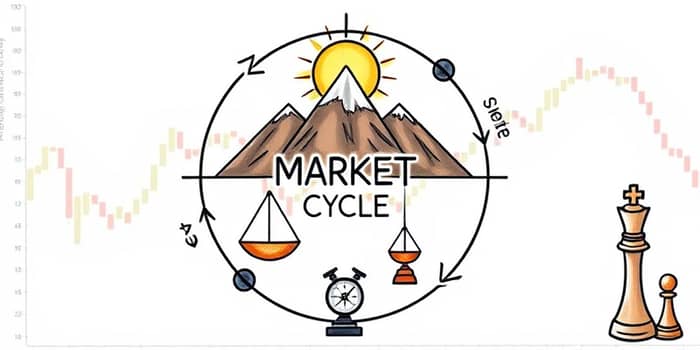
Markets are not random; they move in rhythmic patterns that savvy investors and businesses can harness.
These recurring patterns in financial markets are shaped by human psychology and economic forces, offering a roadmap for those who pay attention.
By learning to read these cycles, you can transform uncertainty into opportunity.
This knowledge empowers you to make informed decisions that align with the natural ebb and flow of markets.
The Rhythm of Markets: Understanding the Cycle
Market cycles describe the predictable phases that assets go through over time.
They are driven by shifts in sentiment, from fear to greed and back again.
Recognizing these phases allows for strategic positioning, which means adjusting your approach to maximize gains and minimize risks.
It's about being proactive rather than reactive in the face of change.
The Four Phases Decoded
Market cycles consist of four distinct phases, each with unique characteristics.
Understanding these phases is key to effective strategic positioning.
- Accumulation Phase: This occurs after a market bottom, where prices are low and sentiment is negative.
- Smart money investors begin buying undervalued assets quietly, leading to sideways trading.
- It's a time for patient investors to build positions before the next upswing.
- Markup Phase: Prices rise steadily as optimism grows and more investors join in.
- Volume surges, and sentiment turns from neutral to bullish or even euphoric.
- This phase often yields the largest gains for those who entered early.
- Distribution Phase: At the market peak, smart money sells to optimistic retail buyers.
- Prices become erratic, and volume remains high, signaling a transition to a bear market.
- It's a critical time to reduce exposure and secure profits.
- Markdown Phase: Prices decline sharply as pessimism spreads and selling accelerates.
- This phase ends at a trough, where depressed prices set the stage for a new accumulation phase.
- It requires defensive strategies to preserve capital.
Each phase offers specific opportunities and challenges for strategic positioning.
Signals to Watch: Identifying Each Phase
Identifying market cycle phases requires attention to specific signals.
Volume and sentiment are primary indicators that can guide your decisions.
- Low volume and sideways prices often signal the accumulation phase.
- Rising volume with steady price increases points to the markup phase.
- High volume and erratic prices near peaks indicate distribution.
- Sharp declines with high selling pressure mark the markdown phase.
Charts and trendlines can visually represent these patterns, making analysis more accessible.
Regular reviews of market data help in staying aligned with the current phase.
Investor's Playbook: Strategic Positioning in Cycles
For investors, strategic positioning involves adjusting portfolios based on the cycle phase.
This approach can enhance returns and protect against downturns.
In the accumulation phase, focus on buying undervalued stocks and assets to build a foundation.
Diversification is key here to spread risk.
During the markup phase, hold positions and ride the gains, considering sector rotations.
Cyclical sectors often perform well in this expansion phase.
In distribution, it's time to reduce exposure and take profits before the decline.
This prevents losses from market peaks.
During markdown, increase cash reserves and shift to defensive assets like FMCG.
These assets tend to outperform in recessions due to steady demand.
Overall, understanding cycles is essential for long-term wealth-building.
Business Strategies Aligned with Cycles
Businesses can also benefit from aligning strategies with market cycles.
This involves adapting operations to economic shifts for sustained growth.
In expansion phases, focus on growth, hiring, and ramping up production.
This capitalizes on strong market demand.
During peaks, prepare for potential contractions by evaluating costs and managing cash flow.
Diversification of revenue streams can provide stability.
In contractions or troughs, cut costs and focus on core operations to weather the storm.
Building cash reserves ensures resilience during downturns.
Strategic planning should include regular assessments of economic indicators.
This proactive approach helps businesses thrive through all phases.
Marketing Mastery: Positioning Brands in Cyclical Times
Marketing positioning can be adapted to market cycles to maintain brand relevance.
It's about creating a unique perception that resonates with customer needs.
Key strategies include focusing on product benefits, quality, and price points.
For example, emphasizing reliability during volatile times can build trust.
Niche positioning targets specific segments unmet by larger competitors.
This approach is ideal for competitive markets, offering better ROI and client fit.
Head-to-head positioning involves superior experiences in mature markets.
Challenging the status quo with unique features can solve unmet needs.
Regular metrics tracking, like win/loss analysis, helps refine strategies.
Aligning go-to-market plans with cycle phases ensures messaging resonates.
- Use customer needs, company strengths, and competition to define positioning.
- Implement strategies such as product characteristics or quality-based appeals.
- Monitor awareness, win rates, and revenue for continuous improvement.
This dynamic approach keeps brands competitive regardless of market conditions.
Practical Tools for Effective Analysis
Effective cycle analysis relies on practical tools and techniques.
These tools help in making data-driven decisions for strategic positioning.
- Sentiment and volume analysis: Monitor shifts in investor mood and trading activity.
- Chart patterns: Use trendlines and highs/lows to visualize cycle phases.
- Feedback loops: Conduct quarterly reviews and win/loss positioning analysis.
- Dashboard metrics: Track awareness, retention, and other key performance indicators.
- Sector rotation: Adjust investments based on economic phase transitions.
These tools provide a framework for anticipating market movements.
They enable proactive adjustments rather than reactive responses.
Regular use of these techniques builds confidence in navigating cycles.
Conclusion: Embracing Cycles for Long-Term Success
Market cycles are a natural part of financial ecosystems.
Embracing them through strategic positioning can lead to sustained success.
By understanding the phases and adapting your approach, you turn volatility into advantage.
Investors can build wealth, businesses can grow resiliently, and brands can maintain relevance.
Remember, cycles repeat, offering endless opportunities for those prepared.
Start applying these insights today to navigate markets with clarity and confidence.
The journey to mastering market cycles begins with a single step of awareness.
References
- https://www.strike.money/stock-market/market-cycles
- https://fullfunnel.io/marketing-positioning/
- https://www.guidantfinancial.com/blog/business-cycles/
- https://www.indeed.com/career-advice/career-development/positioning-strategy
- https://foolwealth.com/insights/four-stages-of-the-stock-market-cycle
- https://www.productmarketingalliance.com/your-guide-to-positioning/
- https://corporatefinanceinstitute.com/resources/economics/market-cycle/
- https://www.whitecoatinvestor.com/understanding-the-market-cycle/
- https://crowdstreet.com/resources/investment-fundamentals/real-estate-cycle-phases
- https://strategiccfo.com/articles/profitability/market-positioning/
- https://www.schwab.com/learn/story/four-stages-stock-market-cycles
- https://www.sharpstance.com/blog/gtm-strategy-and-positioning
- https://earn2trade.com/blog/market-cycles-analysis/
- https://www.fidelity.com/learning-center/trading-investing/markets-sectors/intro-sector-rotation-strats
- https://chartschool.stockcharts.com/table-of-contents/chart-analysis/chart-annotation-tools/stock-market-cycles
- https://www.ucfs.net/four-strategies-to-plan-for-economic-cycles-and-market-changes/