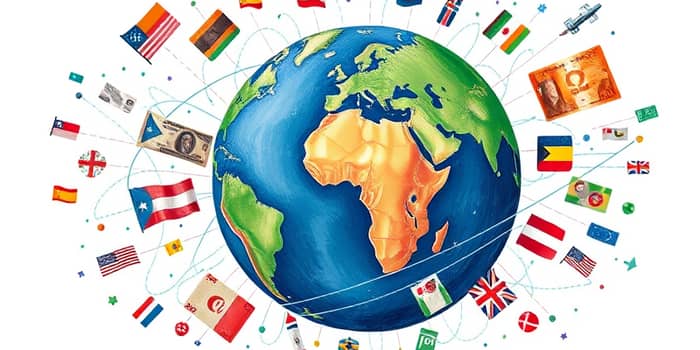
Exchange rates serve as the invisible force linking global markets, influencing everything from the price of your morning coffee to the profitability of multinational corporations. As we navigate 2026, shifts in currency values will reshape trade flows, investment decisions, and personal finances. This article unpacks the latest forecasts, explores the channels driving exchange rate impacts, and offers actionable guidance to manage risk and seize opportunity.
Global Economic Context and Forecasts
Global growth is projected at roughly 2.6 to 3.3 percent in 2026, while developing economies (excluding China) are set to slow to around 4.2 percent. Broad fiscal expansion in major economies will mitigate selling pressures on local currencies, limiting US dollar strength.
Analysts forecast key currency movements against the US dollar by Q4 2026:
The Financial Channel and Its Impact
The financial channel describes how dollar movements alter trade financing and costs. When the dollar appreciates:
- Import prices rise, reducing volumes in non‐dollar countries
- Exporters face tighter borrowing access abroad
- Trade‐related lending contracts, slowing global trade flows
- Effects intensify for firms with heavy dollar debt
This channel operates separately from invoicing mechanisms and has grown more influential since the global financial crisis.
The Role of Global Value Chains
Participation in global value chains (GVCs) dampens the sensitivity of exports to exchange rate shifts. On average, higher GVC engagement:
- Lowers export elasticity by about 22 percent
- Limits price competitiveness gains from depreciation
- Back-and-forth trade within chains reduces net trade response
Nearly two-thirds of trade occurs within these chains, now being reshaped by geopolitical tensions and industrial policies.
Currency Invoicing Patterns
The US dollar and euro remain dominant, accounting for over 80 percent of global trade invoicing. This hegemony means that shifts in these currencies transmit unevenly across countries, depending on their invoicing preferences and hedging practices.
Policy Drivers and Central Bank Actions
Trade policy uncertainty rose in 2025 with increased tariffs and strategic industrial measures. In 2026, governments are likely to maintain or adjust these tools, affecting supply chains and currency flows.
Key central bank moves:
- People’s Bank of China: ~30 bps rate cuts to stimulate growth
- European Central Bank: policy on hold as inflation eases
- Bank of England: terminal rate forecasting 3.25% or lower
- Federal Reserve: faces potential political pressure influencing decisions
Collectively, expansionary fiscal and monetary policies support currency stability and moderate dollar strength.
Exchange Rate Trends and Implications
Market consensus points to US dollar weakness in 2026 due to:
- Lagged global monetary easing effects
- Broad fiscal support outside the US
- Reduced trade policy uncertainty
Meanwhile, the Chinese yuan may appreciate modestly, constrained by PBoC’s focus on stability and deflation concerns.
Key Risks and Regional Effects
Major uncertainties include:
- Questions over Federal Reserve independence
- Emerging geopolitical flashpoints disrupting trade
- Persistent disinflationary pressures from energy markets
- Diversifying supply chains amid tensions
Small open economies with limited diversification remain most vulnerable to currency volatility and tighter financial conditions.
Turning Insights into Action
Understanding how exchange rates shape both macroeconomic trends and everyday finances empowers you to make informed decisions. Consider the following strategies:
- Monitor central bank communications and fiscal policy announcements
- Use forward contracts or hedging tools to lock in favorable rates
- Diversify currency exposures in your investment portfolio
- Stay aware of supply chain shifts affecting import and export costs
By combining data-driven forecasts with practical risk management, businesses and individuals can navigate currency fluctuations with greater confidence. As 2026 unfolds, proactive planning and strategic flexibility will be your strongest assets in a complex global trade environment.
References
- https://www.mufgresearch.com/fx/monthly-foreign-exchange-outlook-january-2026/
- https://www.federalreserve.gov/econres/notes/feds-notes/how-global-value-chains-change-the-trade-currency-relationship-20200203.html
- https://unctad.org/publication/global-trade-update-january-2026-top-trends-redefining-global-trade-2026
- https://academic.oup.com/rfs/advance-article-abstract/doi/10.1093/rfs/hhaf040/8172506
- https://www.oecd.org/en/publications/to-what-extent-do-exchange-rates-and-their-volatility-affect-trade_5kg3slm7b8hg-en.html
- https://www.weforum.org/stories/2015/11/do-exchange-rates-still-matter-for-trade/
- https://www.imf.org/en/blogs/articles/2026/01/19/global-economy-shakes-off-tariff-shock-amid-tech-driven-boom
- https://www.jpmorgan.com/insights/global-research/current-events/us-tariffs
- https://aier.org/article/how-currency-shapes-global-trade-exchange-rates-investment-and-stability/
- https://www.rbccm.com/en/insights/trade-and-tariffs
- https://www.ivalua.com/blog/how-tariffs-impact-procurement-and-supply-chains/
- https://www.ecb.europa.eu/press/other-publications/ire/article/html/ecb.ireart202506_02~a8e66f5ea3.en.html
- https://www.aeaweb.org/conference/2024/program/paper/aTdY8iDN