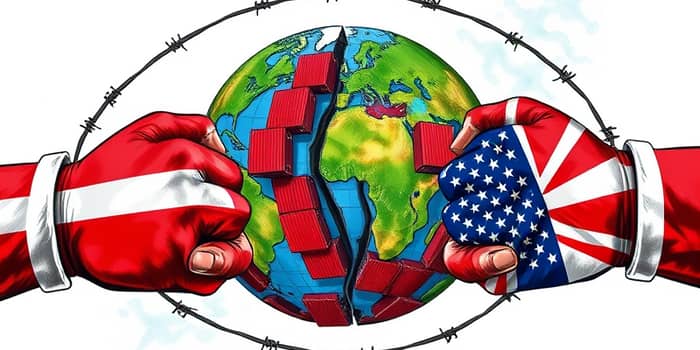
From the Smoot-Hawley Tariff to today’s high-stakes U.S.-China standoff, trade wars have reshaped economies and societies. Understanding their mechanics, costs, and remedies is vital for policymakers, businesses, and citizens navigating an interconnected world.
Definition and Core Concepts
A trade war arises when nations engage in extreme protectionism to shield domestic industries by imposing tariffs, quotas, or other trade barriers in retaliation for similar moves. Also known as customs wars or tariff wars, these conflicts can spiral, raising import costs and triggering countermeasures that disrupt global supply chains. Minor clashes are termed trade disputes, while full-scale engagements earn the war label.
At the heart of every trade war lies a confrontation between free trade advocates and protectionist interests. While the intent is often to preserve jobs or push back against unfair practices like dumping and subsidies, the fallout reaches far beyond border controls.
Historical Context and Lessons
The archetypal example is the U.S. Smoot-Hawley Tariff of 1930, when America raised duties on thousands of imported goods. Partners retaliated swiftly—France hiked auto duties from 45% to 100%, Spain added 40%, and Germany targeted U.S. wheat—deepening the Great Depression and fueling political extremism.
Post–World War II institutions like the General Agreement on Tariffs and Trade (GATT) and its successor, the WTO, emerged to prevent repeats of these destructive cycles. Yet, tensions persist: the EU began as a coal and steel alliance to counter protectionism in 1952, while NAFTA’s replacement, USMCA, reflects ongoing efforts to balance access and sovereignty.
Tools and Tactics in Modern Trade Wars
Countries deploy a suite of instruments to gain leverage or retaliate:
- Tariffs: Taxes on imports to raise foreign goods’ prices, used by the U.S. against Chinese electronics and by China on U.S. soybeans.
- Import quotas: Quantity limits, curbing market share and often reducing consumer choice.
- Subsidies: Government support that undercuts foreign competitors but can distort markets long-term.
- Currency devaluation: Deliberate weakening of the domestic currency to boost exports and discourage imports.
- Embargoes and export restrictions: Total or partial bans on specific goods or countries for political ends.
These tactics aim at strategic sectors—automobiles, agriculture, electronics, semiconductors, and emerging technologies like AI. The resulting disruptions ripple through global value chains, affecting producers, distributors, and consumers alike.
Economic Impacts and Stakeholder Effects
Trade wars rarely produce clear winners. While some domestic industries enjoy short-term gains through protected markets, overall economic output tends to shrink. Supply chain fragmentation raises costs, and inflation climbs as businesses pass tariffs to consumers. Developing nations often suffer the most, their export-dependent economies losing competitiveness and market access.
Industries tied to global value chains face uncertainty, leading to production cuts or relocation. Employment shifts are uneven: job gains in protected sectors may be offset by losses where costs rise. Consumers encounter reduced choices and sticker shock at the grocery store.
Social and Geopolitical Ramifications
Beyond economics, trade wars heighten geopolitical tensions and can erode international cooperation. Rising barriers and retaliation create an environment of suspicion, where alliances fracture and trust dwindles. In extreme cases, economic strife has historically paved the way to military confrontation.
Inequality often widens as wealthier nations navigate the conflict more effectively than poorer ones. Within countries, rural or export-oriented communities may bear disproportionate pain, fueling political polarization and social unrest.
Case Study: The U.S.-China Trade War (2018–Present)
Initiated over allegations of intellectual property theft and unfair trade practices, the U.S. imposed tariffs on over $360 billion of Chinese goods. China countered with duties on roughly $110 billion of U.S. exports. The tit-for-tat measures reshaped global sourcing, accelerated supply chain diversification to Southeast Asia, and triggered new export controls on semiconductors and AI technology.
While some U.S. manufacturers benefited from reduced competition, many sectors faced higher input costs. Chinese producers sought alternative markets, and multinational companies reevaluated investment plans. Ultimately, both economies absorbed higher expenses without securing decisive concessions.
Strategies to Navigate and Mitigate Trade Tensions
Proactive steps can help governments and businesses reduce vulnerability:
- Engage in multilateral negotiations through institutions like the WTO to resolve disputes diplomatically.
- Diversify supply chains across multiple regions to avoid overreliance on any single partner.
- Implement domestic reforms that enhance competitiveness without resorting to excessive protectionism.
- Foster public–private partnerships to develop strategic industries collaboratively.
Adopting these measures can build resilience, promote long-term economic stability and growth, and avoid the cyclical suffering of reciprocal trade barriers.
Lessons for the Future
Trade wars underscore a fundamental truth: no nation truly triumphs in an escalating tariff battle. While barriers may yield political posturing or momentary relief for select industries, the aggregate cost to consumers, workers, and global prosperity is steep. History teaches that cooperation, not conflict, fosters innovation and shared growth.
Moving forward, embracing balanced trade policies—grounded in fairness, transparency, and collaboration—offers the best path. By strengthening multilateral institutions, modernizing trade agreements, and addressing grievances through negotiation, the global community can defuse tensions and ensure a more stable economic future.
Remember: Collective engagement wins where isolation falters, and the true measure of progress lies in partnerships that lift all participants, not in walls that divide.
References
- https://en.wikipedia.org/wiki/Trade_war
- https://www.schwab.com/learn/story/what-is-trade-war-what-investors-need-to-know
- https://online.jwu.edu/blog/what-trade-war/
- https://corporatefinanceinstitute.com/resources/economics/trade-wars/
- https://www.britannica.com/money/trade-war-meaning
- https://www.shapiro.com/resources/trade-wars-how-tariffs-sanctions-and-policies-shape-the-supply-chain/