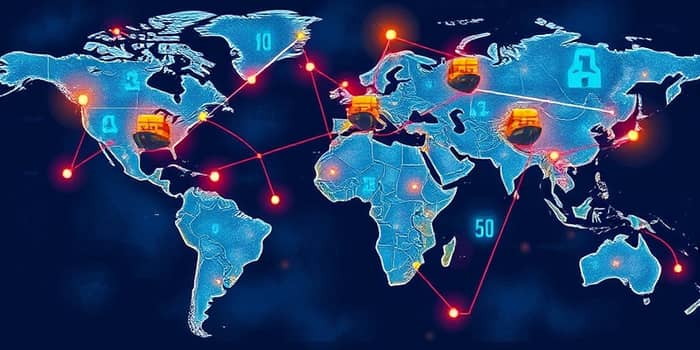
In 2025, the global supply chain confronts a myriad of challenges and opportunities. Annual losses from disruptions still total a staggering $184 billion, reminding us that resilience and innovation must go hand in hand. While some metrics show improvement, the reality of daily financial impacts underscores the need for robust strategies and unwavering commitment.
Current State of Global Supply Chains
After decades of globalization, supply chains have evolved into complex networks connecting producers, distributors, and consumers across continents. In 2025, companies face an average cost of a supply chain disruption of $1.5 million per day, revealing the immense stakes involved. Despite an 88% reduction from peak disruption losses, 94% of firms still report revenue impacts owing to operational interruptions.
In Europe, 76% of shippers experienced disruptions, with a quarter encountering over twenty distinct events in a single year. Companies invest heavily in end-to-end supply chain visibility to anticipate breakdowns and optimize flows. The frequency of major disruptions—averaging every 3.7 years—translates into prolonged recovery cycles often stretching two to three years. These statistics illustrate why fewer than 8% of organizations feel they have full control over risk exposure.
- Annual global disruption losses: $184 billion
- Revenue impact reported by 94% of companies
- Disruptions occur every 3.7 years on average
- Europe: 76% of shippers disrupted in 2024
Primary Risk Factors Shaping 2025
Geopolitical tensions and trade uncertainties dominate corporate risk registers. Tariffs and restrictions have become immediate threats, prompting 73% of U.S. manufacturers to cite trade volatility as a top concern. As global economic forecasts lean toward slower growth, companies are bracing for extended periods of instability.
Cybersecurity emerges as a critical area for investment. Organizations are strengthening defenses and securing supplier contracts to guard against supply chain cyberattacks. This heightened focus reflects an understanding that digital vulnerabilities can paralyze operations and incite significant financial losses.
Climate and environmental challenges continue to disrupt logistics. From wildfire smoke delaying deliveries to droughts slowing canal traffic, 63% of companies reported climate-driven disruptions in 2025. The unpredictable nature of these events calls for innovative planning and real-time monitoring.
- Geopolitical uncertainty and trade tensions
- Escalating cybersecurity threats
- Climate-related logistical disruptions
- Economic instability and inflation pressures
- Labor shortages and skill gaps
Emerging Trends and Strategic Responses
Significant investments in AI and automation signal a transformative era. With 86% of executives planning to deploy advanced analytics, companies aim to optimize forecasting, inventory management, and procurement. Predictions suggest AI adoption will soar from 28% to 82% within five years, reshaping decision-making across supply chains.
Supply chain mapping tools and digital nerve centers for extreme-disruption scenarios are becoming standard practice. These capabilities enable organizations to visualize risks, rehearse responses, and collaborate across functions. Early adopters report faster recovery times and more agile decision loops.
Resilience and agility now define supply chain architecture. Dual sourcing strategies and regional footprint adjustments help firms pivot quickly when disruptions strike. The concept of building anti-fragile systems—those that improve under stress—is gaining momentum among global leaders.
- Adoption of AI and advanced analytics
- Implementation of proactive risk mapping
- Development of anti-fragile supply chain models
- Enhanced cross-functional collaboration
Recommendations for Building Anti-Fragile Supply Chains
Organizations must embrace uncertainty and embed resilience into every layer of the supply chain. A comprehensive risk management framework should integrate technology, talent, and transparency. By fostering a culture that anticipates change rather than reacts to it, companies can unlock new levels of operational excellence.
To achieve this, prioritize proactive risk management and contingency planning. This involves scenario-based exercises, regular risk assessments, and continuous monitoring of geopolitical, cyber, and climate indicators. Such practices transform uncertainty into a source of strategic advantage.
Implementing sustainable supplier diversity and retention benefits not only supports ethical objectives but also mitigates concentration risk. Diversity programs can enhance supplier performance and drive innovation through varied perspectives and capabilities.
Looking Ahead: Preparing for a Dynamic Future
The only constant in global trade is change. Companies that cultivate agility, invest in innovation, and value transparent partnerships will lead the next era of supply chains. By treating every disruption as an opportunity to evolve and embrace uncertainty to gain strategic advantage, organizations can transform challenges into platforms for growth.
Ultimately, the path forward demands collective action. Industry peers, governments, and communities must collaborate to create resilient infrastructure, fair policies, and sustainable practices. Together, we can write the next chapter of the supply chain saga—one defined by connection, adaptability, and shared success.
References
- https://www.wtwco.com/en-gb/insights/2025/05/wtw-global-supply-chain-risk-report-2025
- https://procurementtactics.com/supply-chain-statistics/
- https://www.xeneta.com/blog/the-biggest-global-supply-chain-risks-of-2025
- https://www.jsheld.com/about-us/news/global-supply-chain-disruptions-and-risks-intensify-2025-j-s-held-global-risk-report-highlights-key-challenges
- https://www.spglobal.com/market-intelligence/en/news-insights/research/2025/10/us-supply-chain-outlook-q4-2025
- https://www.z2data.com/insights/most-destructive-supply-chain-challenges-2025-how-to-navigate
- https://tradeverifyd.com/resources/supply-chain-statistics
- https://tax.thomsonreuters.com/blog/2025s-supply-chain-challenge-confronting-complexity-and-disruption-in-global-trade-tri/
- https://unctad.org/news/global-supply-chains-under-strain-ministers-call-just-and-resilient-transitions
- https://www.newyorkfed.org/research/policy/gscpi
- https://www.bsr.org/en/primers/future-of-supply-chains-2025
- https://www.weforum.org/stories/2025/06/how-supply-chains-need-to-adapt-to-a-shifting-global-landscape/
- https://www.worldbank.org/en/data/interactive/2025/04/08/global-supply-chain-stress-index