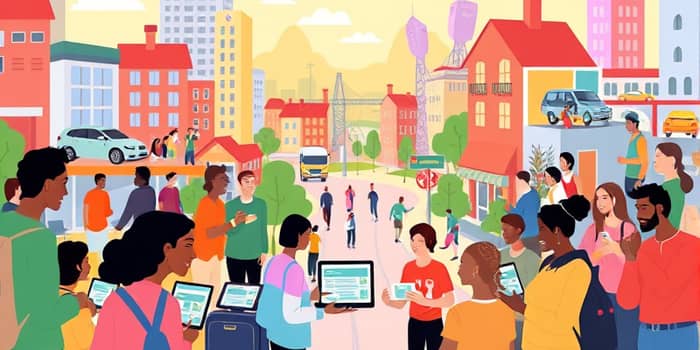
Imagine a world where idle assets become sources of income and community connection. This is the promise of the sharing economy, a revolutionary model that is transforming how we live and work.
By prioritizing access over ownership, it reshapes consumption through peer-to-peer exchanges. This dynamic ecosystem leverages online platforms to unlock underutilized resources, from cars to skills.
Its growth has been meteoric, driven by technological innovation and changing societal values. From gig workers to global corporations, its impact is profound and far-reaching.
Defining the Sharing Economy
The sharing economy, also known as collaborative consumption, involves peer-to-peer activities for sharing goods and services. It emphasizes temporary access rather than permanent ownership.
Key characteristics include digital platform facilitation and the utilization of idle assets. This model fosters efficiency and community-driven interactions.
Four main frameworks exist: franchiser, principal, chaperone, and gardener. Each offers unique approaches to managing exchanges and trust.
Its versatility spans niche services like tool-sharing to major sectors such as transportation. This adaptability fuels rapid adoption across demographics.
Market Size and Explosive Growth
The sharing economy is experiencing explosive growth with varying projections. In 2022, it was valued at approximately USD 387.1 billion.
By 2031, it is expected to reach USD 827.1 billion, growing at a 7.7% CAGR. More recent reports suggest even higher growth rates.
For instance, projections indicate USD 1.4 trillion by 2030 at a 24.8% CAGR. These discrepancies highlight the economy's dynamic nature.
This table underscores the economy's resilience and adaptability. The sheer scale of projections inspires confidence in its future.
Key Sectors Driving the Economy
Several sectors are at the forefront of this transformation. Each contributes significantly to overall growth and innovation.
- Shared Transportation: This segment includes over 90 companies with 61.29% annual growth. It is projected to reach USD 574.8 billion by 2030.
- Sharing Accommodation: Valued at USD 79.80 billion in 2019, it grows at a 25.8% CAGR. Platforms like Airbnb revolutionize tourism globally.
- Peer-to-Peer Energy Trading: With 70+ companies, it saw 27.73% growth last year. This highlights a shift towards sustainable resource management.
- Cooperative Workspaces: Over 170 companies employ 13,000+ people with 12.3% growth. It caters to the rise of remote work.
- Other emerging areas include hyperlocal sharing and niche services. They expand the economy's reach into daily life.
Each sector benefits from technological advancements and consumer trends. This makes the sharing economy a multifaceted phenomenon.
Employment and Manpower Impact
The sharing economy employs approximately 1.5 million people globally. It added 112,000 new hires last year alone.
It is closely tied to the gig economy, where 52% of global workers have engaged independently. This transformation redefines traditional employment.
- Platforms create opportunities for freelancers and part-time workers. This offers flexible income streams.
- Debates persist about job displacement versus new economic opportunities. Balancing these aspects is crucial.
- In the U.S., nonemployer statistics show continued growth in 2025. This indicates a shift towards flexible models.
This workforce evolution opens doors for diverse participation. It challenges conventional labor structures.
Regional Dynamics and Global Spread
The sharing economy varies significantly across regions. Some areas lead in adoption due to unique factors.
- United States: Valued at USD 98 billion in 2024, it remains a key player. Its mature market drives innovation.
- China: Projected to grow at a 33.7% CAGR to USD 374.7 billion by 2030. Rapid urbanization fuels this expansion.
- Other regions like Japan and Europe are also expanding. Emerging markets in Africa gain traction.
Globally, over 22,000 patents support innovation. Urbanization and digital infrastructure enable widespread diffusion.
Drivers Fueling the Expansion
Several factors propel the sharing economy forward. They ensure its resilience and integration into society.
- Urbanization and economic pressures post-COVID make cost-effective solutions appealing. Younger generations favor access over ownership.
- Technological advances like AI and blockchain enhance platform efficiency. They build trust through secure transactions.
- The expansion of the gig economy supports flexible work arrangements. Circular economy principles reduce environmental impact.
- Hyperlocal sharing fosters community and resource optimization. These elements create a perfect storm for growth.
These drivers synergize to accelerate adoption. They align with sustainable consumption trends.
Challenges and Regulatory Landscape
Despite its successes, the sharing economy faces significant hurdles. Addressing them is key to sustainable growth.
- Regulations evolve to ensure trust and safety. Issues around insurance and taxes require clarity.
- Debates on sustainability versus inequality persist. Policy balances are needed for fair outcomes.
- Tariffs and supply chain shifts pose economic risks. Adapting to these changes is essential.
- Older demographics may be less receptive, affecting adoption. Inclusive strategies can bridge gaps.
Navigating these challenges ensures long-term viability and social acceptance. It paves the way for responsible innovation.
The Future of Sharing
Looking ahead, the sharing economy is poised for further innovation. It is expected to generate over USD 1 trillion by 2031.
Future trends include real sharing of skills and knowledge. Deeper integration with AI will enhance user experiences.
With 1,800 startups and 25,000+ companies, competition drives progress. The potential for community building is immense.
Resource optimization and environmental benefits address global challenges. This movement fosters a resilient future.
In conclusion, the sharing economy is more than an economic model. It is a pathway to a connected, efficient, and sustainable world.
References
- https://www.startus-insights.com/innovators-guide/sharing-economy-market-report/
- https://www.globenewswire.com/news-release/2025/04/24/3067614/0/en/Sharing-Economy-Industry-to-Grow-by-US-1-Trillion-Reaching-US-1-4-Trillion-by-2030-Expansion-of-Collaborative-Consumption-Models-Drives-Adoption-in-Various-Sectors.html
- https://www.brookings.edu/articles/the-current-and-future-state-of-the-sharing-economy/
- https://www.proficientmarketinsights.com/market-reports/sharing-economy-market-1199
- https://passivesecrets.com/sharing-economy-statistics/
- https://hbr.org/2025/12/the-hbr-charts-that-help-explain-2025
- https://www.technavio.com/report/sharing-economy-market-industry-analysis
- https://www.deloitte.com/us/en/insights/industry/technology/digital-media-trends-consumption-habits-survey/2025.html
- https://www.futureagenda.org/foresights/the-real-sharing-economy/
- https://menlovc.com/perspective/2025-the-state-of-consumer-ai/
- https://trendsresearch.org/insight/sharing-economy-the-future-of-the-global-economy/
- https://www.thebusinessresearchcompany.com/report/sharing-economy-global-market-report
- https://www.census.gov/library/stories/2025/07/nes-gig-economy.html