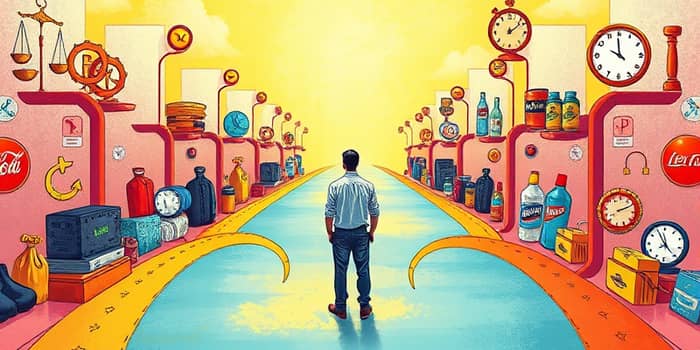
The study of consumer behavior lies at the very heart of economic theory. For centuries, the model of the rational consumer has offered a neat framework for predicting how people respond to prices, incomes, and market signals.
Yet as scholars blend insights from psychology and neuroscience, a central question emerges: do real consumers truly behave as flawless utility-maximizers, or is that an elegant fiction?
Defining Rationality in Economic Theory
Classical economics constructs the consumer as a decision-maker endowed with unbounded reason. Under this view, individuals assess every available option, weigh costs against benefits, and select the choice that yields the greatest net gain.
making choices to maximize utility captures the essence of this assumption, anchoring models in the idea of personal satisfaction.
- consumer rationality and full information ensure thorough option analysis
- utility maximization principle drives choices based on satisfaction
- perfect information and consistent preferences underpin decision models
- unconditional self-interest and personal sovereignty guide individual gains
- predictable behavior patterns inform demand theory in markets
Historical and Theoretical Foundations
The rational choice paradigm traces its roots to 19th-century pioneers like William Stanley Jevons and Irving Fisher. They introduced mathematical functions to model personal happiness and budget constraints.
Over time, these constructs evolved into framework for economic policymaking, shaping everything from tax schedules to welfare analysis.
Modern textbooks still teach the invisible hand of competition and the optimization of utility functions as the bedrock of microeconomics.
Challenges from Behavioral Economics
In the latter half of the 20th century, a wave of psychological research began uncovering systematic deviations from pure rationality.
psychological factors shape consumer choices through emotions, cognitive load, and social context.
Herbert Simon’s theory of bounded rationality argued that limited time and cognitive resources force individuals to settle for satisfactory, rather than optimal, outcomes.
Rather than conduct exhaustive comparisons, people employ mental shortcuts and heuristics to make timely decisions—a reality at odds with traditional economic assumptions.
Key Cognitive Biases Affecting Decisions
Cognitive biases demonstrate how consumer behavior often departs from perfect rationality:
Real-World Examples Illustrating Irrational Patterns
Everyday shopping scenarios reveal the gap between theory and practice. Supermarkets and online retailers exploit cognitive biases to boost sales.
- Impulse purchases override planned budgets in checkout aisles.
- Loyalty programs exploit loss aversion, encouraging repeat spending.
- Default options in insurance or subscription plans capitalize on status quo bias.
Consider how store layouts guide consumers past high-margin items they had no intention of buying—an outcome at odds with a strict utility-maximizing model.
Implications for Policy and Market Analysis
Despite its shortcomings, rational choice theory remains a cornerstone of policy design. Simple models enable rapid estimation of consumer responses to taxes, subsidies, and regulations.
normative assumptions vs real behavior highlight the tension between idealized frameworks and observed actions.
Behavioral insights have led to “nudge” policies—subtle interventions that steer choices without restricting freedom, such as default enrollment in retirement plans.
Ongoing Debates and Future Directions
Scholars continue to debate whether to abandon, amend, or augment the rational consumer model. Some propose fully integrated behavioral-rational hybrids that assign probabilities to biases within utility functions.
Others advocate for richer data on neural and emotional processes to deepen model accuracy.
insights refine traditional models even as core optimization principles endure in mainstream economics.
Conclusion: Fact, Fiction, and Practical Takeaways
The archetype of the fully rational consumer offers clarity and predictive power, yet real human behavior is laced with bias, emotion, and imperfect information.
Recognizing these limits does not invalidate economic modeling, but demands humility and creative adaptation.
By combining mathematical rigor with the richness of behavioral evidence, economists, policymakers, and consumers alike can navigate markets with a more nuanced, empathetic, and effective approach.
References
- https://www.savemyexams.com/dp/economics/ib/22/hl/revision-notes/2-microeconomics/2-4-critique-of-the-maximizing-behaviour-of-consumers-and-producers/rational-consumer-choice/
- https://www.ebsco.com/research-starters/economics/rational-choice-theory
- https://www.econinja.net/microeconomics/2-4-critique-of-maximizing-behaviour/rational-consumer-choice
- https://courses.lumenlearning.com/wm-microeconomics/chapter/rationality-and-self-interest/
- https://business.ucr.edu/news/2024/08/05/expert-insights-rational-choice-theory
- https://en.wikipedia.org/wiki/Rational_choice_model