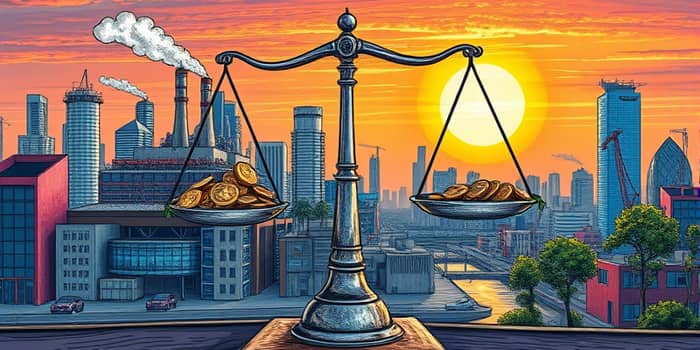
In our quest for advancement, we often face unavoidable choices that shape our world, where every gain in progress demands a sacrifice elsewhere.
These economic trade-offs are woven into the fabric of modern life, from personal decisions to global policies.
Understanding them empowers us to navigate the complex landscape of growth and responsibility with wisdom and foresight.
Understanding the Core of Trade-offs
At its heart, an economic trade-off is a choice between competing priorities.
It reflects the fundamental scarcity of resources that defines our existence.
For instance, the classic guns or butter model illustrates how nations allocate resources during crises.
Today, this concept extends to balancing economic growth with environmental health or social equity.
These decisions are not just abstract; they impact daily lives and future generations.
Recognizing this can inspire more thoughtful and sustainable actions.
Key Dilemmas in Modern Society
Our world is filled with critical trade-offs that challenge our values and priorities.
Here are some of the most pressing ones that define our era.
- Efficiency versus fairness: Maximizing output often leads to inequality, while equitable systems may reduce overall efficiency.
- Short-term gains versus long-term sustainability: Immediate profits can compromise future viability and ecosystems.
- Economic growth versus environmental protection: Industrial expansion drives progress but risks pollution and biodiversity loss.
- Savings versus spending: Choices between current consumption and future security affect both personal and national stability.
Each of these dilemmas requires careful consideration to avoid unintended consequences.
By acknowledging them, we can strive for a more balanced approach to development.
Real-World Examples and Their Impacts
To see trade-offs in action, look at specific cases that highlight their tangible effects.
These examples show how abstract concepts translate into real-life outcomes.
Such instances remind us that no decision is without cost.
They encourage us to weigh the benefits and drawbacks with a holistic perspective.
Case Studies: Balancing Act in Action
Delving deeper, case studies reveal the nuanced nature of these trade-offs.
They offer lessons on how societies can navigate complex choices.
- Sustainable agriculture: This approach trades short-term profits for soil health and water conservation, fostering resilience over time.
- Job creation versus environment: New plants may boost employment but increase pollution, highlighting the need for green alternatives.
- Climate change mitigation: Investing in renewables involves upfront costs but secures energy and public health in the long run.
These scenarios demonstrate that innovative solutions can soften the harsh edges of trade-offs.
They inspire hope for a future where progress does not come at an unbearable price.
Challenges in Measuring Trade-offs
One of the biggest hurdles is accurately assessing the costs and benefits involved.
This often leads to undervaluing long-term or intangible factors.
- Time horizons: Economic models tend to prioritize present gains over future benefits, such as environmental preservation.
- Measurement issues: Quantifying social and environmental impacts is difficult compared to straightforward profits or GDP growth.
- Equity lens: Policies that boost prosperity for some may harm vulnerable populations, requiring inclusive evaluation.
Addressing these challenges demands interdisciplinary collaboration and ethical reflection.
It pushes us to develop better tools for decision-making that honor all dimensions of well-being.
Strategies for Navigating Trade-offs
Despite the complexities, there are practical ways to manage these inevitable choices effectively.
Adopting a proactive stance can lead to more sustainable outcomes.
- Embrace holistic thinking: Consider economic, social, and environmental factors together, not in isolation.
- Foster innovation: Support technologies and policies that reduce trade-offs, like green jobs that combine employment with eco-friendliness.
- Promote transparency: Make trade-offs visible in public discourse to encourage informed voting and consumer choices.
- Plan for the long term: Prioritize investments in education and infrastructure that yield benefits over decades.
- Engage in dialogue: Involve diverse stakeholders to ensure that decisions reflect a broad range of values and needs.
These strategies help minimize negative impacts while maximizing shared prosperity.
They turn daunting trade-offs into opportunities for creative problem-solving.
Broader Implications for Our Future
The way we handle economic trade-offs will shape the legacy we leave for generations to come.
Short-sighted choices can lead to irreversible costs, such as climate change or social unrest.
Conversely, thoughtful balancing can pave the way for a more resilient and equitable world.
Global trade, for example, enhances living standards through specialization but requires careful management to avoid protectionism.
Ultimately, the price of progress is not fixed; it depends on our collective wisdom and courage.
By embracing these challenges, we can forge a path that honors both growth and humanity.
Let this inspire you to reflect on your own choices and advocate for policies that prioritize long-term well-being.
References
- https://helpfulprofessor.com/trade-off-examples/
- https://pollution.sustainability-directory.com/term/socio-economic-trade-offs/
- https://thedailyeconomy.org/article/trade-offs-in-economics/
- https://www.economicsobservatory.com/epidemic-and-economy-what-are-trade-offs
- https://thuong.substack.com/p/the-art-of-trade-offs-in-decision