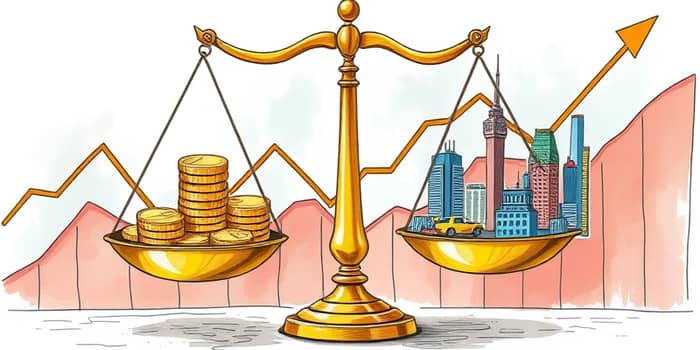
The tension between individual prudence and collective prosperity lies at the heart of the Paradox of Thrift. When households tighten their belts, they believe they are doing the right thing. Yet, at a macro level, increased saving can trigger a spiral of reduced demand, lower output, and, paradoxically, diminished aggregate savings. This article unpacks the mechanisms, real-world lessons, and policy options that allow us to navigate this paradox for sustainable growth.
Origins and Core Concept
The term was popularized by John Maynard Keynes in his 1936 seminal work. He observed that what benefits an individual by boosting savings can harm the broader economy when adopted en masse. In microeconomics, saving more improves personal security. In macroeconomics, however, higher collective saving acts as a leakage from the circular flow of income, leading to contraction.
Keynes introduced the idea that one person’s consumption becomes another person’s income. Thus, when consumption falls, businesses see reduced revenue and production, prompting layoffs and further spending cuts. This self-reinforcing cycle underpins the paradox.
Mechanism in Action
To visualize the process, imagine an economy where every household increases its savings rate by just a few percentage points. The immediate impact is a drop in overall spending on goods and services. Lower sales force firms to trim production, which in turn raises unemployment. As incomes decline, households struggle to save at previous levels, so total savings stagnate or even decrease.
- Immediate effect: household consumption declines sharply
- Direct consequence: business revenues and output contract
- Secondary effect: unemployment climbs, incomes fall
- End result: aggregate savings remain flat or drop
This chain reaction is magnified by the Keynesian multiplier effect, where an initial spending reduction leads to a larger total drop in income and output. The circular flow model underscores how savings act as a disruption: funds withdrawn from consumption are not immediately reinjected without active investment or fiscal intervention.
Real-World Perspectives
History provides stark examples of the Paradox of Thrift in action. During the Great Depression, widespread fear drove people to hoard cash, deepening the economic downturn. More recently, the COVID-19 pandemic saw households globally boost precautionary savings, contributing to a sharp decline in GDP and employment.
- COVID-19 pandemic: record saving rates, plummeting consumer demand
- Great Depression: mass frugality worsened deflationary pressures
- Modern recessions: synchronized global savings surges slow recovery
Neo-classical economists counter that increased bank deposits can fuel investment through lending. They argue that savings signal an opportunity for capital accumulation and technological innovation. Yet, this channel depends on banks’ willingness to lend and borrowers’ readiness to invest—both of which retreat during downturns.
Policy Implications and Balancing Acts
Recognizing the paradox leads to bold policy prescriptions. Keynes advocated for budget deficits and strategic borrowing to offset private saving surges. Central banks can lower interest rates to spur investment. Governments may enact stimulus packages, directing funds toward infrastructure, education, and healthcare to sustain demand.
Critics of deficit spending warn of debt burdens and inflationary pressures. They favor balanced budgets and letting markets self-correct. Yet, in acute recessions, passive approaches risk entrenching high unemployment and eroding productive capacity.
This framework highlights the dual nature of saving. In the short run, aggressive deficit spending can counteract the paradox. In the long run, elevated saving rates are essential for funding research, innovation, and productivity improvements.
Personal Finance Lessons
At the individual level, the Paradox of Thrift teaches us the importance of contextual judgment. During healthy economic expansions, building a robust emergency fund and investing for the future align private aims with societal benefits. Yet, in recessions, strategic spending—such as upskilling or starting a small business—can support both personal growth and overall demand.
Avoid falling into the fallacy of composition by recognizing that what works for your balance sheet may not scale up when everyone does the same. Aim for a diversified financial plan that blends saving, prudent borrowing, and calculated consumption to ride economic cycles with resilience.
Reconciling the Paradox for Sustainable Growth
The ultimate solution lies in harmonizing short-term stabilization with long-term capital formation. Policymakers should deploy countercyclical measures—such as stimulus checks and infrastructure investment—when private saving surges threaten demand. As economies recover, emphasis can shift toward encouraging higher saving rates through tax-advantaged accounts and supportive regulatory environments for investment.
By understanding both sides of the paradox, societies can cultivate balanced fiscal policies that prevent deep recessions without sacrificing future prosperity. Individuals, too, can apply these insights to craft financial strategies that serve personal goals and broader economic health.
The Paradox of Thrift reminds us that our collective well-being depends on a delicate interplay between saving and spending. In embracing this complexity, we unlock the potential for resilient economies and thriving communities.
References
- https://corporatefinanceinstitute.com/resources/economics/paradox-of-thrift/
- https://www.economicsonline.co.uk/all/paradox-of-thrift.html/
- https://www.amosweb.com/cgi-bin/awb_nav.pl?s=wpd&c=dsp&k=paradox+of+thrift
- https://fiveable.me/key-terms/principles-econ/paradox-thrift
- https://www.stlouisfed.org/publications/page-one-economics/2012/05/01/wait-is-saving-good-or-bad-the-paradox-of-thrift
- https://www.youtube.com/watch?v=qrHyDztQlBY