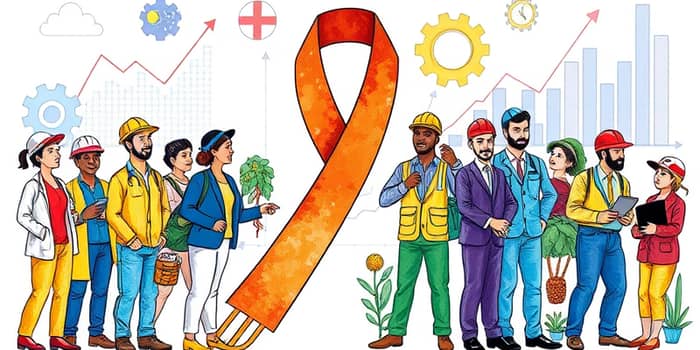
In a world where economies intertwine and technologies revolutionize work, the pulse of labor markets beats at the heart of individual well-being and collective prosperity. Unraveling the complexities of wages, employment rates, and job quality reveals not only stark challenges but also rich opportunities for innovation and social progress.
By combining hard data with inspiring insights and practical guidance, this article empowers readers—from job seekers and business leaders to policymakers—to shape a future of equitable growth and decent work for all.
Global Trends: Stability Veiling Deep Disparities
On the surface, the labor market appears stable: the global unemployment rate is projected to remain steady at 4.9% through 2026, mirroring a plateau seen since 2023.
Yet beneath that calm lies a turbulent sea of regional and developmental contrasts. While lower-income nations anticipate robust job expansion near 3.1%, upper-middle-income economies may see growth languish at just 0.5%. These disparities underscore the urgent need for tailored, targeted strategies that reflect each region’s unique strengths and constraints.
Robust Wages Despite Market Softening
Even as job openings cool and unemployment edges upward in some countries, wage growth has shown remarkable resilience. In the United States, average hourly earnings advanced at more than a full percentage point above pre-pandemic rates throughout 2025.
This buoyancy suggests that many employers value retaining experienced staff and are willing to offer higher pay to compete for talent. At the same time, the global reality remains sobering: nearly 300 million workers live in extreme poverty, eking out incomes below three dollars a day.
Bridging this gulf requires concerted action—combining social safety nets, upskilling programs, and policies that support living wages in developing regions.
Employment Quality and Inequality Issues
Beyond headline figures, job quality varies dramatically. Informal employment, characterized by limited protections and unpredictable earnings, dominates in many parts of the world. By 2026, an estimated 2.1 billion workers will find themselves in this vulnerable sector, lacking health benefits, social security, and legal rights.
- Sub-Saharan Africa: Almost nine in ten workers in informal jobs
- Latin America and the Caribbean: Over half of all employment uninsured and informal
- Central and Western Asia: Nearly one-third of workers without formal contracts
Gender disparities compound these challenges. Women globally remain 24% less likely than men to participate in the workforce, and their progress toward equal pay has stalled. Youth also face towering obstacles: in low-income countries, nearly 28% of young people are neither working nor in school or training, while urban youth unemployment soared to 17.8% in parts of China.
Key Drivers Shaping Labor Market Shifts
A confluence of forces accelerates change and uncertainty across borders:
- Immigration and Population Dynamics: Stricter policies have reduced migrant labor inflows, lowering workforce participation rates among residents and forcing employers to adapt recruitment and retention strategies.
- Trade Policy and Uncertainty: Elevated tariffs now average 16.5% globally, translating into a hidden tax exceeding $500 billion annually on imports. Businesses, uncertain about costs and supply chains, delay hiring decisions.
- Technological Transformation: Advances in artificial intelligence and automation promise dramatic productivity gains, but also raise concerns over job displacement, skill mismatches, and the need for lifelong learning.
Each driver offers potential upsides and risks. Governments, companies, and educational institutions must collaborate to harness technology while protecting vulnerable workers through retraining, social protections, and inclusive growth policies.
Navigating the Changing Landscape: Practical Strategies
Amid these complex trends, stakeholders at every level can take concrete steps to foster resilient, equitable labor markets:
- For Job Seekers: Embrace lifelong learning—enroll in digital skills bootcamps, seek mentorship, and stay agile. Cultivating soft skills like communication and adaptability can future-proof careers.
- For Employers: Invest in workforce development by offering on-the-job training, rotational programs, and partnerships with educational institutions. Transparent pay structures and flexible work models can boost retention and morale.
- For Policymakers: Design targeted support for informal workers—expand social safety nets, promote formalization through incentives, and enhance labor inspections. Support public-private partnerships that bridge skills gaps.
By aligning incentives and resources, these actors can reduce inequality, elevate job quality, and unlock productivity gains that benefit entire societies.
Regional Insights: Tailoring Responses for Impact
Recognizing regional nuances is crucial for effective action.
In North America, slowing vacancy rates call for retraining initiatives that connect displaced workers to emerging sectors like green energy and technology. In Asia and the Pacific, manufacturing hubs can harness AI-driven efficiencies while expanding social protections for a workforce of rising automation risk.
Europe faces an aging labor pool; targeted immigration reforms and lifelong learning platforms can offset demographic headwinds. In Africa, where working poverty is pervasive, investments in infrastructure and formal sector growth can create sustainable livelihoods. Latin America’s incremental improvements in participation ratios demonstrate the power of targeted public investments paired with private sector expansion.
Looking Ahead: Building Inclusive Futures
The ILO warns that without decisive, coordinated action, decent work deficits will endure and social cohesion may fray. Yet history shows that well-designed institutions and collaborative frameworks can transform adversity into opportunity.
Innovations in social policy—universal basic services, portable benefits, and employment guarantee schemes—offer new models for protecting workers in a volatile global economy. At the same time, digital platforms can democratize access to training and job matching, empowering individuals in remote or underserved areas.
Ultimately, the trajectory of labor markets will reflect our collective values and choices. Prioritizing inclusive growth and social justice sets the stage for a future where technology amplifies human potential rather than replacing it; where wages rise in tandem with productivity; and where every individual, regardless of gender, age, or geography, finds opportunity and dignity through work.
By embracing this shared vision—grounded in data, creativity, and compassion—we can write the next chapter of labor market dynamics as one of resilience, equity, and enduring progress.
References
- https://www.jpmorgan.com/insights/global-research/outlook/labor-market-forecast-2026
- https://news.un.org/en/story/2026/01/1166751
- https://www.youtube.com/watch?v=OR2hWPH0lcY
- https://voices.ilo.org/podcast/global-employment-in-2026-a-fragile-stability
- https://www.wearehumanlevel.com/content-hub/the-2026-ilo-employment-and-social-trends
- https://hbr.org/2026/02/9-trends-shaping-work-in-2026-and-beyond