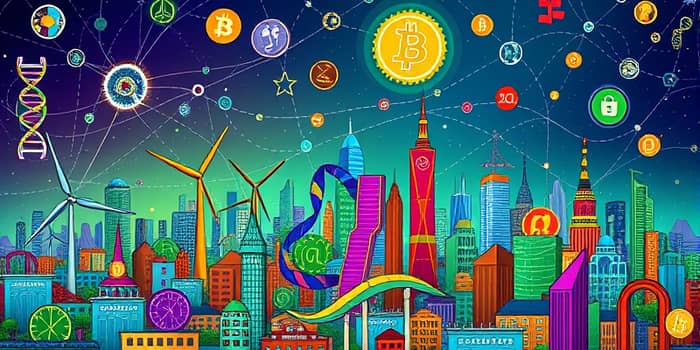
The year 2026 heralds a transformative era in global finance, where innovation shifts from speculative hype to technological traction and scientific validation. This new paradigm emphasizes real value creation, driven by capital that demands measurable outcomes and scalability across sectors like AI, sustainability, and biotech. For investors and entrepreneurs, understanding this evolution is crucial to thriving in an increasingly complex landscape.
Reports from Global Startup Ecosystem and PitchBook highlight a post-correction cycle favoring specialization, with hubs like Valencia emerging as competitive players. The fintech market, valued at $394.88 billion in 2025, is projected to grow exponentially, reflecting the dynamic opportunities ahead. Embracing these changes means positioning oneself at the forefront of economic progress, where strategic decisions can yield unprecedented rewards.
In this detailed guide, we explore the key trends defining 2026, offering practical insights to navigate and capitalize on these shifts. From AI's pervasive influence to sustainability's critical role, we provide a roadmap for success, empowering you to become an investment innovator with purpose. Let's dive into the financial frontiers that will shape our future.
The Shift to Value-Driven Investment
The investment landscape is undergoing a profound transformation, moving away from hype-driven narratives toward tangible impact. Capital now prioritizes projects that demonstrate scalability and real-world utility, as seen in the focus on AI and sustainability. This shift is fueled by a demand for accountability, with investors seeking innovations that deliver sustainable growth and social benefit.
By aligning with this trend, you can avoid pitfalls and leverage emerging technologies for competitive advantage. The following sections break down the major paradigms set to dominate 2026, each offering unique opportunities for growth and innovation.
Applied AI: Utility Over Hype
Artificial Intelligence has evolved from a futuristic concept to a dominant global engine, with investment exceeding $300 billion in 2025. The focus is on measurable outcomes in areas like medical diagnostics, industrial optimization, and legal automation, where AI enhances efficiency and drives economic value.
By 2026, AI co-pilots are expected to integrate into 80% of enterprise applications, revolutionizing how businesses operate. This trend is not just about technology; it's about creating systems that improve human capabilities and foster innovation.
- AI enables fraud prevention and contract drafting, reducing operational costs and errors.
- Predictive analytics drives 60% of loan decisions, democratizing access to finance.
- Multimodal models and NLP improve customer service response times by 300%.
Examples like Mistral AI in Europe and Valencia's Quibim showcase the global and local impact. As Sam Altman notes, AI innovation will advance rapidly, making it essential for investors to stay ahead of the curve.
Sustainability, Decarbonization, and ESG
Sustainability has become Europe's priority axis, with the EU mobilizing €250 billion by 2027 for decarbonization efforts. Climate tech investment is rising, representing 15% of Europe's venture capital, and ESG considerations are now integral to financial materiality.
Key areas include sustainable mobility, new materials, and energy storage, where innovations like carbon capture and tokenized green assets are gaining traction. Investing here aligns with ethical goals and offers long-term profitability.
- AI enhances impact analytics for ESG reporting and risk assessment.
- Tokenized green assets create new markets for eco-friendly investments.
- Companies like Climeworks and Northvolt lead the way, with regional players like Zeleros contributing globally.
This trend underscores the importance of building a net-zero economy while capitalizing on growing demand for sustainable solutions.
Advanced Biotechnology, Health, and Longevity
The convergence of biotech, biomedical data, and personalized therapies is unlocking new frontiers in healthcare. Longevity research, dubbed "the biggest industry in history" by Vinod Khosla, offers immense potential for improving human life and generating returns.
Examples include Insilico Medicine and Valencia's Arthex Biotech, highlighting how regional innovation can have global impact. By focusing on this sector, investors can tap into a market driven by scientific breakthroughs and increasing demand.
- AI accelerates drug discovery and medical diagnostics through data integration.
- Personalized medicine tailors treatments to individual genetic profiles, enhancing outcomes.
- Longevity initiatives aim to extend healthy lifespans, creating new economic opportunities.
Embracing biotech means contributing to a healthier future while leveraging cutting-edge research for financial gain.
Quantum Computing: Commercial Adoption Wave
Quantum computing is transitioning from theory to practice, with Europe leading in public investment and the sector projected to exceed $10 billion by 2026. This technology enables breakthroughs in logistics, drug simulation, and cryptography, solving problems beyond classical computing's reach.
Applications include optimization for supply chains and quantum-secure transactions, which are becoming essential in finance. As it enters boardrooms, quantum computing will redefine risk modeling and decision-making processes.
- Hybrid classical-quantum systems enhance computational power for specific, complex tasks.
- Quantum-secure infrastructure protects against future cyber threats in digital transactions.
- Europe's funding surpasses the US, fostering innovation hubs and commercial pilots.
Investing here positions you at the forefront of technological advancement and security.
Tokenization, Digital Assets, and Blockchain
Tokenization revolutionizes asset ownership by making it more accessible and liquid, with mainstream adoption expected by 2026 through native issuers like public companies and funds. This trend bridges traditional finance with digital innovation, creating new opportunities for democratization.
Blockchain enables secure and transparent transactions, with quantum-secure layers enhancing trust. Examples from State Street and Itaú demonstrate practical applications in real-world assets, from real estate to securities.
- Tokenized assets offer fractional ownership, increasing liquidity and market access.
- Interoperability with embedded finance streamlines financial flows and reduces friction.
- Crypto converges with tradfi for utility-driven applications, powering digital ecosystems.
This paradigm shift towards digital ownership and seamless commerce is reshaping finance for the better.
Embedded Finance, Open Banking, and Real-Time Payments
Embedded finance integrates financial services into non-financial platforms, enhancing user experience through API integrations and multi-rail payments. It evolves towards autonomous finance, where self-executing flows optimize treasury management and cash forecasting.
Real-time payments and request-to-pay systems reduce transaction friction, while AI-driven insights enable just-in-time funding. This trend fosters a more interconnected and efficient financial ecosystem.
- API-first approaches allow for scalable and compliant solutions in cloud-native environments.
- Cross-border settlement becomes faster and more cost-effective, boosting global trade.
- Autonomous finance systems reduce manual intervention, improving accuracy and agility.
Adopting embedded finance means embracing innovation for everyday transactions.
Defense Tech and Dual-Use Technologies
Amid rising cyber threats, defense tech investment surged by 48% in 2025, with cybercrime costs projected to reach $9.5 trillion by 2026. This sector is critical for protecting critical infrastructure and ensuring security in a digital age.
Dual-use technologies that serve both civilian and military purposes are gaining traction, addressing global challenges while offering robust returns. Focus areas include cybersecurity, infrastructure protection, and innovations in drones and robotics.
Public and private collaboration drives advancements, making it a key area for strategic investment. This trend highlights the imperative of resilience in our interconnected world, where safeguarding assets is paramount.
Strategic Insights for Innovators
To succeed in this new landscape, shift your focus to tangible impact by prioritizing projects with measurable outcomes and traction. Capital demands proof over promises, so leverage human-AI synergy to build loyalty and drive growth in your ventures.
Opportunities abound in frictionless asset flows and interoperable trading, enabled by tokenization and blockchain for boundless liquidity. However, be mindful of risks such as AI's physical limits on energy, private credit write-downs, and regulatory challenges that require proactive management.
Actionable advice includes scaling via behavioral analytics, implementing quantum-safe security measures, and investing in underserved markets to diversify your portfolio. Valencia serves as a model hub, competing globally in AI and sustainability, proving that local innovation can have worldwide impact.
In conclusion, embracing new financial paradigms in 2026 requires a proactive and informed approach. By understanding these trends and applying strategic insights, you can navigate uncertainties and seize opportunities for growth and innovation.
Start by assessing your portfolio against these paradigms, investing in technologies with proven traction, and fostering collaborations that drive meaningful change. Remember, innovation is not just about technology; it's about creating a better, more sustainable world. Embrace the journey, and become an investment innovator today, ready to shape the future of finance.
References
- https://startupvalencia.org/innovation-investment-trends-2026/
- https://m2pfintech.com/blog/10-banking-and-fintech-trends-that-will-redefine-2026-and-beyond/
- https://www.msci.com/research-and-insights/paper/investment-trends-in-focus-key-themes-for-2026
- https://www.broadridge.com/next/articles/2026-predictions-article
- https://trellis.net/article/10-impact-investing-trends-that-will-define-2026/
- https://wezom.com/blog/fintech-development-trends-2026
- https://endeavor.org/stories/global-venture-capital-trends-2026/
- https://www.freshfields.com/en/our-thinking/briefings/2026/01/the-year-ahead-in-financial-services-12-trends-to-watch-in-2026/
- https://www.blackstone.com/insights/article/office-of-the-cio-2026-investment-perspectives/
- https://www.insightpartners.com/ideas/2026-investor-predictions/
- https://www.deloitte.com/us/en/insights/topics/technology-management/tech-trends.html
- https://am.gs.com/en-gb/advisors/insights/article/investment-outlook/portfolio-construction-2026
- https://internationalbanker.com/technology/five-significant-tech-trends-that-will-feature-in-2026/
- https://www.apolloacademy.com/2026-credit-outlook/
- https://www.tcw.com/Insights/2026/2026-01-05-ETF-Outlook