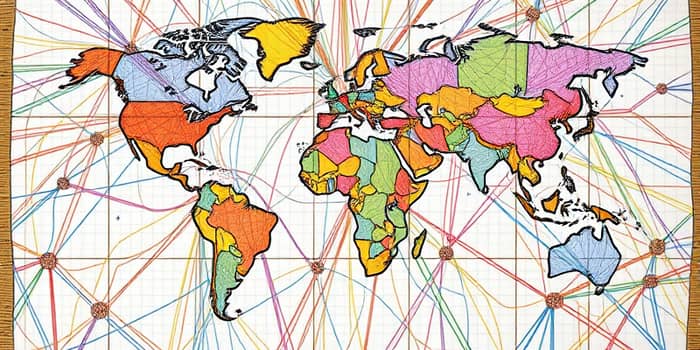
In 2025, global trade soared to a record-breaking $35 trillion, a milestone that vividly illustrates the profound interconnectedness of our world economy.
This achievement marks not just a peak but the beginning of a complex tapestry woven from growth, fragmentation, and resilience.
As we look toward 2026, this tapestry reveals a landscape of slowing expansion and geopolitical fragmentation, yet it also holds threads of opportunity for those who navigate it wisely.
Understanding this interconnectedness is crucial for businesses, policymakers, and individuals aiming to thrive in an era of uncertainty and transformation.
The Slow Motion of Global Growth
Global GDP growth in 2026 is projected to decelerate, reflecting a broader trend of subdued economic momentum.
Forecasts converge around figures like 2.6% or 2.7%, below the pre-pandemic average of 3.2%, signaling a cautious outlook for the coming years.
This slowdown is particularly pronounced in developing economies, excluding China, where growth is expected to taper to 4.2%.
Low-income countries, however, show resilience with an average of 5.6% over 2026-2027, highlighting disparities within the global fabric.
To grasp these regional nuances, the following table provides a snapshot of growth projections and key drivers for 2026.
This table underscores the regional shifts that are reshaping economic landscapes, with some areas outperforming others despite headwinds.
Trade in Transition: From Record Highs to Deceleration
Trade growth in 2025 was robust, expanding by 7% to exceed $35 trillion for the first time, driven by front-loading shipments and demand in sectors like AI and semiconductors.
However, this momentum is expected to fade in 2026, with projections slowing to 2.2% as barriers rise and initial boosts diminish.
The resilience of trade in the face of tariffs highlights its critical role in the global economy, yet it also points to vulnerabilities from increasing protectionism.
For a deeper look, consider the U.S. trade data from October 2025, which serves as a microcosm of broader trends.
- Exports reached $302.0 billion, up 2.6% monthly, showing sustained demand.
- Imports fell to $331.4 billion, a 3.2% decrease, indicating shifting consumption patterns.
- The trade deficit narrowed to $29.4 billion, a 39.0% drop, reflecting adjustments in global flows.
- Goods exports rose to $195.9 billion, while real goods exports increased by 3.9%.
- Goods imports in real terms declined by 4.2%, suggesting a recalibration of supply chains.
These figures reveal a resilient yet decelerating trade environment, where short-term gains mask longer-term challenges from geopolitical tensions.
Key Trends Weaving the New Tapestry
Several interconnected trends are defining the economic landscape of 2026, each adding a thread to the global tapestry.
Understanding these can help identify opportunities and mitigate risks in a fragmented world.
- Slower growth headwinds for developing countries, as momentum loss in major economies tightens demand and finance.
- Geopolitical fragmentation and protectionism, with tariffs and regulations reshaping value chains and increasing uncertainty.
- Digital and green transitions, driven by AI and semiconductor demand, boosting trade but also introducing new dependencies.
- South-South trade deepening, with over 50% of Africa's exports going to developing markets, fostering regional resilience.
- Services trade robust, contributing significantly to 2025 expansion, exemplified by a U.S. services surplus of $29.8 billion.
- Investment subdued despite easing conditions, with nearshoring expected to rise post-tariffs, such as in Mexico via USMCA.
- Regional shifts, including China's tech stock surges and diversified supply chains among developing economies.
These trends illustrate how interdependent risks and opportunities are creating a complex web that requires strategic navigation.
Regional Vignettes: Contrasts and Connections
Different regions are experiencing varied economic narratives, each contributing uniquely to the global tapestry.
In East Asia and the Pacific, high-tech manufacturing value chains drive growth, though a slight slowdown is anticipated.
Europe and Central Asia face modest demand, with limited fiscal stimulus constraining expansion.
Latin America and the Caribbean see moderate recovery, bolstered by consumer demand and investment, but geopolitical reviews like USMCA add layers of complexity.
South Asia stands out with resilient growth, led by India's strong consumption and public investment.
Sub-Saharan Africa grapples with high debt and climate shocks, yet its deepening ties with developing markets offer a path for resilience.
These vignettes highlight the South-South trade deepening that is becoming a cornerstone of global economic stability.
The US Lens: A Microcosm of Global Shifts
The United States provides a focused view of broader economic dynamics, with its trade data reflecting global interdependencies.
In October 2025, U.S. exports showed strength, growing 2.6% monthly, while imports declined, indicating a shift in trade balances.
Real exports grew 5% year-over-year in the first three quarters of 2025, underscoring sustained external demand.
Surpluses with partners like the Netherlands and Brazil reveal strategic trade relationships that buffer against global uncertainties.
This microcosm demonstrates how tariff impacts and consumer spending resilience are shaping not just national but global economic flows.
Risks That Threaten to Unravel the Fabric
The global economic tapestry is fragile, with several risks posing threats to its cohesion and stability.
- Trade tensions evident in 2026, as protectionism and tariffs disrupt established flows and increase costs.
- High debt and borrowing costs, constraining policy space for many developing economies and limiting growth potential.
- Climate shocks, exacerbating vulnerabilities in regions like Sub-Saharan Africa and adding pressure to global supply chains.
- Stretched AI valuations, creating bubbles in tech sectors that could lead to market corrections and reduced investment.
- Crumbling cooperation, with multilateralism weakening and economic confrontation seen as a top risk by institutions like WEF.
These risks highlight the age of competition that defines current global interactions, requiring vigilant management.
Opportunities for Resilience and Growth
Amid the challenges, there are significant opportunities that can strengthen the economic tapestry and foster inclusive growth.
- Easing inflation, projected to drop to 2.6% in 2026, providing relief for consumers and businesses alike.
- Monetary loosening and fiscal expansion in large economies, offering stimuli that can boost demand and investment.
- Stronger South-South and regional links, enhancing resilience through diversified trade and investment networks.
- A potential pickup in 2027, as trade adjusts to new barriers and investment strengthens, signaling a path to recovery.
- Digital and green transitions, driving innovation and creating new sectors for economic activity and job creation.
These opportunities underscore the resilient yet decelerating trade environment that, if leveraged wisely, can lead to sustainable progress.
Navigating the Tapestry: A Path Forward
To thrive in this interconnected world, practical steps can be taken by individuals, businesses, and governments to harness opportunities and mitigate risks.
First, embrace diversification in supply chains and markets to reduce dependency on single regions and enhance flexibility.
Second, invest in digital and green technologies to capitalize on emerging trends and build competitive advantages.
Third, foster regional collaborations, such as South-South partnerships, to create resilient economic blocs that can withstand global shocks.
Fourth, advocate for policy coordination to avoid a low-growth trap and strengthen multilateral frameworks for trade and investment.
Fifth, prioritize debt management and climate adaptation strategies to safeguard against financial and environmental vulnerabilities.
By taking these actions, we can weave a more robust and inclusive economic tapestry for the future.
The journey ahead is challenging, but with insight and collaboration, the threads of global interconnectedness can lead to shared prosperity and stability.
References
- https://unctad.org/publication/global-trade-update-january-2026-top-trends-redefining-global-trade-2026
- https://www.bea.gov/news/2026/us-international-transactions-3rd-quarter-2025
- https://desapublications.un.org/publications/world-economic-situation-and-prospects-2026
- https://www.bea.gov/news/2026/us-international-trade-goods-and-services-october-2025
- https://www.atlanticcouncil.org/dispatches/five-trends-to-watch-in-the-global-economy-in-2026/
- https://www.worldbank.org/en/news/press-release/2026/01/13/global-economic-prospects-january-2026-press-release
- https://unctad.org/news/10-trends-shaping-global-trade-2026
- https://www.deloitte.com/us/en/insights/topics/economy/global-economic-outlook-2026.html
- https://www.caixabankresearch.com/en/economics-markets/activity-growth/new-map-us-goods-imports
- https://www.youtube.com/watch?v=DGBhOCBtS6o
- https://www.census.gov/foreign-trade/about/index.html
- https://unctad.org/publication/world-economic-situation-and-prospects-2026
- https://www.weforum.org/publications/global-risks-report-2026/digest/
- https://www.euronews.com/2026/01/14/economic-confrontation-biggest-threat-to-global-stability-in-2026-world-economic-forum-rep