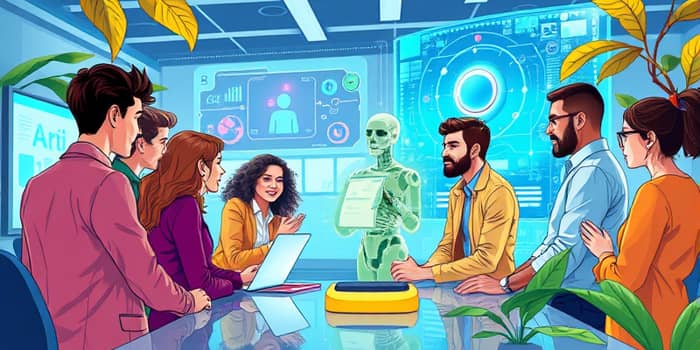
The world of work is transforming at an unprecedented pace.
We are witnessing a profound shift driven by forces that will redefine careers for decades to come.
Understanding these changes is essential for navigating your professional journey successfully.
Embrace this evolution as an opportunity for growth and innovation.
The Economic Landscape: Key Forces Reshaping Work
Several macrotrends are converging to reshape the global economy.
Technological change stands out as the most transformative force.
Broadening digital access impacts 60% of employers globally.
AI and information processing affect 86% of businesses, revolutionizing operations.
Robotics and automation influence 58% of companies, enhancing efficiency.
Energy technologies drive change for 41% of organizations, supporting sustainability.
Economic uncertainty adds complexity, with rising costs affecting 50% of employers.
Slower growth may displace 1.6 million jobs, creating volatility.
Geoeconomic fragmentation and environmental challenges further contribute to this dynamic.
The green transition is a top driver, emphasizing climate mitigation efforts.
Demographic shifts require strategic responses, especially in aging populations.
- Technological advancements like AI and automation.
- Economic pressures from inflation and cost of living.
- Geoeconomic fragmentation and trade volatility.
- Green transition towards sustainable practices.
- Demographic changes in workforce composition.
These factors demand adaptability and foresight from every professional.
Job Market Dynamics: Creation and Displacement
The job market is experiencing significant upheaval with both gains and losses.
By 2030, 22% of today's jobs will see creation or displacement.
This results in 170 million new jobs, representing a 14% increase.
Conversely, 92 million jobs may be displaced, an 8% reduction.
The net effect is a positive addition of 78 million jobs, a 7% growth.
Growth areas are fueled by macrotrends, creating new roles in emerging fields.
Declining roles often involve manual tasks or outdated skills.
- Fastest-growing roles: AI specialists, data analysts, cybersecurity experts.
- Declining roles: Those requiring manual dexterity or routine precision.
AI augments rather than replaces, changing 39% of core skills by 2030.
This empowers professionals through enhanced human-machine collaboration.
Essential Skills for the Future Workforce
Skills are the currency of the future workplace.
Upskilling is no longer optional but a critical imperative for survival.
Top emerging skills include AI and big data expertise.
Networks and cybersecurity are crucial for digital security.
Technological literacy becomes a baseline requirement for all workers.
Creative thinking and innovation are highly valued in an automated world.
Resilience, flexibility, and agility enable adaptation to rapid changes.
Curiosity and lifelong learning drive continuous personal development.
- AI and big data proficiency.
- Networks and cybersecurity knowledge.
- Technological literacy across platforms.
- Creative and analytical thinking.
- Resilience and emotional intelligence.
Human-centric skills are rising in importance, with 92% of executives prioritizing them.
Soft skills like communication and empathy complement technical abilities.
Training needs vary, with 29 out of 100 workers requiring upskilling in-role.
Only 17% of companies currently invest adequately in reskilling efforts.
This gap highlights the urgency for individual proactive learning.
Adapting to New Work Models and Environments
Workplaces are evolving beyond traditional office settings.
Remote and hybrid models are becoming standard, with 50% of U.S. full-time jobs capable of remote work.
AI integration is pervasive, with over 80% of daily GenAI users expecting efficiency gains.
This technology frees up focus for human elements like creativity and strategy.
Hybrid roles blend technical, analytical, and interpersonal skills seamlessly.
Leadership roles are evolving to manage AI ethics and integration effectively.
Skills-based hiring is gaining traction, with 63% of organizations adopting it.
This shift emphasizes practical assessments over formal credentials.
- AI-enhanced daily tasks and decision-making.
- Hybrid work flexibility and collaboration tools.
- Data-driven personalization of work experiences.
- Flattened organizational structures and leaner teams.
- Increased focus on AI governance and privacy.
These trends require a mindset shift towards continuous adaptation.
Strategic Career Preparation: Steps to Thrive
Preparing for the future involves actionable strategies at both individual and organizational levels.
Build AI literacy to understand and leverage new technologies.
Cultivate soft skills like persuasion and emotional intelligence.
Embrace lifelong learning through online courses and certifications.
Develop adaptability to thrive in hybrid and evolving roles.
- Enhance AI and digital tool proficiency.
- Strengthen communication and collaboration abilities.
- Pursue ongoing education and skill development.
- Seek roles that blend technical and human elements.
- Network within emerging industries and communities.
Employers must re-orient for AI, with 50% planning strategic shifts.
Upskilling cross-functionally fosters innovation and retention.
Transparent ethics in AI use build trust and engagement.
- Invest in employee training and development programs.
- Adopt skills-based internal mobility practices.
- Implement AI ethics frameworks and governance.
- Foster a culture of continuous learning and adaptability.
Risks include widening skills gaps and entry-level uncertainty.
However, optimism prevails as AI augments human potential.
Focus on social skills and creativity to remain indispensable.
The global scale of change, as surveyed by the World Economic Forum, underscores its universality.
By embracing these shifts, you can turn challenges into opportunities for growth.
Your career path is yours to shape with intention and resilience.
References
- https://blog.workday.com/en-us/20-future-work-trends-blog.html
- https://www.eitdeeptechtalent.eu/news-and-events/news-archive/the-future-of-work-emerging-job-trends-and-the-impact-of-ai-2025-2030/
- https://www.weforum.org/publications/the-future-of-jobs-report-2025/digest/
- https://www.greatplacetowork.com/resources/blog/7-workplace-trends-to-watch-for-2025
- https://www.startus-insights.com/innovators-guide/future-of-work/
- https://www.kornferry.com/insights/briefings-magazine/issue-30/2030-the-very-human-future-of-work
- https://www.pwc.com/gx/en/issues/workforce/hopes-and-fears.html