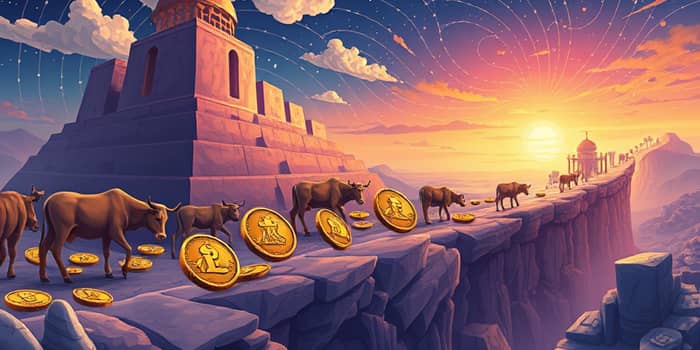
From the first traded shells to today’s cryptocurrencies, money has continually redefined value exchange. Its transformation illuminates human creativity and adaptation over millennia.
Tracing this path offers insight into how societies organize commerce, establish trust, and envision future financial landscapes.
Phase 1: Early Money Systems
In prehistoric communities, barter was the norm: goods and services exchanged directly based on mutual need. Over time, commodity money emerged to simplify these transactions.
In Mesopotamia, farmers deposited surplus grain in temple granaries and received clay tokens in exchange. These tokens became widely accepted, laying foundations for asset-backed credit in ancient economies.
Other societies valued cattle for their utility, while coastal regions adopted cowrie shells as a portable and trusted medium of exchange.
- Cattle as trade units (9000–6000 BC)
- Cowrie shells used in commerce (1200 BC)
Phase 2: Metal Coins Era
By 600 BCE, the kingdom of Lydia introduced the first official metal currency: the electrum stater. This innovation standardized trade and instilled greater confidence than barter goods could offer.
As Greek city-states, Persian empires, and Rome expanded, coinage spread across continents. The stamping of rulers’ images on coins served both as authentication and political messaging.
Metal coins boasted numerous advantages: they were durable, divisible, and easily recognizable, thanks to consistent weight and purity standards maintained by official mints.
- High durability against wear
- Portability facilitating long journeys
- Divisibility into smaller denominations
Phase 3: Paper Money Revolution
Carrying large hoards of metal coins became impractical for merchants. In 7th century China, paper receipts for deposited coins evolved into government-issued banknotes.
The Tang and Song dynasties developed sophisticated printing techniques to produce notes backed by state reserves. These innovations addressed metal shortages and reduced transaction costs, pioneering promissory notes of deposit.
By the 17th century, European goldsmiths issued their own notes to depositors. Over time, these private issues gave way to national banknotes, and soon banknotes circulated as common currency across growing markets.
Phase 4: Modern Fiat Currency and Banking
The Renaissance ushered in modern banking. European states moved from precious-metal-backed coins to fiat currencies, whose value derived solely from government decree.
Central banks emerged, wielding the power to control money supply, set interest rates, and stabilize economies. This era saw the rise and fall of the gold standard, culminating in flexible monetary policies.
Through regulatory frameworks and open market operations, institutions ensured that national currencies maintained public confidence even without physical commodity backing.
Phase 5: Digital Currency Era
In the 1980s, cryptographers like David Chaum introduced eCash, envisioning truly anonymous digital transactions. These early experiments laid groundwork for secure electronic payment systems.
Visionaries such as Wei Dai and Nick Szabo conceptualized decentralized digital money, though practical adoption remained elusive until 2008. That year, Bitcoin emerged, combining peer-to-peer networks with cryptographic proof to create the first censorship-resistant currency.
The rise of blockchain technology enabled open ledgers and fostered innovation in smart contracts, decentralized finance (DeFi), and tokenized assets. We now live in an era of borderless, programmable monetary systems that challenge traditional banking models.
Looking Forward: The Future of Money
As technologies like central bank digital currencies (CBDCs), digital identity, and Internet of Things payments mature, financial systems will become more integrated and programmable.
The trajectory of money teaches us that innovation often arises in response to necessity. By learning from the past, we can shape an inclusive and resilient monetary future that upholds trust and empowers communities worldwide.
References
- https://digikhata.in/blog/the-evolution-of-money
- https://www.withvincent.com/research/cryptocurrency-timeline
- https://www.jpmorgan.com/payments/payments-unbound/volume-2/how-paper-money-evolved
- https://en.wikipedia.org/wiki/Cryptocurrency
- https://www.providentmetals.com/knowledge-center/precious-metals-resources/history-of-money.html
- https://www.blockpit.io/en-us/blog/bitcoin-history-evolution
- https://en.wikipedia.org/wiki/History_of_money
- https://en.wikipedia.org/wiki/Digital_currency
- https://ampere.co.uk/news-and-updates/history-of-money
- https://bernardmarr.com/a-short-history-of-bitcoin-and-crypto-currency-everyone-should-read/
- https://www.uscurrency.gov/history
- https://trendspider.com/learning-center/the-history-of-cryptocurrencies/
- https://kids.usmint.gov/about-the-mint/history-timeline
- https://kriptomat.io/cryptocurrencies/history-of-cryptocurrency/
- https://financialcrimeacademy.org/history-of-virtual-currencies-and-cryptocurrencies/