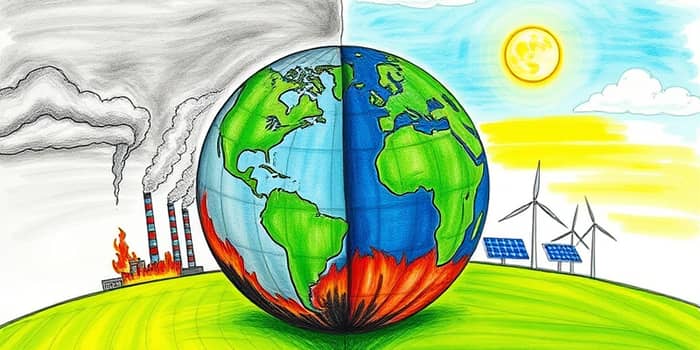
Climate change is no longer a distant threat; it is an immediate economic challenge that permeates every aspect of our global society.
The profound financial implications of environmental shifts are reshaping industries, households, and nations alike.
Understanding this dynamic is essential for crafting resilient futures that balance risk with reward.
At its core, the economics of climate change revolves around balancing dire costs with transformative opportunities.
From catastrophic natural disasters to innovative green technologies, the stakes have never been higher.
Embracing both perils and promises is key to navigating this era of unprecedented change.
We begin by exploring the multifaceted impacts that define this period.
The physical and transition risks pose significant threats to stability, while unequal burdens highlight global injustices.
Yet, within these challenges lie seeds for growth and renewal that can redefine prosperity.
Understanding the Core Impacts
Climate change introduces a complex web of economic pressures that can be categorized into key areas.
These include physical risks, transition risks, unequal global impacts, and emerging opportunities that shape our response.
- Physical risks: such as reduced productivity and infrastructure damage from extreme weather events
- Transition risks: arising from policy shifts to low-carbon economies and market adjustments
- Unequal global impacts: disproportionately affecting low-income countries with higher vulnerability
- Opportunities: including job creation and new industries in renewables and adaptation
Physical risks refer to direct damages from climate events like storms and heatwaves.
Examples encompass reduced agricultural productivity and infrastructure damage that disrupt supply chains globally.
Such events strain public resources and lead to cascading financial losses across sectors.
Transition risks arise from societal shifts towards sustainability and decarbonization efforts.
Policy changes and market adjustments can create volatility, but they also pave the way for innovation.
Embracing these risks is crucial for long-term prosperity and economic resilience.
Unequal global impacts mean that low-income countries bear a disproportionate burden of climate effects.
With higher disaster deaths and GDP losses, these regions face amplified challenges that demand global solidarity.
Supporting vulnerable nations is both a moral imperative and an economic necessity.
Opportunities, however, abound in the transition to low-carbon economies driven by green technologies.
From job creation in renewables to new industries, the potential for positive change is immense.
We will explore these in detail to highlight pathways for growth and sustainability.
The Staggering Economic Costs
The financial toll of climate change is staggering, with projections indicating trillions in annual losses worldwide.
These costs manifest across various sectors and regions, underscoring the need for urgent and coordinated action.
Global GDP losses are a primary concern for economists and policymakers alike.
By mid-century, output could be 17% lower than baseline projections, equating to approximately $32 trillion annually.
This revision from earlier estimates highlights the evolving understanding of climate economics and its nuances.
In the United States, disaster costs have escalated dramatically over the past decades.
Since 1980, there have been over 400 billion-dollar weather and climate events, adjusted for inflation.
This trend imposes heavy burdens on households, governments, and insurance systems.
Household impacts in the U.S. include rising costs from wildfire smoke mortality and coastal insurance premiums.
Such expenses strain budgets and reduce economic security for millions of families.
Resource and sector strain further exacerbate the situation through labor and supply disruptions.
Heat stress reduces labor output in agriculture and construction, while altered rainfall patterns deplete freshwater.
These changes increase operational costs and disrupt supply chains, cutting into tax revenues.
Vulnerable regions, particularly least developed countries, suffer more intensely from climate effects.
They experience 2.5 times more disaster deaths and lose a larger share of GDP compared to wealthier nations.
This inequality demands targeted interventions and international support for adaptation.
To summarize key cost categories, refer to the table below:
Damages from climate change significantly outweigh mitigation costs in economic terms.
By mid-century, annual climate damages are estimated to be approximately five times higher than abatement costs for a 2°C pathway.
This makes investment in prevention not only ethical but economically prudent for long-term stability.
Unveiling the Opportunities
Transitioning to a low-carbon economy presents numerous opportunities for growth, innovation, and job creation.
These benefits span various sectors, offering a hopeful counterpoint to the dire costs of inaction.
Job creation is a major advantage in the shift towards sustainability and resilience.
Climate resilience investments could generate 150 million new jobs by 2050 across 93 economies globally.
Clean energy sectors alone contributed significantly to global GDP growth in recent years.
Economic gains from accelerated net-zero transitions include lower energy bills and sustained GDP growth.
By avoiding healthcare and insurance cost spikes from disasters, societies can achieve net positive outcomes.
Renewable energy investments are booming, with totals reaching $2.4 trillion in 2022.
Technologies like solar, wind, and hydropower are becoming more affordable, enabling equitable access worldwide.
Sector shifts are underway, with 15 key industries committing to halve emissions this decade.
This includes energy, where renewables are projected to supply 60% of power by 2030.
Mitigation strategies focus on cutting fossil fuels and boosting renewables through targeted actions.
Adaptation efforts, such as resilient infrastructure and climate-smart agriculture, are equally vital for success.
Key opportunity areas that drive economic transformation include:
- Job creation in green industries and renewable energy sectors
- Economic gains from energy efficiency and sustainable practices
- Renewable energy expansion and technological innovation
- Sectoral transitions towards low-carbon and resilient models
Other sectors like agriculture, air quality, and built environment also play critical roles in this shift.
The IPCC 1.5°C pathways emphasize that even services and information sectors are key to achieving goals.
Investing in these areas can unlock significant growth potential and resilience benefits for economies.
Policy Levers and Global Context
Effective policies are essential to harness opportunities and mitigate costs in the climate economy.
Carbon pricing, through taxes or emissions trading, spurs low-carbon investments by internalizing environmental costs.
The year 2024 marks a critical threshold, with temperatures exceeding 1.5°C above pre-industrial levels.
This milestone signals severe impacts ahead, such as increased floods and heatwaves, necessitating robust action.
Inequality in climate impacts requires a just transition framework for vulnerable communities and nations.
High-latitude regions may see short-term benefits, like extended growing seasons, but global trade transmits risks.
Supporting vulnerable nations is both a moral and economic imperative for global stability.
Link decoupling between GDP and CO2 emissions is weakening but remains insufficient for climate goals.
Enhanced efforts are needed to align economic growth with sustainability through innovative policies.
Key policy measures that can drive positive change include:
- Implementing carbon pricing mechanisms to incentivize green investments
- Promoting just transition frameworks for vulnerable communities and workers
- Enhancing international cooperation on climate finance and technology transfer
These actions can help balance costs and opportunities in a fair and effective manner.
Sector-Specific Pathways
Different sectors face unique challenges and opportunities in the transition to a climate-resilient economy.
High-emission sectors, such as energy and industry, are central to reducing greenhouse gas emissions.
Energy accounts for 65% of greenhouse gas emissions, with fossil fuels comprising 80% of current supply.
Shifting to renewables is not just an option but a necessity for long-term economic viability.
The UNFCCC reports that 15 sectors, representing over 20% of major firms by revenue, are aligning with targets.
This corporate engagement drives innovation and market transformation towards sustainability.
In the United States, vulnerable sectors identified by the EPA require targeted strategies for adaptation.
These sectors include:
- Agriculture and food systems affected by changing weather patterns
- Air quality management impacted by pollution and health costs
- Built environment and infrastructure vulnerable to extreme events
- Coastal and marine ecosystems facing sea-level rise and erosion
- Energy production and distribution needing grid resilience upgrades
- Freshwater resources and management challenged by droughts and floods
These sectors require targeted strategies to enhance resilience and adapt to changing conditions effectively.
The UN's six-sector solution emphasizes energy and industry, supported by incentives and mandates for progress.
Conclusion: A Call to Action
The economics of climate change presents a dual narrative of peril and promise for our world.
By acknowledging the staggering costs and embracing transformative opportunities, we can steer towards a sustainable future.
Investment in mitigation and adaptation is not a burden but an investment in prosperity and resilience.
From job creation to energy savings, the benefits far outweigh the expenses when approached strategically.
Global cooperation and equitable policies are vital for addressing the unequal impacts of climate change.
As individuals, communities, and nations, we must act now to secure economic and environmental health.
Let this understanding inspire action and innovation in every economic decision we make.
The path forward is clear: integrate climate considerations and unlock the potential for a greener, more prosperous world.
References
- https://www.bakertilly.global/insights/the-economic-consequences-of-climate-change
- https://www.carboncollective.co/sustainable-investing/climate-change-investments
- https://www.pik-potsdam.de/en/news/latest-news/nature-study-on-economic-damages-from-climate-change-revised
- https://www.worldbank.org/en/topic/climatechange/publication/jobs-in-a-changing-climate
- https://unctad.org/news/gdp-and-co2-emissions-record-temperatures-heighten-urgency-break-link
- https://www.wemeanbusinesscoalition.org/policy/the-economic-opportunities-of-the-clean-energy-transition/
- https://www.cbo.gov/publication/61146
- https://netzeroclimate.org/sectors/
- https://www.un.org/en/climatechange/reports
- https://www.theclimateclub.co/climatechangeblogs/the-united-nations-six-sector-solution-to-the-climate-crisis
- https://www.oecd.org/en/publications/2025/11/the-climate-action-monitor-2025_aed0c4bb/full-report/how-vulnerable-are-countries-to-climate-risks_92df65fe.html
- https://unfccc.int/news/15-sectors-of-global-economy-shift-the-dial-on-climate
- https://www.ncei.noaa.gov/access/billions/
- https://www.epa.gov/climateimpacts/climate-change-impacts-sector
- https://www.brookings.edu/articles/how-much-is-climate-change-costing-us-households/
- https://www.un.org/en/climatechange/raising-ambition/renewable-energy
- https://climatedata.imf.org