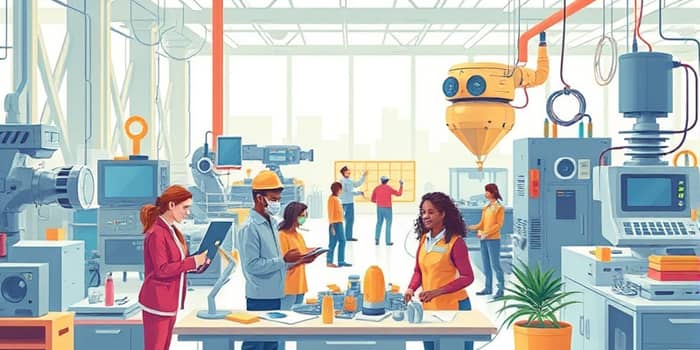
Automation is no longer a distant promise—it is reshaping economies, redefining work, and unlocking new pathways for innovation. As organizations across the globe embrace intelligent systems, the transformation ripples through industries, markets, and communities.
In this comprehensive analysis, we explore the forces driving automation adoption, its tangible benefits, the challenges of workforce displacement, and the strategies that can help individuals and companies thrive in an automated era.
Market Growth and Investment Trends
Automation has moved from optional luxury to strategic imperative. Recent forecasts show the financial process automation market is projected to reach approximately $226.8 billion in 2025, and the hyperautomation sector is expected to grow at a compound annual growth rate of 19.80%, topping $31.95 billion by 2029.
Companies are overcoming 2025’s investment hesitations driven by recession fears and geopolitical uncertainty. With 2026 positioned as the "ramp-up" year, organizations are reenergizing projects and committing capital to automation initiatives.
- 30 percent of enterprises will automate over half of their network operations by 2026.
- 89 percent of U.S. employees said they felt more satisfied with their jobs after automation introduction.
- The AI-powered e-commerce market reached $8.65 billion in 2025, signaling rapid digital transformation.
Productivity and Cost Benefits
Investing in automation is delivering measurable returns. Eighty-four percent of finance professionals report they can make decisions faster thanks to automated tools. Companies leveraging Robotic Process Automation (RPA) achieve operational efficiencies that translate into significant savings.
Key performance outcomes include:
- 75 percent of companies achieve ROI within 12 months of automation implementation.
- RPA can deliver cost savings of up to 40-50%, accelerating profitability.
- Automated payment processing frees up more than 500 work hours per finance team each year.
Sector-specific gains further illustrate broad impact. In healthcare, automation completes over 30 billion tasks annually, from scheduling to claims processing. Within financial services, roughly 25 percent of banking activities can now be automated, reducing overhead and improving accuracy.
Job Displacement: Scale and Scope
While automation enhances productivity, it also displaces roles. Global estimates suggest between 92 and 300 million jobs could be lost to AI by 2030, affecting up to 9.1 percent of the workforce worldwide.
In the United States, nearly half of all jobs face significant transformation or replacement. Entry-level positions and administrative roles are most vulnerable, with as many as 50 million U.S. jobs at risk.
- 47 percent of U.S. workers risk job loss to automation over the coming decade.
- AI already replaces 11.7 percent of the U.S. workforce, equating to $1.2 trillion in wages.
- From January to June 2025, an average of 491 tech workers per day lost roles due to AI integration.
Clerical and data entry positions face the steepest declines. Bank tellers, cashiers, telemarketers, and call center agents are increasingly supplanted by algorithms and chatbots.
Job Creation Counterbalance
The automation narrative is not solely one of loss. New roles emerge in AI development, maintenance, data analysis, and digital infrastructure. McKinsey projects that by 2030, AI could create 170 million new jobs, yielding a net gain of 78 million jobs globally.
By 2025, the balance could see 85 million roles eliminated but 97 million new positions formed in sectors like healthcare, renewable energy, and advanced manufacturing.
Workforce Adaptation and Retraining Requirements
Preparing for an automated future requires proactive skill development. Experts estimate 20 million U.S. workers will need retraining for new AI-enabled careers over the next three years. Globally, 14 percent of employees may change career paths by 2030 due to technological shifts.
Key adaptation strategies include:
- Investing in continuous learning platforms focused on AI literacy and digital tools.
- Partnering with educational institutions to create certification programs in emerging technologies.
- Fostering a growth mindset that values adaptability and lifelong upskilling.
Worker Sentiment and Concerns
Despite potential gains, anxiety runs high. Over half of employees worry about AI-driven displacement, and 30 percent of U.S. workers fear their roles will be replaced by 2029.
Organizations must address these concerns with transparency, clear communication, and pathways for advancement. Involving employees in automation projects as co-creators can ease fears and build trust.
Industry-Specific Impact and Path Forward
Manufacturing stands to gain the most, with projected productivity boosts of $3.8 trillion by 2035. Financial services and healthcare also lead in adoption, improving customer experiences and operational resilience.
To navigate this transition effectively, stakeholders should:
- Align government policies with retraining incentives and social safety nets.
- Encourage public-private partnerships to fund skill development initiatives.
- Promote ethical AI deployment that balances efficiency with human dignity.
Automation’s economic impact is profound—offering unprecedented productivity gains while challenging traditional workforce models. By embracing continuous learning, fostering collaboration between humans and machines, and designing policies that protect and empower workers, we can shape a future where technology elevates all.
The journey ahead demands bold leadership, compassionate policy, and unwavering commitment to inclusive growth. The choices we make today will define the prosperity of tomorrow’s economy.
References
- https://thunderbit.com/blog/automation-statistics-industry-data-insights
- https://www.nu.edu/blog/ai-job-statistics/
- https://www.2am.tech/blog/business-process-automation-statistics-facts-trends
- https://explodingtopics.com/blog/ai-replacing-jobs
- https://www.market-xcel.com/us/blogs/us-industry-outlook-ai-automation-growth-trends
- https://www.brookings.edu/articles/measuring-us-workers-capacity-to-adapt-to-ai-driven-job-displacement/
- https://www.scio-automation.com/update/automation-2026-key-trends-technologies-opportunities-for-businesses
- https://www.imf.org/en/blogs/articles/2026/01/14/new-skills-and-ai-are-reshaping-the-future-of-work
- https://www.nu.edu/blog/ai-statistics-trends/
- https://www.anthropic.com/research/anthropic-economic-index-january-2026-report
- https://boterview.com/a/ai-replacing-jobs-statistics
- https://rossum.ai/blog/automation-statistics-that-will-upset-the-finance-applecart/
- https://tblocks.com/articles/future-of-automation/
- https://www.weforum.org/stories/2026/02/software-defined-automation-the-force-awakens/