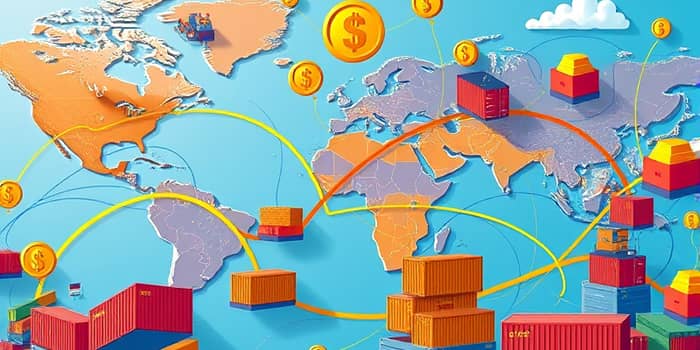
In an era defined by evolving supply chains and shifting policy priorities, the dynamic interplay between taxation through tariffs and global trade policies shapes the economic fortunes of nations, industries, and consumers alike. This in-depth exploration examines the historical evolution of trade, the powerful correlation between trade expansion and economic growth, the latest trends in U.S. trade deficits, the sweeping impacts of 2025 tariff measures, and practical strategies for stakeholders to thrive in this new landscape.
Historical Evolution of Global Trade
Global trade has undergone a profound transformation over the past two centuries. Prior to 1870, exports accounted for less than ten percent of global economic output; today, they represent roughly a quarter of worldwide GDP. This dramatic increase illustrates significant economic transformation driven by industrialization, technological progress, and the lowering of traditional trade barriers.
The twentieth century witnessed a remarkable acceleration of cross-border commerce. Innovations such as containerization, refrigerated shipping, and digital communication catalyzed the expansion of value chains across continents. Governments engaged in successive rounds of negotiations under the General Agreement on Tariffs and Trade (GATT) and later the World Trade Organization (WTO), steadily reducing average tariff rates from double digits to low single digits. The outcome was an era in which products, ideas, and capital flowed more freely than ever before, creating outsize gains for participating economies.
Trade and Economic Growth: A Correlated Journey
Numerous studies underscore a robust link between trade openness and GDP growth. At the country level, those with faster increases in trade as a share of output tend to register higher annual growth rates. Research by economists such as Frankel and Romer, along with Alcalá and Ciccone, confirms that trade intensification drives innovation and productivity gains through technology transfer, specialization, and scale economies.
The United States provides a compelling illustration of long-term benefits from liberalized trade. According to the Peterson Institute for International Economics, post-World War II trade liberalization elevated American real incomes by approximately nine percent—equivalent to $1.5 trillion in 2013 dollars. During the 2009–2014 recovery, U.S. real GDP expanded at an annual rate of 2.3 percent, with exports contributing nearly one-third of that growth. Over the same period, jobs supported by exports climbed by 1.6 million, reaching more than 11 million positions by 2013.
2025 Tariff Measures and Their Economic Impact
In 2025, the U.S. administration introduced a series of sweeping tariff measures that marked a departure from decades of liberalization. From March onward, a 20 percent tariff targeted all imports from China, while aluminum and steel imports faced a 25 percent duty. Starting in April, non–USMCA goods from Canada and Mexico incurred 25 percent tariffs, with potential levies looming on automotive and European Union imports.
- 20% tariff on Chinese goods enacted in March 2025
- 25% duties on aluminum and steel from multiple countries
- 25% tariffs on non-USMCA Canada/Mexico goods effective April 2025
- Pending levies on EU and automotive imports
Conventional scoring estimates that these measures generate $3.1 trillion in revenue over ten years; yet, dynamic revenue effects—accounting for economic contraction and retaliation—reduce net gains by $582 billion. The April tariffs alone yield $1.4 trillion conventionally, but lose $366 billion under dynamic assumptions.
Economic growth has already felt the sting. Analyses suggest a reduction of 0.9 percentage points in real GDP growth in 2025 due to all new tariffs, with persistent long-run GDP declines of 0.4 to 0.6 percent—equivalent to $100–$180 billion annually. Exports plummet by over 18 percent under the full suite of 2025 tariffs, erasing much of the gains built up over previous decades.
Sectoral and International Repercussions
Certain industries bear a disproportionate share of the new tariff burden. Fabricated metal products face average rates above 30 percent, rising to more than 35 percent under the EU scenario. Apparel, textiles, and leather goods—industries heavily reliant on inputs from China and USMCA partners—see apparel prices rising steeply, with consumer costs up to 17 percent higher under combined tariffs. Transportation equipment suffers average rates above 25 percent, reflecting the EU’s role as a major supplier of automotive components.
- Fabricated metal products: 30–35% average rates
- Leather, apparel, and textile goods: 17% consumer price hikes
- Transportation equipment: 25%+ tariff burden
- Specialty chemicals and electronics: rising input costs
Global partners also endure unintended global repercussions. Canada faces a two percent decline in real income, Mexico 2.7 percent, Ireland three percent, and China half a percent. Smaller economies that rely heavily on U.S. markets are particularly vulnerable, lacking the leverage to retaliate effectively or diversify swiftly.
Navigating the New Landscape: Strategies for Stakeholders
Despite these headwinds, opportunities exist for businesses, policymakers, and communities to adapt. By embracing innovation, diversification, and strategic planning, stakeholders can mitigate risks and harness emerging trends.
- Diversify supply chains to reduce reliance on high-tariff sources
- Invest in domestic manufacturing to capture local added value
- Negotiate bilateral agreements with emerging markets and allies
- Leverage digital platforms for efficient logistics and trade finance
- Implement workforce training to build competitive skills
Policymakers should weigh revenue goals against long-term competitiveness. Temporary tariff measures may shore up short-term budgets, but they risk eroding the industrial base, inflating consumer prices, and inviting retaliation. Collaborative approaches—such as sectoral dialogues with industry, targeted tax incentives for high-growth sectors, and streamlined customs procedures—can preserve fiscal health while fostering growth.
Conclusion
The story of taxes and trade is one of balance: between revenue and growth, protection and openness, short-term gains and enduring resilience. Historical experience shows that lowering barriers fuels prosperity, yet recent policy shifts demonstrate the allure of tariffs as fiscal tools. As nations navigate this complex terrain, the choices made today will define the contours of tomorrow’s economic landscape.
By understanding the intricate relationship between trade policy and economic performance, and by adopting data-driven strategic measures, businesses and governments can chart a course toward sustainable growth, innovation, and shared prosperity in an ever-evolving global marketplace.
References
- https://budgetlab.yale.edu/research/where-we-stand-fiscal-economic-and-distributional-effects-all-us-tariffs-enacted-2025-through-april
- https://ourworldindata.org/trade-and-globalization
- https://www.richmondfed.org/publications/research/economic_brief/2025/eb_25-12
- https://ustr.gov/issue-areas/economy-trade
- https://cepr.org/voxeu/columns/2025-trade-war-dynamic-impacts-across-us-states-and-global-economy
- https://unctad.org/publication/global-trade-update-october-2025-global-trade-remains-strong-despite-policy-changes-and
- https://www.jpmorgan.com/insights/global-research/current-events/us-tariffs
- https://www.oecd.org/en/about/news/press-releases/2025/11/corporate-tax-revenues-rise-as-global-corporate-tax-rates-continue-to-stabilise-new-oecd-data-show.html
- https://www.bea.gov/news/2025/us-international-trade-goods-and-services-august-2025
- https://unctad.org/publication/global-trade-update-april-2025-escalating-tariffs-impact-small-and-vulnerable-economies
- https://data.worldbank.org/indicator/NE.TRD.GNFS.ZS
- https://now.tufts.edu/2025/04/23/how-international-trade-affects-economy
- https://www.trade.gov/trade-data-analysis
- https://oec.world/en/