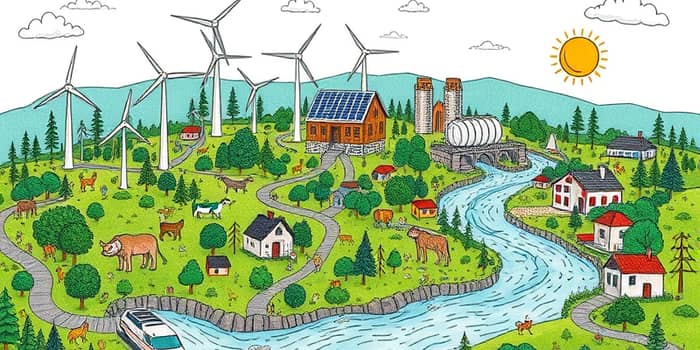
In an era of rapid change, the challenge of sustaining economic prosperity while safeguarding our planet has never been more urgent. Sustainable economics calls for a fusion of growth strategies with deep respect for natural limits.
At its core lies the tension between expansion and conservation: how can societies thrive without depleting the very resources that sustain life? This article explores evidence, principles, and solutions for achieving long-term economic growth without sacrificing our environmental heritage.
The Growth-Pollution Nexus
Economic activity and environmental pollution share a complex, non-linear growth-pollution relationship rather than a straightforward rise-and-rise pattern. Data from 1990 to 2014 reveal that a 1 percent increase in GDP per capita corresponded to only a 0.4 percent rise in CO₂ emissions and a 0.28 percent annual uptick in greenhouse gases.
During downturns, this link can invert. Between 2005 and 2011, the Great Recession saw greenhouse gas emissions drop by 1.2 percent annually, even as GDP and population continued growing by 0.9 percent each year. Such dynamics underscore opportunities to decouple growth from pollution.
Specific pollutants follow distinct trends. SO₂ emissions, linked to acid rain, correlate positively with GDP in medium-growth regimes but show negative durability in low- and high-growth phases. As industrial output rises, conventional energy use spikes, amplifying CO₂ release and stressing air, soil, and water.
Core Principles of Sustainable Economics
Transitioning to a green economy relies on a framework of guiding principles that integrate economic, environmental, and social objectives. The United Nations outlines five pillars guiding this shift.
- Wellbeing Principle: Focuses on shared prosperity and public goods while respecting individual rights and social justice.
- Planetary Boundaries Principle: Safeguards ecosystems by investing in restorative practices and recognizing multiple values of nature.
- Efficiency and Sufficiency Principle: Advocates low-carbon, circular production that aligns consumption within planetary limits.
- Equity Principle: Ensures fair access to resources and opportunities across generations and communities.
- Resilience Principle: Builds adaptive systems capable of weathering economic and environmental shocks.
Economic theory adds three cornerstones: scarcity, efficiency, and sovereignty. Recognizing resource limits, maximizing productivity, and preserving individual and collective decision-making authority fosters both innovation and stewardship.
- Scarcity: Drives prioritization and careful resource allocation.
- Efficiency: Enhances output while minimizing waste.
- Sovereignty: Empowers communities to chart their own sustainable paths.
Policy and Technological Solutions
Real-world progress hinges on merging policy instruments with cutting-edge technology. Governments can implement market-based tools—carbon pricing, pollution taxes, and tradable permits—to align economic signals with true environmental costs.
Innovation plays a pivotal role. Investment in renewable energy and sustainable agriculture spurs industries that reduce emissions while generating growth. Energy-efficient manufacturing, green infrastructure, and digital optimization yield productivity gains and environmental dividends.
Evaluating interventions demands a long-term cost-benefit analysis that internalizes social and ecological externalities. By favoring projects with clear sustainability outcomes, policymakers can direct capital toward transformative, low-impact solutions.
Economic Opportunities and Historical Lessons
Pursuing sustainability is not a sacrifice but a pathway to new prosperity. In 2018, the U.S. environmental technologies and services sector supported 1.6 million jobs and generated $345 billion in economic activity. Global demand for green skills—from renewable engineers to ecosystem restoration specialists—continues to climb.
The Industrial Revolution teaches us caution. Rapid mechanization in the 18th and 19th centuries outpaced waste management, resulting in long-term ecological damage and public health crises. Today, we can apply those lessons by embedding environmental safeguards before scaling up new technologies.
Conclusion: Towards a Sustainable Future
Balancing growth with environmental stewardship demands a holistic vision—one that weaves together economic efficiency, social equity, and ecological integrity. By adopting intergenerational equity and ecological integrity as guiding stars, societies can spur innovation, unlock new industries, and nurture the health of our planet.
The path forward lies in collective action, informed policy, and unwavering commitment to embedding sustainability at every level of decision-making. When economies thrive within natural boundaries, they become engines of lasting prosperity—for today’s communities and for generations to come.
References
- https://www.greeneconomycoalition.org/news-and-resources/the-5-principles-of-green-economy
- https://pmc.ncbi.nlm.nih.gov/articles/PMC9684716/
- https://www.watsonwolfe.com/2023/09/09/the-four-principles-of-sustainability/
- https://www.tandfonline.com/doi/full/10.1080/27658511.2024.2345445
- https://www.stlouisfed.org/on-the-economy/2017/september/effects-economic-growth-pollution
- https://www.epa.gov/clean-air-act-overview/clean-air-act-and-economy
- https://www.imd.org/blog/sustainability/economic-sustainability/
- https://www.eea.europa.eu/en/analysis/publications/growth-without-economic-growth
- https://triplepundit.com/2013/three-economic-principles-sustainability/
- https://greenly.earth/en-us/blog/ecology-news/what-was-the-industrial-revolutions-environmental-impact
- https://greenly.earth/en-us/blog/company-guide/green-economy--meaning-and-principles
- https://earth.org/gdp-climate-change/
- https://sustainability.umw.edu/areas-of-sustainability/economic-sustainability/