Every market transaction tells a story not only of price and volume, but of hidden gains that producers capture when market conditions align in their favor. Beyond traditional profit metrics lies an indispensable concept—producer surplus—that reveals the true benefits sellers enjoy above their marginal costs.
By uncovering these concealed gains, businesses and policymakers can make more informed decisions to foster growth, efficiency, and economic welfare.
Understanding the Core Concept
At its heart, producer surplus measures the difference between market price and cost that producers earn when selling goods above their marginal costs. It isolates variable expenses—labor, materials, energy—while ignoring fixed production costs such as rent or machinery.
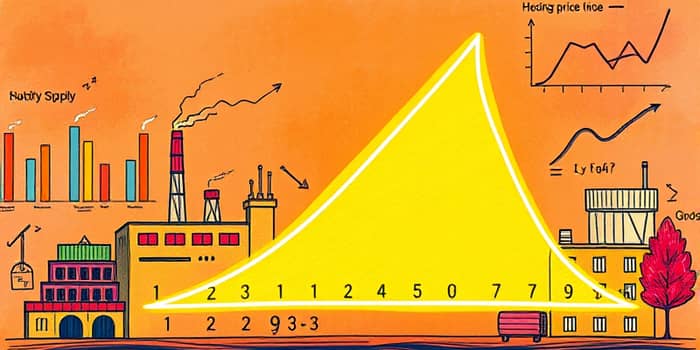
Graphically, this surplus forms a triangle: the region above the supply curve (marginal cost curve) and below a horizontal market price line, extending to the equilibrium quantity. Lower-cost producers reap the greatest gains, while the marginal producer earns zero surplus by selling at exactly its marginal cost.
Imagine a wheat farmer with a marginal cost of $3 per bushel in a market priced at $5. For each bushel sold, she earns $2 in surplus. Multiply that across thousands of bushels, and the aggregated surplus becomes a powerful signal of agricultural profitability and investment potential.
Distinguishing Producer Surplus from Profit
Though related, producer surplus and profit serve distinct analytical purposes. Profit accounts for all costs—fixed and variable—providing a bottom-line measure of financial performance. Producer surplus, by contrast, focuses solely on gains above variable costs, offering clarity on the negotiation between supply and price.
Consider a boutique chocolatier who pays fixed rent of $2,000 monthly but faces variable costs of $4 per box of truffles. If they sell at $10 per box, each unit yields $6 in producer surplus, yet overall profit may vary when fixed costs are deducted.
Calculating Producer Surplus in Practice
Quantifying producer surplus guides pricing, production, and policy decisions. Key calculation methods include:
- Triangular area formula: (Market price − Minimum acceptable price) × Quantity ÷ 2.
- Aggregate revenue approach: Total revenue minus total variable costs for all units sold.
- Per-unit summation: Adding individual differences between price received and marginal cost for each unit.
Visualizing these methods on supply-and-demand graphs helps stakeholders identify ranges of potential surplus under different pricing scenarios. Sophisticated firms overlay cost data on interactive dashboards to simulate surplus under fluctuating market prices.
Real-World Examples Amplifying Theory
Across industries, producer surplus shapes strategic behavior and market outcomes:
Oil Market: When crude trades at $40 per barrel, efficient producers with extraction costs of $20 gain a $20 producer surplus per barrel. The total surplus—the blue-shaded triangle above the marginal cost curve—reflects the aggregate gains across all wells.
Luxury Automobiles: In high-demand cycles, premium carmakers can price vehicles at $150,000 when production costs average $100,000, securing a $50,000 surplus per unit that funds design innovations and brand expansion.
Coffee Beans: Farmers with low harvesting costs of $2 per bag earn $3 surplus when market prices reach $5. Those at the cost frontier approach zero surplus, illustrating how supply-side efficiency dictates earnings distribution.
Artisanal Bakeries: A neighborhood bakery may sell loaves above marginal costs, realizing positive surplus, even while fixed overhead — rent, utilities — delays net profit for several months.
Seasonal Goods: Sunglass manufacturers ramp up production before summer, capitalizing on elevated prices to capture surplus that offsets lean winter sales.
Economic Implications and Market Welfare
Producer surplus is a building block of total economic welfare. When added to consumer surplus, it quantifies the collective gains from trade, signaling market efficiency or deadweight losses under taxes, quotas, or price controls.
- Pricing strategies leverage surplus estimates to optimize markups and promotional discounts.
- Resource allocation shifts toward industries with persistent high surplus, guiding investment and innovation.
- Welfare analysis evaluates policy impacts on producer and consumer wellbeing, ensuring balanced outcomes.
In the short run, competitive markets may deliver robust producer surplus, while in the long run, entry erodes surpluses as costs adjust and prices align with minimum average costs. Monopolistic or oligopolistic markets, however, sustain higher producer surplus but may reduce total welfare through restricted output.
Conclusion: Harnessing Insights for Strategy
By focusing on producer surplus, stakeholders uncover a powerful lens into market dynamics that extends beyond simple profit calculations. Firms can calibrate production, pricing, and investment to maximize gains above marginal costs, while policymakers can design interventions that preserve efficiency and equity.
Ultimately, embracing producer surplus as a core metric empowers businesses and governments to craft more resilient, innovative, and welfare-enhancing markets, turning hidden economic gains into strategic advantages.
References
- https://mru.org/dictionary-economics/producer-surplus-definition
- https://www.youtube.com/watch?v=8BckiU_YZV8
- https://www.mypos.com/en-gb/blog/business-guide/what-is-producer-surplus
- https://capital.com/en-int/learn/glossary/producer-surplus-definition
- https://www.sumup.com/en-gb/invoices/dictionary/producer-surplus/
- https://www.analyticssteps.com/blogs/what-producer-surplus-it-any-different-profit
- https://corporatefinanceinstitute.com/resources/economics/consumer-surplus-and-producer-surplus/
- https://www.economicshelp.org/blog/glossary/consumer-surplus/
- https://www.youtube.com/watch?v=oE8rw-yBKG0
- https://www.khanacademy.org/economics-finance-domain/microeconomics/consumer-producer-surplus/consumer-producer-surplus-tut/a/lesson-overview-consumer-and-producer-surplus
- https://www.studypug.com/calculus-help/consumer-and-producer-surplus/
- https://www.khanacademy.org/economics-finance-domain/microeconomics/consumerproducer-surplus/consumer-producer-surplus-tut/v/producer-surplus
- https://www.masterclass.com/articles/producer-surplus-definition
- https://www.youtube.com/watch?v=J4dM9r2qU1I