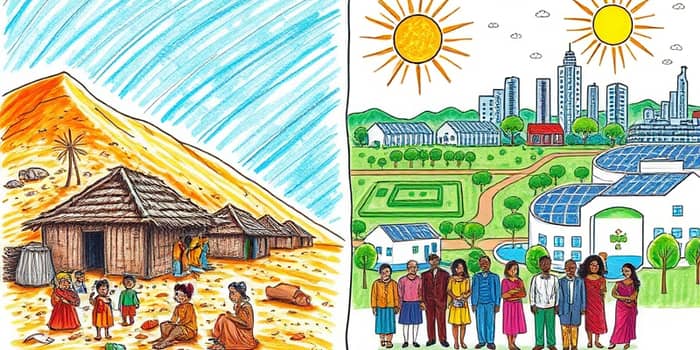
In a world of abundance and innovation, the persistence of poverty can feel like a moral paradox. Every day, millions confront the uncertainty of empty cupboards, limited access to basic healthcare and precarious shelter. Yet, just beyond this struggle, new frontiers of opportunity are emerging through technology, community action and policy innovation. Bridging this divide is not only an economic imperative but a profound human mission that demands empathy, creativity and solidarity.
Since 1990, extreme poverty has plunged from 2.3 billion to around 831 million people in 2025. Nonetheless, recent estimates reveal a rise to 808 million people in extreme poverty, underscoring the fragility of progress and the unevenness of recovery after global shocks. Addressing this challenge requires a nuanced understanding of data, regional disparities and the underlying drivers that perpetuate economic exclusion.
Shifting Global Poverty Landscape
Over the past three decades, the world witnessed an unprecedented dip in extreme poverty. From nearly half the population living on less than $2.15 per day in 1990, we now see rates hovering around 9.9% in 2025. This journey, marked by global cooperation and targeted development programs, delivered dramatic gains but also exposed the vulnerability of the poorest to crises like pandemics, conflict and climate shocks. Recent revisions by the World Bank estimate the global extreme poverty rate at 10.1%, a slight improvement from 10.3% in 2024 but still above pre-pandemic levels.
Beyond the extreme threshold, nearly half the planet struggles below higher poverty lines. At $8.30 per day, relevant to upper-middle-income contexts, a staggering 3.7 billion people remain mired in economic uncertainty. These figures remind us that prosperity must be measured not only by headline rates but by the lived realities of billions striving for stability and dignity.
Regional Disparities: Contrasts and Challenges
Regional analysis sharpens our view of where interventions are most critical. Sub-Saharan Africa suffers the highest concentration, with a poverty rate of 46.0% in 2024. Western and Central Africa, in particular, saw an upward revision from 32.8% to 35.7%, adding 15.6 million more people below the $3 per day mark. In Eastern and Southern Africa, extreme poverty remains entrenched, defying simple solutions.
South Asia offers a beacon of success, cutting poverty from 9.7% to 7.3% between 2022 and 2025. Fueled by robust policies and inclusive growth strategies, countries like India and Bangladesh have lifted millions into a more stable economic orbit. Yet, this region still houses more than 200 million people living on less than $3 per day, reminding us that progress, while impressive, is incomplete.
The Middle East and North Africa (MENA) region also grapples with rising poverty, now at 9.4% in 2025. Conflict, political instability and economic shockwaves have pushed one in eight individuals into extreme hardship. Meanwhile, East Asia and the Pacific see extreme poverty among women falling below 5%, illustrating how targeted gender policies can reshape outcomes.
Fragile and conflict-affected contexts now harbor over one billion people, more than double the share in 2005. Here, poverty is both the root cause and consequence of instability, creating a cycle that demands bespoke solutions sensitive to each nation’s history and culture.
The Gender Gap: Women and Poverty
Despite strides in inclusivity, women continue to face unique barriers. Globally, 11.4% of women subsist in extreme poverty, compared to 10.9% of men. These figures mask deeper inequities shaped by care responsibilities, wage gaps and legal constraints on property and inheritance. women disproportionately affected by poverty often see their potential stifled by norms that limit education, financial inclusion and political participation.
Empowering women through targeted policies—such as childcare support, legal reforms and access to credit—can trigger ripple effects across families and communities. Evidence shows that bolstering women’s education and entrepreneurship yields higher returns in health, nutrition and overall economic resilience.
Beyond Income: Multidimensional Poverty
Income alone cannot capture the full experience of deprivation. The global multidimensional poverty index 2025 identifies 1.1 billion people suffering acute deficits in health, education and living standards. Over half of this total are children, trapped in cycles of malnutrition, lack of schooling and substandard housing. This holistic lens uncovers vulnerabilities that income measures may overlook, guiding more nuanced interventions.
Wealth Inequality: The Gini Divide
Even as poverty rates shift, wealth concentrates at the top at alarming rates. South Africa, Namibia and Botswana record Gini coefficients above 54, indicating extreme disparities. In high-income regions, countries like the United States show a coefficient of 41.8, far above the 25-30 range typical of Nordic economies. These divides threaten social cohesion, as frustrated citizens grow weary of inequitable systems that favor the few.
Public opinion surveys reveal that over half of people in 36 nations view the gap between rich and poor as a “very big problem.” Closing this gap demands progressive taxation, fair labor standards and mechanisms that democratize access to capital and innovation.
Fragile States and Conflict: A Deadly Spiral
In fragile and conflict-affected states, more than one billion people face governance breakdowns, conflict and humanitarian crises. Poverty in these settings feeds instability—each day without access to essentials chips away at trust and fuels grievances.
International cooperation and local leadership must collaborate to rebuild institutions, deliver emergency relief and lay the groundwork for sustainable peace. Without restoring hope, displaced families will continue to suffer and migration pressures will intensify.
Building Trust and Social Cohesion
declining trust in public institutions is eroding confidence worldwide, undermining the social contract. When citizens doubt their governments’ capacity or goodwill, collective action stalls. Reinforcing transparency, accountability and community engagement can mend this breach.
Civil society organizations, faith groups and local councils play vital roles in restoring faith and galvanizing grassroots innovations. By fostering dialogue and ensuring that voices from marginalized groups are heard, societies can rebuild solidarity—an essential ingredient for driving policies that leave no one behind.
Pathways to Inclusive Prosperity
The scale of economic disparity calls for bold, coordinated efforts across sectors and borders. Ending poverty and narrowing inequality demands bold action:
- Invest in universal education and healthcare.
- Expand gender-sensitive social protection schemes.
- Promote inclusive and sustainable economic growth.
- Support small businesses and local agriculture.
- Strengthen governance and combat corruption.
These strategies must be underpinned by robust data systems, community-driven design and flexible funding that adapts as challenges evolve. By marrying evidence-based policy with grassroots energy, the vision of a world where prosperity is shared can move from aspiration to reality.
The journey to eradicate poverty and close the inequality gap is neither linear nor simple. Yet, each success story offers a blueprint for replication and scaling. When communities unite, governments act with integrity and the private sector innovates responsibly, transformative change is within reach. Embracing our shared humanity and committing to targeted interventions can light a path from desperation to dignity, ensuring that prosperity reaches every corner of our global community.
References
- https://blogs.worldbank.org/en/opendata/september-2025-global-poverty-update-from-the-world-bank--new-da
- https://blogs.worldbank.org/en/opendata/june-2025-global-poverty-update-from-the-world-bank--2021-ppps-a
- https://www.un.org/en/desa/6-takeaways-world-social-report-2025
- https://unstats.un.org/sdgs/report/2025/goal-01/
- https://worldpopulationreview.com/country-rankings/wealth-inequality-by-country
- https://ourworldindata.org/poverty
- https://www.visualcapitalist.com/visualizing-global-wealth-inequality/
- https://hdr.undp.org/content/2025-global-multidimensional-poverty-index-mpi
- https://wid.world
- https://worldpopulationreview.com/country-rankings/poverty-rate-by-country
- https://www.pewresearch.org/global/2025/01/09/economic-inequality-seen-as-major-challenge-around-the-world/
- https://sapa-usa.org/countries-with-highest-poverty-rate/
- https://www.oxfamamerica.org/explore/issues/economic-justice/extreme-inequality-and-poverty/
- https://ophi.org.uk/global-mpi/2025
- https://ourworldindata.org/grapher/economic-inequality-gini-index
- https://gfmag.com/data/economic-data/poorest-country-in-the-world/
- https://ilostat.ilo.org/those-left-behind-the-forgotten-in-the-fight-against-global-poverty/