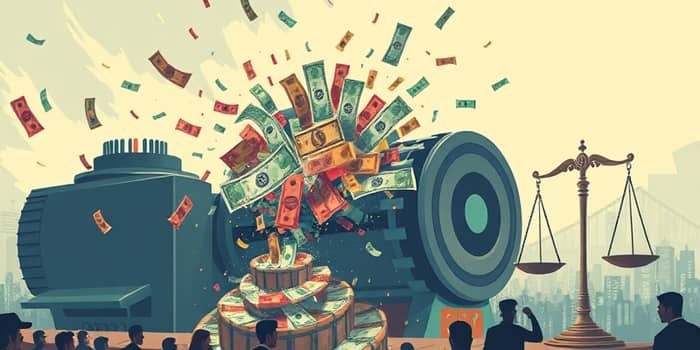
Across history, unchecked money creation has planted the seeds of economic turmoil. From revolutionary France to modern crises, each episode warns that printing currency without restraint imposes real costs on societies. This article explores the mechanisms, consequences and practical steps individuals and policymakers can take to navigate and mitigate the risks of rampant monetary expansion.
The Historical Lessons of Hyperinflation
During the French Revolution, the government turned bonds called "assignats" into de facto currency in a bid to finance war and reform. By 1793, assignats had lost 65% of their value, and by 1796 they were worthless. The middle class watched savings evaporate as prices soared daily.
Post–World War I Germany offers another stark example. With prices doubling every few days, workers demanded to be paid twice daily so they could purchase basic goods before their wages lost value. Families stood in line for bread with wheelbarrows half-full of marks, only to see them become worthless by nightfall.
How Money Printing Fuels Inflation
At its core, inflation from printing focuses on too much money chasing too few goods. Imagine an economy that produces $10 million worth of goods each month, backed by $10 million in currency. If the money supply suddenly doubles to $20 million without any increase in output, demand skyrockets, and prices follow suit. A $10 book now costs $20, reflecting 100% inflation.
This dynamic introduces menu costs and pervasive uncertainty. Businesses must constantly update prices, supply chains adjust erratically, and long-term contracts become fraught with risk. Consumers scramble to spend cash before it loses value, disrupting normal economic planning.
Modern Echoes: Quantitative Easing and COVID-19
In early 2020, central banks worldwide unleashed unprecedented firepower. The Fed’s balance sheet jumped from $4 trillion to $7 trillion in three months, directly funding fiscal relief. The ECB and its counterparts added another €6.3 trillion. While intended to stabilize markets, this massive liquidity surge stoked fears of persistent inflation.
By 2022, the US faced its highest inflation since the 1980s. The dollar slid 8% in value, and asset bubbles inflated commodities, equities and real estate. Critics likened these policies to a “dangerous drug for elites”—easy money that ultimately punishes everyday citizens through price volatility.
The Economic and Social Toll
Unchecked money printing carries profound consequences. First, it crowds out private investment. Governments absorb domestic savings to finance deficits, leaving businesses starved for capital. In South Africa, the fiscal deficit now consumes 100% of domestic savings, risking exclusion of the private sector.
Second, currency devaluation erodes purchasing power globally. Emerging markets burdened with dollar-denominated debt face skyrocketing repayment costs, prompting capital flight. Zimbabwe and Venezuela offer recent warnings of how political and monetary mismanagement can spiral into humanitarian crises.
Debating the Role of Modern Monetary Theory
Modern Monetary Theory (MMT) claims that sovereign currency issuers can print money at will, so long as inflation remains under control. However, history suggests that once governments taste free financing, political pressures make restraint nearly impossible. Past quantitative easing programs mostly inflated asset prices, not consumer goods, but recent experience shows the risk of spillover into general inflation.
While proponents argue for short-term gains—reduced unemployment and stimulated growth—the balance of evidence warns against unsustainable wealth without matching output. Central bank independence erodes when policymakers defer to fiscal demands, creating a feedback loop of ever-larger money injections.
Navigating the Storm: Practical Strategies
Individuals and policymakers need concrete tools to guard against monetary mischief. Consider these approaches:
- Diversify savings into real assets: precious metals, real estate or productive equity.
- Advocate for fiscal responsibility: support transparency and balanced budgets.
- Monitor inflation indicators: consumer price index, wage growth and money supply metrics.
- Support independent central banks with clear mandates to target price stability.
- Build international cooperation: emerging markets can form currency swap networks to reduce dollar dependence.
By combining personal vigilance with policy engagement, citizens can pressure governments to adopt responsible monetary disciplines and avoid the lure of easy financing. Public education campaigns, research grants and civic groups all play a role in promoting sustainable money management.
A Call to Action
Unchecked money printing offers a seductive shortcut to funding government ambitions, but the price is paid by the most vulnerable. When citizens stand in line for bread or watch their savings vanish, the human cost of monetary mischief becomes painfully clear. It is incumbent on all of us—voters, consumers and elected officials—to demand accountability.
We must champion balanced policies that align money supply with real output, safeguard central bank autonomy and foster economic systems that reward productivity over political expedience. Only by learning from the mistakes of assignats, postwar marks and modern QE can we build a stable financial future for generations to come.
Conclusion
Money is more than a medium of exchange—it is the lifeblood of economies and the bedrock of trust in institutions. While printing presses might offer temporary relief, they carry long-term risks that can devastate livelihoods. Through informed action, responsible governance and vigilant citizens, we can steer away from the precipice of hyperinflation and create a fair, prosperous system that endures.
References
- https://www.allangray.co.za/latest-insights/markets-and-economy/the-dangers-of-printing-money/
- https://www.economicshelp.org/blog/634/economics/the-problem-with-printing-money/
- https://fsgjournal.nl/article/2022-04-19-why-is-printing-money-so-much-of-a-problem
- https://blogs.cfainstitute.org/investor/2021/04/19/myth-busting-money-printing-must-create-inflation/
- https://people.bsu.edu/econbriefs/2025/04/30/yes-printing-money-during-covid-led-to-inflation-by-dr-cecil-bohanon-and-dr-john-horowitz/
- https://www.youtube.com/watch?v=UsDUncfW4fY&vl=en