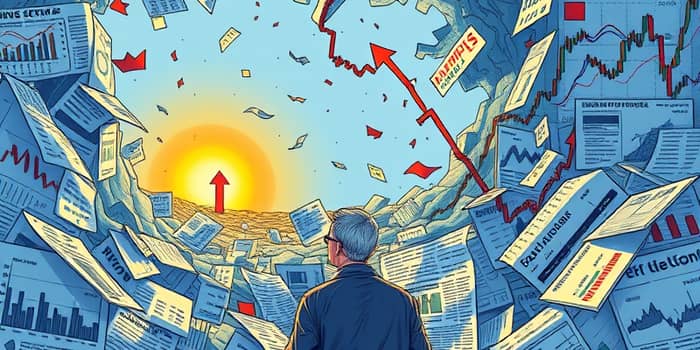
Every day, investors are bombarded with breaking headlines, fluctuating charts, and the siren song of social media chatter. It is easy to feel overwhelmed by constant, short-term price fluctuations that seem urgent but often distract from the real drivers of value. While these turbulent moments can spark anxiety, panic, or false confidence, they also offer a powerful opportunity: the chance to step back, cultivate a calm mindset, and align your decisions with enduring principles that have guided successful investors for decades.
Understanding Market Noise
Market noise refers to the myriad of transient, non-essential signals that surface in financial markets, drawing attention away from core fundamentals. Fischer Black first described noise in 1986, highlighting its role in creating inefficiencies and masking true information. Noise traders, often operating on incomplete data, rumors, or emotional impulses, contribute significantly to these erratic movements.
In practical terms, noise emerges when good or bad news, viral rumors, or sudden algorithmic trades trigger reactions unrelated to a company’s underlying performance. Imagine a storm of data points, all shouting for your attention, yet most carry no long-term significance. Recognizing the difference between noise and genuine news is the first step toward informed, strategic investing.
Sources and Amplifiers of Noise
Understanding where noise originates empowers you to filter out distractions. Major amplifiers include sensational media coverage, rapid-fire algorithmic trading, and widespread behavioral biases that drive groupthink. Each element stokes volatility, creating a kaleidoscope of dramatic swings that can feel both captivating and terrifying.
- News and media sensationalism: Headlines often exploit negativity bias, focusing on fear and greed to drive engagement.
- Algorithmic trading systems: High-frequency programs react within microseconds to specific keywords and data releases.
- Behavioral biases in investors: Herd mentality and the urge to take immediate action inflate reactionary trades.
- Speculative noise traders: Millions of non-professionals trade on hype, rumors, and emotions without deep analysis.
Each of these drivers can amplify isolated events—like a weak jobs report or a surprising earnings call—into sweeping market moves that may not reflect long-term trajectories.
Impacts and Risks of Noise
When noise dominates, it can create artificial price surges followed by abrupt reversals, eroding investor confidence and leading to suboptimal decisions. In a noise-driven market, emotions often override reason, causing panic selling in downturns and irrational exuberance during rallies.
Left unchecked, these distortions undermine disciplined strategies, encouraging attempts at market timing that typically result in buying high and selling low. Over time, the psychological toll of chasing volatile swings can overshadow the benefits of compound growth and steady wealth accumulation.
These figures illustrate the magnitude of noise traders compared to professionals and highlight the near-random pattern of daily market movements. Despite the slight edge toward positive days, the volatility introduced by noise can tempt investors into poor timing decisions.
Strategies to Tune Out Noise
Mastering market noise requires a blend of mindset, method, and ongoing discipline. By adopting a framework that prioritizes measured responses over impulsive actions, you can harness volatility to your advantage and cultivate a sense of control in any market environment.
- Ignore daily price swings and treat them as coin flips with limited information, rather than signals to buy or sell.
- Focus on core fundamentals—economic growth, corporate earnings, and inflation trends—when making long-term allocations.
- Implement diversification and risk management to protect against extreme fluctuations and ensure portfolio resilience.
- Establish rules to limit media consumption and avoid action bias, the urge to do something when uncertainty spikes.
Benjamin Graham famously noted that “the investor’s chief problem—and even his worst enemy—is likely to be himself.” Acknowledging this truth helps you create structures—like predetermined asset allocations, periodic rebalancing schedules, and clear entry points—that prevent emotional trading.
In practice, this might look like setting quarterly check-ins, resisting the temptation to react to every news alert, and embedding reminders of your long-term objectives in your investment plan. Over time, these routines build a durable psychological shield against the pull of market noise.
Long-term patience and consistency are the bedrock of substantial returns. Although noise can cause abrupt dips and frenzied rallies, history shows that markets reward those who stay the course. From the dot-com collapse to the 2008 financial crisis, investors who resisted the allure of speculation and remained invested in quality assets emerged stronger.
Today’s conditions—controlled inflation, declining interest rates, and strengthening economic indicators—echo past periods of recovery. By tuning out noise and focusing on core drivers, you can position your portfolio to benefit from the next leg of growth, rather than being derailed by short-lived market storms.
Remember, markets rise more than they fall over extended periods, and disciplined investors reap the rewards of patience. Embracing this perspective transforms uncertainty into opportunity, turning every market fluctuation into a reminder to reaffirm your commitment to fundamental principles.
As you continue your journey, cultivate self-awareness and readily question emotional impulses. Keep learning, stay curious about market mechanics, and periodically revisit your strategy to ensure it aligns with evolving goals and risk tolerances. Ultimately, mastering market noise is not about eliminating volatility, but thriving amid it.
By filtering out the static and focusing on the signal—the timeless forces of growth, innovation, and resilience—you equip yourself with the clarity and confidence to navigate any market landscape. Let every challenge reinforce your discipline, and every dip reveal opportunities for strategic action. In doing so, you transform market noise from a source of stress into a catalyst for purposeful, long-term success.
References
- https://corporatefinanceinstitute.com/resources/career-map/sell-side/capital-markets/noise-trader/
- https://www.leelynsmith.com/insights/article/market-noise-what-it-is-and-why-you-should-ignore-it/
- https://www.netwealth.com/resources/our-views/why-cutting-through-noise-is-a-sound-investment-strategy/
- https://keystotheinvestingcastle.com/2024/05/23/market-noise-the-randomness-of-short-term-investment-predictions/
- https://nexusinvestments.com/insight/market-noise-how-to-beat-it-with-temperament/
- https://sterling.com.jm/how-navigate-noise-market/
- https://www.schroders.com/en-hk/hk/individual/insights/navigate-market-noise-and-capture-long-term-growth-through-diversification/