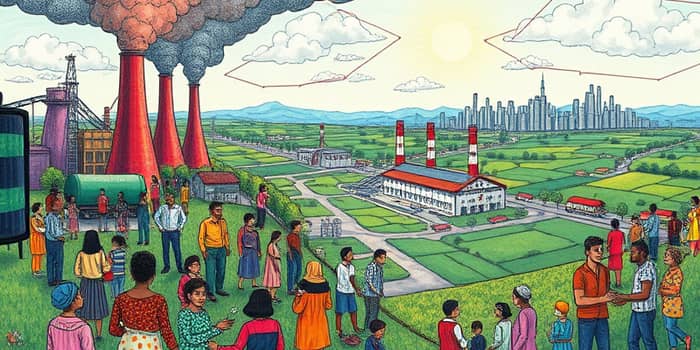
In our quest for prosperity, free markets often act as engines of innovation and growth. Yet, when left unchecked, they can falter, leading to wasted resources, social burdens and unmet needs. Understanding these breakdowns is essential to crafting solutions that restore balance.
Understanding Market Failure
Market failure occurs when individual rational decisions lead to outcomes that diminish collective welfare. In an ideal scenario, markets achieve Pareto efficiency, where no one can be better off without making someone else worse off. But real economies encounter friction, and the equilibrium of supply and demand does not always maximize social value.
First coined by economists in the late 1950s, the term draws on Victorian roots from thinkers like John Stuart Mill. It describes an inefficiency arising from uncoordinated private actions that leave potential gains unrealized.
Core Causes and Dynamics
Multiple structural issues can derail market efficiency. Key drivers of failure include:
- Externalities, where third-party costs or benefits go unpriced
- Public goods that suffer from free riders and underprovision
- Market power distortions from monopolies and oligopolies
- Information asymmetries leading to adverse selection and moral hazard
- Inequality and distributional imbalances that exclude vulnerable groups
Each of these mechanisms imposes hidden burdens or denies opportunities, creating gaps between private incentives and social optimum.
Externalities: Costs and Benefits Unseen
Negative externalities occur when private transactions impose unaccounted social costs on others. Classic examples include air and water pollution, climate change from fossil fuels, and deforestation. Without pricing these impacts, firms and consumers overproduce harmful goods, pushing society into a net welfare loss.
Conversely, positive externalities emerge when beneficial activities—like vaccination and education—are underprovided, because recipients don’t fully capture the wider benefits. Achieving social efficiency demands aligning private and social marginal costs and benefits.
Overfishing and the “tragedy of the commons” illustrate how common-pool resources collapse as individuals overuse without bearing the full cost.
Public Goods and Free Riders
Public goods are non-excludable and non-rivalrous in consumption, meaning no one can be prevented from using them and one user does not diminish another’s benefit. Clean air, national defense and basic research fit this category, yet private markets underprovide them due to free-rider problems.
Innovative arrangements—such as toll lanes or subscription models—sometimes succeed in privatizing these goods, but true public goods often require collective financing or government provision to reach socially optimal levels.
Market Power and Information Imperfections
When firms dominate markets, they can restrict output and drive up prices, deviating from competitive equilibria. Monopolies or monopsonies wield leverage over suppliers or consumers, reducing overall welfare.
Information asymmetries further complicate transactions. In the used-car “lemons” market, sellers know more about vehicle quality than buyers, driving up uncertainty and market breakdowns. Principal–agent problems arise when managers act in self-interest, not shareholders’, while moral hazard prompts risky behaviors when actors are insulated from consequences.
Real-World Examples and Impacts
The scale of market failures can be staggering. Below is a snapshot of prominent cases:
These figures underscore how externalities, bubbles and unequal gains can ripple through economies, harming livelihoods and future resilience.
Policy Responses and Interventions
Recognizing failure points, policymakers deploy tools to realign incentives and restore efficiency. Common interventions include:
- Pigovian taxes or subsidies to internalize externalities
- Antitrust enforcement to curb monopolies and promote competition
- Direct public provision or financing of essential goods
- Regulatory standards to reduce information gaps
For example, carbon pricing places a cost on greenhouse gas emissions, encouraging cleaner production. Congestion pricing in urban centers reduces traffic by charging peak-hour fees, recapturing social costs and smoothing demand.
Property-rights reforms can alleviate common-pool resource depletion, while social safety nets and targeted transfers address distributional inequities.
Looking Ahead: Bridging Gaps and Building Trust
Market failures are neither rare nor incurable. They remind us that free markets alone cannot guarantee optimal outcomes in every domain. Thoughtful interventions and adaptive governance can steer systems toward greater fairness and sustainability.
By understanding the root causes—from externalities to information flaws—leaders and citizens can craft solutions that harness market dynamism while protecting public interests. The journey demands humility, rigorous analysis and a willingness to innovate beyond traditional frameworks.
Ultimately, restoring faith in markets hinges on our ability to bridge gaps, share knowledge and ensure that no individual or generation bears undue costs. With proactive policies and engaged communities, we can unlock the full promise of free markets—balanced by compassion and collective responsibility.
References
- https://en.wikipedia.org/wiki/Market_failure
- https://opportunityinstitute.org/blog/post/the-4-or-5-worst-market-failures-in-human-history/
- https://www.economicshelp.org/micro-economic-essays/marketfailure/
- https://www.econlib.org/library/Topics/College/marketfailures.html
- https://www.cato.org/policy-analysis/how-market-failure-arguments-lead-misguided-policy
- https://www.ebsco.com/research-starters/business-and-management/market-failure
- https://opportunityinstitute.org/blog/post/econ-101-market-failures/
- https://www.edchoice.org/defining-market-failure-with-examples/
- http://www.ers.usda.gov/amber-waves/2008/november/market-failures-when-the-invisible-hand-gets-shaky
- https://study.com/academy/lesson/video/market-failure-definition-types-causes-examples.html