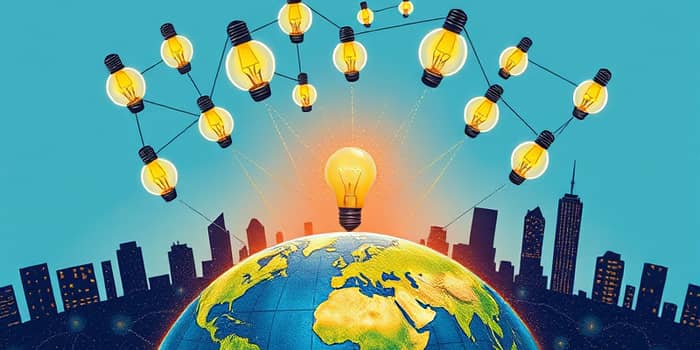
Since the turn of the millennium, the global landscape of creativity and discovery has undergone a profound transformation. Across every continent, the relentless pursuit of novel ideas and technological breakthroughs has catalyzed unprecedented shifts in economic trajectories. From the surge of patent filings to the proliferation of digital platforms, new concepts have rippled through supply chains, labor markets, and consumer behaviors, birthing opportunities and challenges alike. In this exploration, we examine how the global expansion of innovation capabilities has become the driving engine behind modern growth.
From Invention to Impact: Mapping Innovation’s Journey
Innovation is not merely the act of conceiving new products or processes; it is the continuous cycle of ideation, refinement, commercialization, and diffusion. In the two decades since 2000, metrics such as GDP, exports, trademarks, and scholarly publications have surged in tandem with creative breakthroughs. While trademark registrations leapt by more than 70% and publications climbed by 64%, patent growth remained modest by comparison. Yet these numbers only hint at a deeper narrative: how experimental ideas traverse laboratories and workshops to reshape entire industries.
At its core, this process thrives on connectivity—between researchers collaborating across borders, entrepreneurs navigating emerging markets, and policymakers fostering supportive ecosystems. The result has been an entrepreneurial activity surges globally documented rise in startup formation of up to twelvefold in some regions. As knowledge flows freely through digital channels, innovations per capita have grown in lockstep with GDP, forging new pathways for economic participation and wealth creation across diverse communities.
Uneven Progress: Winners and Laggards
Despite a universal appetite for novelty, the benefits of innovation have accrued unevenly. The top ten economies now command 54% of global exports, 73% of trademark filings, 87% of patents, and 70% of publications. This concentration of innovation outputs underscores the emerging divergence between established powerhouses and nations still building their knowledge infrastructures. Economies that have invested strategically in research and education have captured high-value activities, while others risk relegation to low-margin manufacturing or resource extraction.
East Asia exemplifies this dynamic. Over the past two decades, its share of global innovation domains expanded from 25% to 64%, leveraging focused investment in science and technology. Conversely, many economies face structural hurdles—limited access to capital, insufficient R&D funding, and gaps in technical skills—that hamper their capacity to climb the complexity ladder. Bridging these divides demands targeted interventions and international cooperation to ensure that the wave of innovation lifts all participants.
The Digital Revolution and Its Ripple Effects
The advent of digital platforms, AI, and the Internet of Things has accelerated the pace at which ideas can be tested and scaled. E-commerce sales grew by 60% between 2016 and 2022, reaching $27 trillion across 43 countries, while smartphone shipments doubled to 1.2 billion units by 2023. These digital economy expansion trends have lowered barriers to entry, enabling entrepreneurs to access customers and collaborators worldwide with minimal upfront investment.
As firms harness cloud computing, blockchain, and 5G connectivity, they streamline operations and reduce transaction costs. Meanwhile, IoT networks are projected to reach 39 billion devices by 2029. The following table highlights select metrics that illustrate how digital adoption has reshaped productivity, investment, and environmental footprints over recent decades.
Labor Markets and the Skill Premium Shift
Technological change has reshaped work in profound ways. Between 2020 and 2022, 68% of US firms adopted AI tools, while robotics usage remained between 23.6% and 26.9%. Contrary to fears of massive job losses, overall employment held steady, with displacement effects of approximately 0.7% per year offset by reinstatement through new roles at about 0.35% per year. This pattern underscores the rise of skill-biased technological change patterns that favor more educated workers and elevate wage premiums for STEM disciplines.
Wage gaps reflect this shift: computers and ICT account for nearly 25% of the college wage premium, while trade and multinational operations contribute another 5–7%. As AI systems augment complex tasks—such as data analysis and customer verification—they complement skilled labor, raising demand for advanced training and continuous learning. Policymakers and businesses must collaborate to design education and reskilling programs that equip workers for these evolving roles.
Navigating Challenges: Environment, Policy, and Equity
Innovation’s march forward brings challenges that must be addressed. Electronic waste and carbon emissions from data centers create environmental footprints that threaten sustainability. Policy uncertainty and geopolitical tensions can stun investment. And unequal access to digital tools risks widening socioeconomic divides. Recognizing these dangers is the first step toward crafting solutions that embed resilience and fairness at every stage of the innovation cycle.
- Environmental concerns: ICT emissions and e-waste
- Uneven R&D funding and access to capital
- Policy and geopolitical risks hindering investment
- Positive spillovers: circular economy models and recycling jobs
- Growth of digital infrastructure supporting remote communities
Looking Ahead: Forecasts and Strategies for Inclusive Growth
Forecasts for 2026 suggest modest yet steady global growth of 2.7%, with the US at 2.1% propelled by AI and data center investments. To harness momentum, stakeholders should pursue policies that foster inclusive and sustainable growth. This involves boosting R&D incentives, expanding digital access in underserved regions, investing in green technologies, and strengthening international partnerships to reduce barriers and share best practices.
By prioritizing education, supporting small and medium enterprises, and embracing circular innovation, societies can ensure that the next wave of breakthroughs benefits a broader cross-section of participants. Whether through open-source collaborations, public-private research consortia, or community-based tech hubs, the goal remains the same: to create a virtuous cycle where fresh ideas fuel prosperity that, in turn, underwrites the next era of invention.
In an age where seismic shifts can be triggered by a single algorithm or a novel material, it falls to innovators, leaders, and citizens alike to chart a course that balances ambition with responsibility. By understanding the ripple effects of creativity—from lab benches to boardrooms and beyond—we can build economies that thrive today and sustain the promise of tomorrow.
References
- https://unctad.org/publication/digital-economy-report-2024
- https://www.pwc.com/us/en/about-us/newsroom/press-releases/annual-outlook-2026.html
- https://www.bls.gov/bls/congressional-reports/assessing-the-impact-of-new-technologies-on-the-labor-market.htm
- https://www.census.gov/library/stories/2025/09/technology-impact.html
- https://desapublications.un.org/publications/world-economic-situation-and-prospects-2026
- https://www.worldbank.org/en/publication/digital-progress-and-trends-report
- https://unctad.org/publication/world-economic-situation-and-prospects-2026
- https://www.cbo.gov/publication/61147
- https://www.library.hbs.edu/working-knowledge/eight-trends-for-2026-pricing-passion-and-the-risks-ahead
- https://www.trade.gov/selectusa-software-and-information-technology-industry
- https://nonprofitresourcehub.org/2026-economic-outlook-moderate-growth-in-a-shifting-landscape/
- https://www.mckinsey.com/capabilities/tech-and-ai/our-insights/the-top-trends-in-tech
- https://www.weforum.org/publications/global-risks-report-2026/digest/