The Human Development Index (HDI) transforms how we understand progress by looking past GDP. In a world hungry for equitable growth, the HDI offers a multidimensional lens on progress that measures well-being, not just wealth.
Why We Need More Than GDP
Traditional economic metrics like Gross Domestic Product capture financial activity but miss the realities of everyday lives. A sharp rise in GDP can mask a community where children lack schools, people die prematurely, and basic services are out of reach. Recognizing this gap, scholars and policymakers collaborated to create an index that blends health, education, and income into a single measure.
This shift in perspective helped to shift focus beyond GDP, emphasizing that human capabilities are at the heart of development. By valuing life expectancy, schooling, and purchasing power equally, the HDI empowers nations to target inequalities that raw economic figures cannot reveal.
Unpacking the HDI’s Dimensions
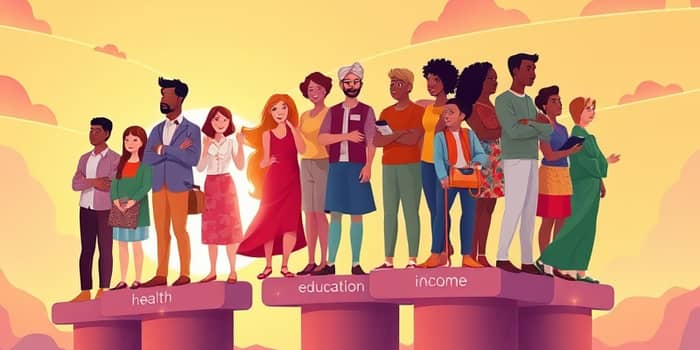
At its core, the HDI compiles three essential dimensions:
- Health: Measured by life expectancy at birth, reflecting long and healthy lives.
- Education: Assessed through mean years of schooling for adults and expected years for children.
- Income: Determined by gross national income per capita (PPP, log scale), capturing a decent standard of living.
Each dimension is normalized to a scale of 0 to 1 using fixed goalposts. This scoring system ensures that improvements in one aspect cannot fully compensate for deficiencies in another, thanks to the geometric mean reflects balance in the aggregation.
How the HDI Is Calculated
The calculation involves three steps: deriving individual dimension indices, aggregating them, and interpreting the composite score. Below is a concise breakdown of key formulas:
Finally, the HDI is the cube root of the product of these three indices: HDI = (Health × Education × Income)1/3. This approach ensures imperfect substitutability across dimensions, so high income cannot overshadow poor health or schooling.
Expanding the Conversation: Gender, Inequality, and Beyond
The HDI’s influence extends through specialized indices that highlight critical nuances:
- Gender Development Index (GDI): Compares female and male HDI values to expose gender disparities.
- Inequality-Adjusted HDI (IHDI): Penalizes uneven distribution of achievements within a country.
- Augmented HDI (AHDI): Incorporates a freedom or democracy dimension alongside the core three metrics.
These derivatives respond to valid critiques: that average scores hide subnational gaps, mask gender imbalances, and overlook individual agency. They remind us that true progress must be inclusive and fair.
From Data to Action: Using HDI for Change
Translating the HDI’s insights into real-world improvements requires collaboration and focus. Here are practical steps for communities, NGOs, and policymakers:
- Set Clear Targets: Use HDI data to identify lagging dimensions—perhaps focusing on boosting school retention or expanding primary healthcare access.
- Allocate Resources Strategically: Direct investments to underperforming regions, ensuring health clinics and schools reach rural or marginalized populations.
- Monitor Progress Visually: Develop community dashboards that display HDI trends over time, fostering accountability and local engagement.
By embracing a data-driven decisions for communities approach, stakeholders can pinpoint interventions, track outcomes, and celebrate milestones that lift lives.
Looking Ahead: The Future of Human Development
As global challenges evolve, so too must our metrics. Emerging discussions about sustainability, climate resilience, and subjective well-being hint at the next generation of development indices. Incorporating environmental pressures and personal happiness surveys could yield an even richer portrait of human progress.
Moreover, refining goalposts and expanding subnational data will empower local governments to adapt strategies that resonate with community priorities. When people see themselves reflected in the numbers, they become active architects of their own advancement.
Conclusion
The Human Development Index stands as a testament to humanity’s commitment to holistic growth. Its powerful framework transcends mere economic output by centering on what truly matters: health, knowledge, and dignity. As we navigate an era of rapid change, the HDI reminds us that development is not a race for wealth, but a shared journey toward richer, fuller lives.
By adopting the HDI and its complementary measures, societies can craft policies that uplift every individual, ensuring that no one is left behind in the pursuit of a brighter future.
References
- https://hdr.undp.org/data-center/human-development-index
- https://ourworldindata.org/human-development-index
- https://pmc.ncbi.nlm.nih.gov/articles/PMC6472489/
- https://www.nso.gov.vn/en/metadata/2019/10/explanation-of-terminology-content-and-methodology-of-some-statistical-indicators-on-living-standard/
- https://en.wikipedia.org/wiki/Human_Development_Index
- https://databank.worldbank.org/metadataglossary/africa-development-indicators/series/UNDP.HDI.XD
- https://ourworldindata.org/grapher/human-development-index
- https://gouldguides.carleton.edu/c.php?g=146949&p=3349784
- https://rpubs.com/mattcola/1045137
- https://hdr.undp.org/data-center