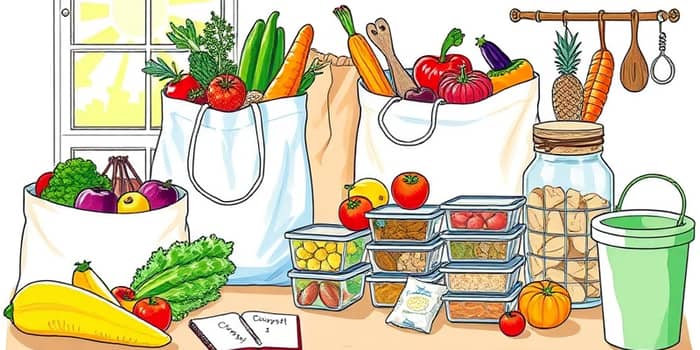
In 2025, Americans face record-high grocery bills while an alarming amount of food winds up in landfills. Yet, by combining smart shopping habits with simple steps toward waste reduction, households can reclaim hundreds of dollars annually and protect the planet. This guide will equip you with data-driven insights and practical tactics for meaningful impact.
The Rising Cost of Groceries in 2025
The American food landscape has never been more challenging. Supply chain disruptions, labor shortages, and climate-driven crop failures have converged to push grocery outlays to new heights. Understanding the current cost structure is the first step toward regaining control of your budget.
Today, the average American spends $235 per week on groceries—equivalent to more than $900 per month for a single individual. In larger households, economies of scale can lower per-person expenses, but total outlays for a family of four still approach $1,000 monthly under the USDA’s thrifty food plan. These numbers reflect a complex interplay of regional factors, from fuel and labor costs to local regulations and import fees.
Since 2020, grocery prices have risen over 27% in aggregate, with food-at-home inflation hovering around 2.4% year-over-year in mid-2025. Key contributors to this surge include a 27% jump in egg prices, a 10.6% increase for beef and veal, and climbing costs for non-alcoholic beverages. Faced with these trends, households must adapt strategies that deliver consistent relief rather than one-off savings.
These costs do not impact all households equally. In states like Mississippi, groceries consume nearly 2.64% of annual income for an average family—far above the national average. Conversely, residents in Midwestern regions often pay less than 2% of household earnings on food. Recognizing this disparity is crucial for tailoring strategies that work in your unique economic environment.
Food Waste: A Trillion-Dollar Drain
While consumers struggle to keep up with escalating food bills, an astonishing volume of edible items never reaches a table. Every year, an estimated 30-40% of the U.S. food supply goes uneaten, translating into over $200 billion in lost value. This crisis deepens economic pressure and accelerates environmental degradation.
More than 30-40% of the U.S. food supply is wasted annually, equivalent to 145 billion meals discarded. When we tally the carbon footprint, water usage, and farmland dedicated to these lost resources, the environmental toll becomes staggering: food production accounts for 13% of total U.S. carbon emissions, consumes a quarter of all freshwater, and utilizes 80 million acres of cropland.
Retailers are not immune. Each year, food retail businesses generate 16 billion pounds of surplus waste, often discarding perfectly edible products. Although 84% of grocery executives express a desire to donate more surplus, logistical challenges and inconsistent tracking systems impede meaningful progress. Consequently, much of the industry’s effort remains focused on downstream recycling and donation rather than prevention.
In response, the U.S. National Strategy aims to halve food waste by 2030 through four core objectives: preventing loss during production, reducing consumer and retail waste, boosting organic recycling, and implementing supportive policies. Success will depend on coordinated action across farms, manufacturers, retailers, and individual households.
State-by-State Cost Variations
Geographic factors heavily influence grocery budgets. Differences in climate, transportation logistics, and local economies can cause weekly costs to vary by over $100 between states.
Households in high-cost states, such as Hawaii and Alaska, contend with logistical hurdles that inflate prices, while residents of Wisconsin, Iowa, and Nebraska benefit from lower transportation and production expenses. Understanding your local context can help tailor savings strategies to regional opportunities.
Strategies to Save Money and Reduce Waste
According to industry surveys, 87% of shoppers have already begun experimenting with cost-saving approaches, employing an average of 3.9 different tactics per shopping trip. By layering these methods—such as combining digital coupons with bulk discounts and seasonal shopping—you can multiply savings and bolster your household’s resilience against future price hikes.
Adopting a strategic shopping approach empowers you to reclaim resources and cut food waste at the same time. Below are proven tactics that savvy consumers deploy to stretch every dollar and minimize landfill contributions.
- Choose store-brand or generic items, which can be up to 30% cheaper than national brands without sacrificing quality.
- Plan weekly menus and build a detailed shopping list to eliminate impulse buys and reduce waste.
- Buy seasonal produce in bulk when prices dip; then blanch and freeze extras for later use.
- Leverage loyalty programs, digital coupons, and cash-back apps to unlock unadvertised savings.
- Implement meal prepping and batch cooking to cut down on cooking time and snack cravings.
- Compare prices at discount and ethnic markets often have lower prices on staples.
- Use reusable bags and containers; some stores offer small incentives for eco-friendly practices.
- Consider a vegetarian meal or two per week—households that adopt plant-based dinners save an average of $130 per month.
Each of these steps not only cuts monthly grocery budgets significantly but also drives systemic change by reducing the demand for overproduction and excess inventory.
Building Sustainable Habits and Community Impact
Long-term success hinges on embedding waste-conscious habits into your daily routine. Small actions, when compounded over weeks and months, lead to substantial results for both your wallet and the planet.
Start by auditing your refrigerator and pantry. Track which items frequently expire before use and adjust shopping lists accordingly. Establish a “first in, first out” rotation system to ensure older products get used promptly. When leftovers accumulate, repurpose them into creative dishes—soups, casseroles, and stir-fries breathe new life into ingredients.
Integrating composting practices can transform unavoidable scraps into a valuable soil amendment. Even small-scale indoor compost bins accelerate the breakdown of fruit peels, coffee grounds, and vegetable leaves. This process closes the loop, returning nutrients to gardens or community green spaces instead of hauling them to landfills.
Share insights and resources with neighbors, friends, and local community groups. Coordinated bulk purchases, community composting programs, and recipe exchanges not only amplify individual effort but foster social connections around a common goal. In regions where food insecurity coincides with high waste levels, organized gleaning teams can harvest surplus produce from farms and gardens to support food banks.
By promoting conscious shopping behaviors—such as bulk purchasing and meal sharing—in your social circles, you create a ripple effect: others learn cost-saving recipes and waste prevention methods, reinforcing your own commitment.
On a personal level, challenge yourself to track weekly food spending and waste volume. Set incremental targets—reduce spending by 5% each month or cut weekly waste by half. Use simple journals or smartphone apps to log purchases, plan meals, and document leftovers. Over time, the data becomes a powerful motivator and a roadmap to continuous improvement.
Conclusion: Taking Action Today
The intersection of ballooning grocery costs and rampant food waste presents a unique opportunity. Every dollar you save through informed shopping directly combats the broader crisis of overproduction and environmental strain. Moreover, each meal you repurpose or ingredient you preserve diminishes the mountain of waste undermining our food system.
Now is the moment to act. Review your upcoming shopping list with fresh eyes. Experiment with a meatless meal. Challenge a friend to a waste-free week. Every effort counts and builds a collective force for change.
In 2025, you hold the power to transform grocery economics into a force for sustainability. By maximizing savings and minimizing waste, you benefit financially, you help your community, and you protect the planet—one mindful meal at a time.
References
- https://beehivemeals.com/blogs/trending-topics/how-much-do-groceries-really-cost-in-2025
- https://www.biologicaldiversity.org/programs/population_and_sustainability/grocery_waste/
- https://workmoney.org/money-tips/budget-101/how-much-should-you-spend-on-groceries-in-2025
- https://www.foodlogistics.com/sustainability/waste-reduction/article/22918098/wasteless-ai-the-food-waste-problem-in-the-grocery-retail-industry
- https://www.fidelity.com/learning-center/personal-finance/save-on-groceries
- https://www.fda.gov/food/consumers/food-loss-and-waste
- https://www.instacart.com/company/ideas/average-grocery-cost-per-month
- https://www.epa.gov/sustainable-management-food/united-states-2030-food-loss-and-waste-reduction-goal
- https://nielseniq.com/global/en/insights/education/2025/grocery-trends/
- https://www.usda.gov/about-food/food-safety/food-loss-and-waste/food-waste-faqs
- https://www.thepacker.com/news/retail/grocery-prices-rise-shoppers-change-their-habits
- https://refed.org/food-waste/the-problem/
- https://www.feedingamerica.org/our-work/reduce-food-waste
- https://pmc.ncbi.nlm.nih.gov/articles/PMC11241329/