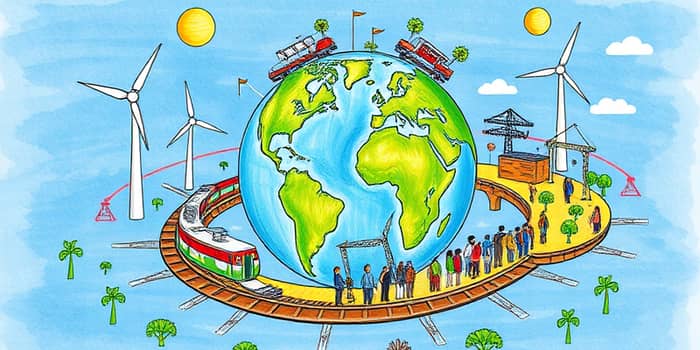
The European Union’s Global Gateway strategy stands as a beacon of hope for sustainable and equitable development across the world. Conceived as a direct response to emerging global challenges, it offers a comprehensive framework for building resilient infrastructure and deepening international cooperation. By extending the principles of the European Green Deal beyond EU borders, Global Gateway fosters a new era of high-quality, sustainable connectivity that benefits both partner countries and Europe itself.
As geopolitical shifts and climate urgencies reshape the global landscape, the Global Gateway initiative invites stakeholders to reimagine partnership. It encourages civil society, private investors, and governments to embrace a values-driven model that prioritizes transparency, human rights, and environmental stewardship. The following exploration delves into its origins, core aims, financing structures, and the real-world impact it seeks to achieve.
Background and Launch
When President Ursula von der Leyen first introduced Global Gateway in December 2021, she framed it as a European Green Deal Worldwide. This ambitious policy builds on the EU’s internal sustainability agenda, transforming it into an outward-facing strategy for global good. From the outset, it set out to bridge the infrastructure investment gap estimated at trillions of euros, while also bolstering economic resilience in a post-pandemic world.
The initiative quickly gained momentum. By mid-2022, the European Commission, in tandem with the European Investment Bank and national development agencies, had established the Global Gateway Investment Hub. This platform coordinates efforts across at least 30 partner nations, ranging from African states to Western Balkans, Ukraine, and parts of Asia and Latin America. It embodies the Team Europe approach to public-private cooperation, channeling grants, loans, and technical assistance into transformative projects.
Core Objectives and Rationale
Global Gateway pursues a dual ambition for growth and autonomy. It aims to safeguard EU strategic interests while empowering partner countries to achieve durable prosperity without falling into debt traps. At its heart, the initiative counters alternative models like China’s Belt and Road Initiative by emphasizing rule of law, civil liberties, and rigorous environmental safeguards.
- Mobilize investments for sustainable development and strategic autonomy
- Promote mutually beneficial partnerships with transparent governance
- Support UN Agenda 2030 and Paris Agreement climate targets
- Enhance trade, health, education, and research systems worldwide
These pillars reflect a broader ambition: to catalyze a green and digital transition that strengthens supply chains, nurtures innovation, and builds resilience against future shocks. By aligning with G7 commitments and leveraging EU global leadership, Global Gateway positions itself as a constructive force for inclusive growth.
Funding and Mobilization Targets
From its launch through 2027, Global Gateway set out to mobilize €300 billion in investments. By October 2025, it had already surpassed this goal, achieving €306 billion and prompting an ambitious new target of €400 billion by 2027. Nearly half of the funding—€150 billion—focuses on Africa, channeled through the Africa–Europe Investment Package to drive green and digital projects alongside health and education enhancements.
Financing instruments combine EU budget grants, loans from the European Investment Bank and EBRD, contributions by member states, and guarantees from export credit agencies. This 360-degree integration of resources ensures that projects are bankable, sustainable, and shielded from undue fiscal risk.
Priority Sectors and Areas
Building on its multifaceted objectives, Global Gateway invests in six critical sectors that underpin modern economies and societal well-being. Each sector is chosen to maximize developmental impact and align with partner countries’ priorities.
- Digital connectivity: subsea cables, secure internet networks, and telecom expansion
- Climate and energy: renewables, smart grids, raw materials for green technologies
- Transport: green corridors, ports, railways, and road network upgrades
- Health systems: local vaccine production, resilient supply chains, facility modernization
- Education and research: accessible quality learning for girls, women, and vulnerable groups
By focusing on these areas, the initiative not only supports immediate infrastructure needs but also lays the groundwork for long-term innovation and social progress.
Partnerships and Strategic Alliances
The success of Global Gateway hinges on collaboration at all levels. Internally, EU institutions work alongside national governments, development banks, and civil society under the umbrella of the Team Europe approach. Externally, the initiative aligns with complementary programs such as the US-led Build Back Better World, now PGII, and G7 infrastructure commitments.
- Team Europe: coordinated action between EU, member states, DFIs, and private sector
- US PGII alignment: reinforcing shared values and funding synergies
- G7 infrastructure partnership: pooling billions for quality investments
This networked model amplifies impact, reduces duplication, and ensures that projects reflect both European expertise and local ownership.
Strategic Context and Challenges
Global Gateway emerges against a backdrop of shifting power dynamics and urgent climate imperatives. It seeks to reduce dependency on fractured supply chains exposed by the COVID-19 pandemic and geopolitical tensions exacerbated by the war in Ukraine. Yet implementing a geopolitically informed development agenda brings trade-offs.
Civil society groups question whether the initiative genuinely prioritizes poverty alleviation and inequality reduction or merely repackages existing aid commitments. In regions where sovereign debt distress affects over half of low-income countries, prudent financial management and safeguards against overindebtedness are essential. The Commission’s emphasis on grants combined with concessional loans aims to mitigate these risks.
Looking Forward: Impact and Future Directions
As Global Gateway moves toward its 2027 milestone, its true success will be measured by the quality of partnerships and tangible improvements in people’s lives. From providing reliable electricity in rural communities to expanding digital classrooms for girls, the impact stories are beginning to emerge. Ursula von der Leyen’s vision of a "template for resilient connections" is taking shape in ports, power stations, and research labs around the world.
Looking ahead, it will be essential to maintain a balance between geostrategic interests and genuine development outcomes. Increased engagement with local stakeholders, transparent evaluation mechanisms, and continued support for civil society will ensure that the initiative remains both values-driven and people-centered. In doing so, Global Gateway can set a new standard for how regions collaborate—with respect, fairness, and a shared commitment to a greener future.
References
- https://en.wikipedia.org/wiki/Global_Gateway
- https://feps-europe.eu/the-global-gateway-in-context/
- https://international-partnerships.ec.europa.eu/policies/global-gateway/global-gateway-overview_en
- https://europeandemocracyhub.epd.eu/global-gateways-moment-of-truth/
- https://www.diplomatie.gouv.fr/en/french-foreign-policy/development-assistance/events-and-news/2023/article/what-is-the-european-global-gateway-strategy
- https://concordeurope.org/2025/09/16/understanding-the-eus-global-gateway-why-civil-society-must-pay-attention/
- https://www.eib.org/en/stories/global-gateway-investment-developing-countries-climate-change
- https://www.eurodad.org/who_profits_from_the_global_gateway_the_eu_s_new_strategy_for_development_cooperation
- https://commission.europa.eu/topics/international-partnerships/global-gateway_en