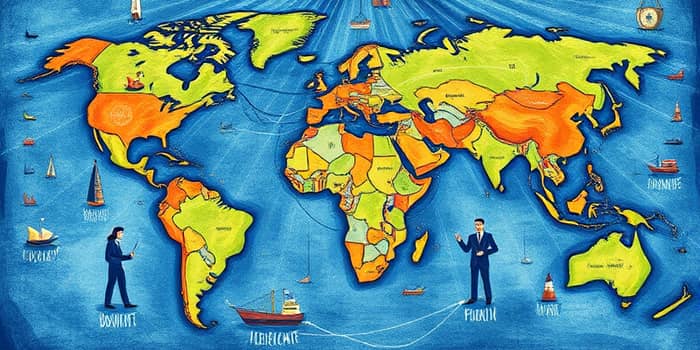
In a world marked by rapid shifts and evolving alliances, understanding the intricate web of global economic forces is more important than ever. By connecting the dots of world markets, we gain insight into not only challenges but also the pathways to collective prosperity.
This comprehensive overview will inspire stakeholders—policymakers, business leaders, and citizens—to embrace informed strategies that foster resilience, inclusion, and long-term growth.
Global Growth in Transition
The global economy is exhibiting a subtle deceleration, with GDP growth easing from 3.3% in 2024 to a projected 3.2% in 2025, and further to 3.1% in 2026. While some institutions forecast modest rebounds, others anticipate continued moderation, reflecting heightened trade policy uncertainty and shifting geopolitical landscapes.
This diversity of forecasts underscores the importance of adaptability and vigilance. By acknowledging geopolitical tensions are reshaping markets, stakeholders can craft policies and strategies that anticipate both headwinds and tailwinds.
Regional Divergence and Opportunities
Behind global averages lie diverse regional growth trajectories. Advanced economies grapple with subdued expansion, while emerging markets continue to outpace peers.
The United States is projected to grow just above 2% in 2025, navigating government funding uncertainties and persistent inflationary pressures. In Europe, the eurozone’s GDP is expected to range between 0.9% and 1.4%, with Germany’s recovery a key driver of optimism. Meanwhile, Asia displays pronounced contrasts: China’s growth hovers near 5%, supported by domestic consumption and a pro-growth policy environment, while India maintains robust momentum above 6%.
Smaller economies like Malta achieve standout figures near 6%, and regions such as the Middle East and Central Asia see renewed vigor thanks to infrastructure investments and energy market dynamics. Each region’s performance offers lessons in specialization, policy calibration, and the value of strong governance.
The Pulse of Global Trade
Trade remains the lifeblood of economic integration. Despite volatility from tariffs and geopolitical rifts, global trade expanded by roughly $500 billion in the first half of 2025. Goods trade grew by 2.5% quarter-on-quarter, while services rebounded to nearly 4% growth in Q3.
Manufacturing, especially electronics and electric vehicles, spearheaded this momentum, highlighting emerging markets driving expansion. Exports from advanced economies increased by 10% annually through July 2025, though a momentary contraction in August underscores the need for diverse supply chains and agile logistics.
Navigating Uncertainty: Strategies for Resilience
In a climate of persistent risk, deliberate action is paramount. By adopting a practical road map for resilience, organizations and nations can weather disruptions and seize emerging prospects.
- Enhance supply chain flexibility through multiple sourcing and nearshoring.
- Invest in digital infrastructure to boost productivity and market access.
- Promote workforce upskilling, focusing on green and digital competencies.
- Foster public-private partnerships for sustainable development projects.
- Strengthen fiscal buffers and contingency planning for external shocks.
These measures empower stakeholders to transform uncertainty into opportunity, ensuring that economies remain dynamic and inclusive.
Embracing Collaboration to Bridge Imbalances
Global imbalances in goods trade narrowed in mid-2025 as shifting policies in major economies took effect. China’s surplus with the United States receded, and the European Union saw its trade cushion shrink. At the same time, deficits widened in Japan, India, and the United Kingdom.
Such fluctuations remind us that competition and cooperation must coexist. By upholding unwavering commitment to global cooperation, international bodies and governments can negotiate fair tariffs, harmonize standards, and construct frameworks that balance national interests with collective welfare.
Forecasting Stability in a Dynamic Era
Inflation is trending downward globally—expected to reach 4.2% in 2025 and 3.6% in 2026—yet major economies like the United States retain above-target pressures. Central banks are signaling gradual easing, but ambiguities around trade policies and technological disruption remain.
Policymakers must weigh growth, price stability, and social objectives with nuance. Embedding climate goals, digital regulations, and inclusive labor policies within monetary frameworks can mitigate sustainable economic strategies for tomorrow.
- Prolonged policy uncertainty and tariff escalations.
- Geopolitical conflicts disrupting energy and food supplies.
- Labor market mismatches amid automation and demographic shifts.
- Fiscal vulnerabilities and potential financial corrections.
- Erosion of institutional trust and global cooperation.
Conclusion
The narrative of global economics is one of interconnection, challenge, and promise. By understanding trends—from regional growth disparities to trade oscillations—and deploying targeted strategies, we can chart a course toward shared prosperity.
Through resilience built on informed collaboration, stakeholders at every level can not only anticipate change but also drive transformative outcomes. Let this synthesis of data and insight inspire action: a future where markets, communities, and people thrive together.
References
- https://www.pwc.com/mt/en/publications/economic-outlook/2025-q2.html
- https://unctad.org/publication/global-trade-update-october-2025-global-trade-remains-strong-despite-policy-changes-and
- https://www.mckinsey.com/capabilities/strategy-and-corporate-finance/our-insights/global-economics-intelligence
- https://data.imf.org/en/news/imf%20data%20brief%20november%2012
- https://www.imf.org/en/publications/weo/issues/2025/10/14/world-economic-outlook-october-2025
- https://www.hinrichfoundation.com/research/how-to-use-it/global-trade-outlook-and-statistics-update-october-2025
- https://www.oecd.org/en/publications/oecd-economic-outlook-interim-report-september-2025_67b10c01-en.html
- https://ec.europa.eu/eurostat/statistics-explained/index.php/EU_international_trade_in_goods_-_latest_developments
- https://www.oecd.org/en/data/insights/statistical-releases/2025/11/international-trade-statistics-trends-in-third-quarter-2025.html
- https://www.spglobal.com/market-intelligence/en/news-insights/research/2025/11/global-economic-outlook-november-2025
- https://www.istat.it/en/press-release/foreign-trade-and-import-prices-july-2025/
- https://www.oxfordeconomics.com/key-themes-2025/
- https://www.istat.it/en/press-release/foreign-trade-and-import-prices-september-2025/
- https://www.worldbank.org/en/publication/global-economic-prospects
- https://www.imf.org/en/publications/weo