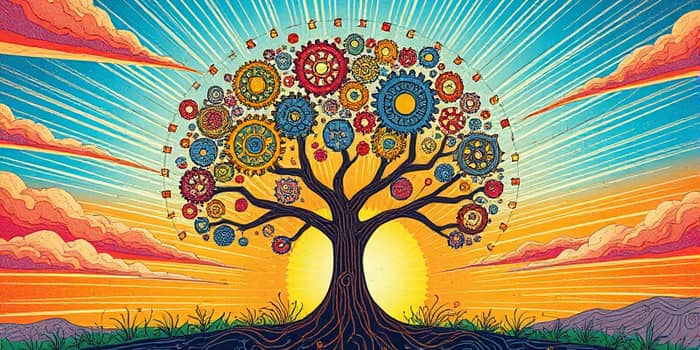
For centuries, thinkers warned of a stationary state, where diminishing returns would trap societies in scarcity. Yet history tells a different story: one of breakthroughs, human ingenuity, and a journey toward abundance. By directing innovation toward scarce resources, economies have repeatedly overcome diminishing returns through innovation and unlocked new realms of possibility.
The Journey from Scarcity to Abundance
Classical economists, from Ricardo to Malthus, envisioned limits to growth—land, labor, and capital would face diminishing yields. In the mid-20th century, Robert Solow and Trevor Swan upended that view. They demonstrated that technological progress drives sustained growth, not mere capital accumulation. Suddenly, innovation became the catalyst turning scarcity into abundance.
Endogenous growth theories later formalized this insight. Paul Romer celebrated ideas as nonrival goods; Lucas emphasized human capital accumulation. Together, they illustrated how knowledge nurtures itself, creating a perpetual engine of prosperity.
Directed Technological Change: Theories Unfolded
The concept of directed change explains how innovators respond to economic signals—channeling ingenuity toward costly inputs or expanding markets. Key contributors include:
- Hicks (1932): Defined _induced_ inventions responding to relative factor price shifts.
- Acemoglu (1998, 2002): Showed how labor supply changes directed skill-biased or labor-saving technologies.
- Allen (2011): Highlighted Britain’s high wages and cheap energy as drivers of labor-saving steam power.
This framework unites diverse episodes, revealing a pattern: when a factor becomes expensive or a market swells, innovation flows in that direction.
Lessons from History: Shaping the Modern Economy
Between 1850 and 2015, the U.S. labor market transformed dramatically. Jobs rose, fell, and rose again as productivity gains translated into new demand. Railroads spawned engineers and conductors; as locomotive costs dropped, passenger travel exploded. Automobiles birthed a million-plus mechanics at their peak. Meanwhile, agricultural labor shrank from the majority to a small fraction, freeing millions for manufacturing and services.
These shifts illustrate economize on scarce factors in action: high farm labor costs triggered labor-saving machinery, which lowered food prices and expanded purchasing power for other goods.
Mechanisms of Change: Productivity, Demand, and Jobs
How does technology generate employment rather than destroy it? The process unfolds in three key steps:
- Productivity gains increase output without proportional labor input.
- Lower prices and higher wages boost purchasing power.
- Rising demand for goods and services fuels job creation in expanding sectors.
Moreover, complementary innovations amplify these effects. Automated teller machines didn’t merely replace bank tellers; they enabled higher-value customer interactions, spurring branch expansions and new financial services roles.
Global Impact: Beyond Economics
Technological progress has lifted billions out of poverty. Agricultural innovations doubled and tripled crop yields, halving undernourishment rates in developing nations. Medical breakthroughs slashed child mortality and extended life expectancy worldwide.
Since 1870, the combination of sanitation, vaccines, electricity, and telecommunications has transformed living standards across continents. No longer confined by local constraints, humanity taps into a shared pool of ideas, collaborating on challenges from climate change to renewable energy.
Dispelling Myths and Embracing Potential
Technological advancement often provokes anxiety. The Luddites feared mechanization; today, fears center on automation wiping out middle-class jobs. Yet history shows persistent growth in new occupations and industries, even amid seismic shifts.
- Job wipeout predictions rarely materialize.
- Churn remains the engine of renewal.
- Policy choices shape outcomes.
By understanding these patterns, societies can craft education, training, and social safety nets that harness innovation’s benefits while mitigating transitional hardships.
Charting the Future: Challenges and Opportunities
Despite the triumphs of past centuries, challenges remain. Climate change demands directed innovation toward sustainability. Inequality gaps highlight uneven access to education and capital. Productivity growth in advanced economies has slowed, pointing to the need for fresh breakthroughs in energy, materials, and digital infrastructure.
Yet the same forces that fueled the Industrial Revolution and the information age are at work today. With strategic investments and inclusive policies, we can steer innovation toward global well-being. By embracing the principles of directed change, we ensure that tomorrow’s inventions address the scarcest resources—be they clean water, carbon-free energy, or equitable opportunity.
From scarcity to abundance, the arc of progress bends toward imagination, collaboration, and purpose. The next chapter awaits our collective ingenuity.
References
- https://academic.oup.com/oxrep/article/41/2/313/8300927
- https://ourworldindata.org/technological-change
- https://www.gabelliconnect.com/featured-news/how-the-20th-century-tech-boom-left-us-rich-uncertain/
- https://www.aeaweb.org/articles?id=10.1257%2Fjep.29.3.31
- https://researchfdi.com/how-technology-is-changing-the-landscape-of-economic-development/