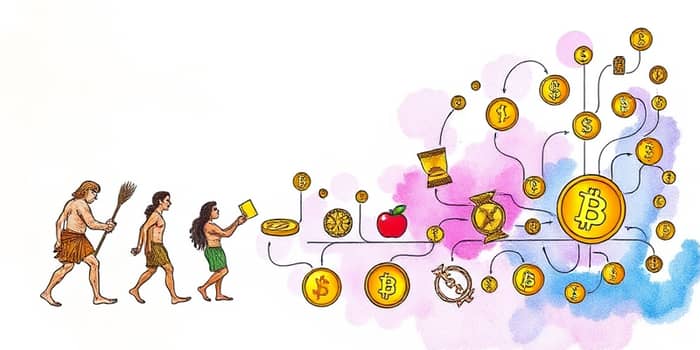
Human exchange has journeyed from primitive barter to digital currencies, shaping economies and societies through millennia.
This evolution reflects our ingenuity in overcoming trade barriers and building trust across distances.
The story begins with ancient tribes seeking ways to facilitate mutual benefit in early economies.
It spans continents and eras, culminating in today's global financial networks.
Understanding this history offers insight into modern finance and inspires future innovations.
The Dawn of Barter: From Mesopotamia to Early Trade
Around 6000 to 4000 BCE, barter emerged as the first exchange method.
Mesopotamian tribes traded goods like wool, animal skins, and wheat directly.
This system required a double coincidence of wants, limiting efficiency and portability.
Sumerians used clay tokens to record transactions along the Tigris and Euphrates rivers.
Despite its simplicity, barter laid the groundwork for more complex systems.
- Goods commonly bartered included salt, spices, and weapons.
- It was introduced to Phoenicians and spread through early networks.
- The lack of a universal medium made long-distance trade challenging.
Commodity Money and the Birth of Coins
By the 7th to 6th century BCE, commodities like gold and silver became proxies.
These materials were valued for their durability and rarity across regions.
The first gold coins created in Mesopotamia marked a significant leap.
They standardized value, making trade more portable and efficient.
Ancient Egypt and other civilizations expanded trade routes using these innovations.
- Salt and spices were bartered in early foreign exchanges.
- Gold was less dense but still heavy, prompting further evolution.
- This era saw the rise of early banking concepts in trade hubs.
Medieval Innovations: Paper and Banking Systems
From the 12th to 15th centuries, paper money and bills of exchange emerged.
The Song Dynasty in China issued the first official paper money in the 1020s.
This innovation reduced the need for bulky metal coins in large transactions.
In Europe, tally sticks and checks facilitated credit and commerce expansion.
The Islamic Golden Age contributed with networks from Spain to China.
- Bills of exchange allowed promises of future payment in Italian trade.
- Pawnbrokers and money-changers became key professions in medieval economies.
- Colonial eras introduced hub-and-spoke trade models benefiting European powers.
The Gold Standard and Global Systems
In 1875, an informal gold standard ended the silver and gold double standard.
Major economies pegged currencies to fixed gold amounts, stabilizing exchange rates.
This system was adopted by England in 1819 and the US in 1834.
It provided a stable framework for international trade until World War I.
The Bretton Woods Conference in 1944 established a new global order.
Fiat Currencies and the Digital Shift
The Nixon Shock in 1971 ended USD-gold convertibility, leading to floating rates.
This allowed currencies to fluctuate based on market forces, increasing flexibility.
Forex daily volume today is approximately $6.6 trillion in trades, showing immense growth.
Technological advances in the 1980s and 1990s, like online trading, revolutionized finance.
PayPal and other digital platforms secured online payments, boosting e-commerce.
- The Jamaica Agreement in 1976 formalized floating exchange rates globally.
- CLS Bank reduced funding needs to 2% of gross settlements, enhancing efficiency.
- Amazon and eBay reached 1 million sales by 1997, fueling digital adoption.
Cryptocurrencies: The Modern Frontier
Bitcoin launched in 2009 as a decentralized digital currency using blockchain technology.
It bypasses central banks and fiat systems, offering peer-to-peer electronic cash.
This innovation solves trust issues in digital exchanges with cryptography.
It represents a shift from government-backed currencies to open, global networks.
The evolution continues with new cryptocurrencies and financial technologies.
- Bitcoin's whitepaper introduced a proof-of-work consensus mechanism.
- It enables secure transactions without intermediaries, reducing costs.
- This era highlights the ongoing quest for financial inclusivity and innovation.
Conclusion: Reflecting on the Journey
From barter to Bitcoin, exchange systems have continuously adapted to human needs.
Each era introduced solutions to challenges, from portability to trust.
The global interconnectedness of modern finance stems from centuries of progress.
This history inspires us to embrace change and seek better ways to trade.
As we look ahead, the evolution of exchange will likely involve further digitalization.
Understanding our past helps navigate the complexities of future economies.
Let this journey remind us of the power of innovation in shaping our world.
The story is far from over, with new chapters waiting to be written.
References
- https://www.ig.com/au/ig-academy/a-beginners-guide-to-forex-trading/the-history-of-forex
- https://study.com/academy/lesson/history-of-trade-origin-timeline-evolution.html
- https://community.thriveglobal.com/timeline-of-money-from-ancient-to-modern/
- https://www.worldfinance.com/markets/a-history-of-foreign-exchange
- https://www.chicagofed.org/publications/chicago-fed-letter/2006/february-223
- https://www.creditkarma.com/money/i/history-of-money
- https://en.wikipedia.org/wiki/History_of_money
- https://www.aafes.com/TimeLine/