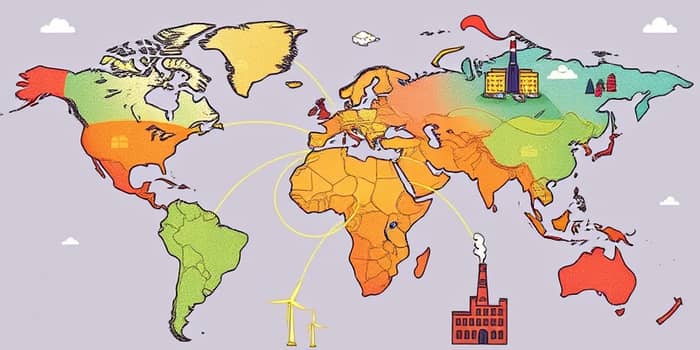
As economies around the globe seek recovery and growth, the flow of capital across borders has never been more pivotal. Global foreign direct investment rose 14% in 2025, reaching $1.6 trillion—a testament to both opportunity and fragility in today’s markets. From bustling financial centres to local communities, FDI shapes industries, drives innovation, and fuels sustainable development. This article explores how investors, policymakers, and local stakeholders can harness these trends to create lasting impact.
The Global FDI Landscape
In 2025, developed economies captured the lion’s share of investment, with inflows into OECD countries up 21% in the first nine months alone. The European Union recorded a 56% surge, powered by landmark cross-border acquisitions in Germany, France, and Italy. Meanwhile, the United States, having accumulated $5.7 trillion in inward capital by the end of 2024, accounted for 31% of the world’s FDI stock, up from 26% two decades earlier. Yet beneath these headline figures lies a more complex narrative: fleeting financial centre activity versus real, on-the-ground projects.
Investors must read beyond top-line growth. The underlying expansion remains fragile, hinging on geopolitical shifts, regulatory climates, and sectoral dynamics. Recognizing which capital flows translate into tangible infrastructure and job creation is essential for crafting resilient strategies.
Sector-Specific Opportunities and Risks
Data centres and megaprojects stand out as focal points. Announced capital investments in the U.S. for data centres, semiconductors, and renewable energy were 11% higher in early 2025 than the full prior year. Meanwhile, military technology FDI projects grew 29% from 2023 to 2024, with forecasts pointing to a further 33% rise—driven by the U.S., Germany, France, and the U.K.
Renewable energy, after a lull in 2025, is poised for revival as nations recommit to climate goals. Conversely, traditional sectors like coal, oil & gas, and automotive manufacturing face ongoing headwinds, with volumes expected to stay subdued through 2026.
Regional Patterns and Strategic Shifts
The United States continues to lead inbound FDI, recording a record 2,259 projects in 2024. However, project announcements between June and September 2025 declined 26%, and total capital investment dropped 18% year-on-year. Simultaneously, U.S. outbound FDI has softened, with volumes down 20% compared to 2019.
Western Europe, long a favourite destination, is experiencing a multi-year decline in project activity. Its global share of FDI has shrunk from 33% in 2004 to 23% in 2024. By contrast, Canada is emerging as a magnet for cross-border capital, attracting investment from the U.K., France, Switzerland, India, and China.
Driving Innovation and Job Creation
Foreign affiliates employ 5.3 million U.S. workers—4.6% of all private-sector employment—and support nearly eight million jobs when indirect effects are counted. Thirty percent of these jobs are in manufacturing, representing 12% of the nation’s total manufacturing workforce, while 60% stem from the service sector.
On the innovation front, foreign companies spent over $34 billion on R&D and $160 billion on plants and equipment in 2006. Today, reinvested earnings exceed $200 billion, nearly 70% of total inward FDI, underscoring the importance of concentrated economic growth around the location of strategic projects.
Local Impact and Sustainable Growth
FDI’s power extends beyond headline totals; it reshapes local landscapes. A one-standard-deviation increase in FDI correlates with an 11% rise in regional light emissions—an indicator of economic activity—in the first year after project completion. Yet this growth often deepens inter-regional inequality, benefiting areas within close proximity to investment while leaving remote regions behind.
In authoritarian regimes, both growth and inequality effects are amplified. Conversely, democracies with free and fair elections and robust judicial access unlock more balanced gains, as accountability and access to justice enhance multiplier effects. For communities, this means that policy frameworks and civic institutions matter as much as capital size.
Practical Strategies for Stakeholders
Whether you are an investor seeking stable returns, a policymaker aiming for inclusive growth, or a community leader nurturing local enterprise, understanding these dynamics is essential. Consider the following actionable steps:
- Map strategic sectors: Identify industries—such as data centres, renewable energy, or advanced manufacturing—where megaprojects are concentrated and align with national priorities.
- Engage with local institutions: Partner with civic bodies and legal experts to ensure projects deliver shared benefits and uphold equity.
- Leverage reinvestment: Encourage foreign affiliates to channel earnings into local R&D, training programs, and community infrastructure.
Communities can amplify benefits by building networks of suppliers, fostering skills development, and promoting small-firm participation in global value chains.
- Foster regional clusters: Develop industry parks and innovation hubs that aggregate suppliers, researchers, and service providers around anchor investments.
- Invest in human capital: Create vocational training and STEM programs tailored to the needs of incoming investment projects.
- Monitor inequality: Track economic indicators at the sub-national level to identify gaps and tailor local development funds accordingly.
Looking Ahead: The Next Decade of FDI
Short-term headwinds may temper project volumes through 2025, with forecasts projecting a 4–8.5% decline. Yet the long-term outlook remains promising. Megaprojects will continue to uplift capital investment, and as countries intensify efforts to meet 2030 climate and industrial targets, inbound FDI—especially in green technologies—will accelerate. The United States and Europe are poised to lead, backed by industrial strategies and transition funding. Asia’s role as a major capital exporter will strengthen, with China, India, Japan, and South Korea at the forefront.
By embracing strategic alignment, institutional rigor, and inclusive frameworks, stakeholders can transform raw capital into sustainable prosperity. Whether you’re an entrepreneur, policymaker, or citizen, these global capital flows hold the potential to generate innovation, jobs, and resilient communities in the years ahead.
References
- https://unctad.org/publication/global-investment-trends-monitor-no-50
- https://academic.oup.com/isq/article/69/2/sqaf025/8113129
- https://www.ftlocations.com/knowledge-hub/blog/FDI-data-trends-of-2025
- https://legacy.trade.gov/investamerica/impacts.asp
- https://globalbusiness.org/foreign-direct-investment-in-the-united-states-2025/
- https://camoinassociates.com/resources/us-fdi-trends-report/
- https://www.congress.gov/crs-product/IF10636
- https://www.oecd.org/en/topics/foreign-direct-investment-fdi.html
- https://www.kearney.com/service/global-business-policy-council/foreign-direct-investment-confidence-index
- https://www.imf.org/external/pubs/ft/fandd/2001/06/loungani.htm
- https://www.bea.gov/news/2026/us-international-investment-position-3rd-quarter-2025
- https://data.worldbank.org/indicator/BX.KLT.DINV.CD.WD