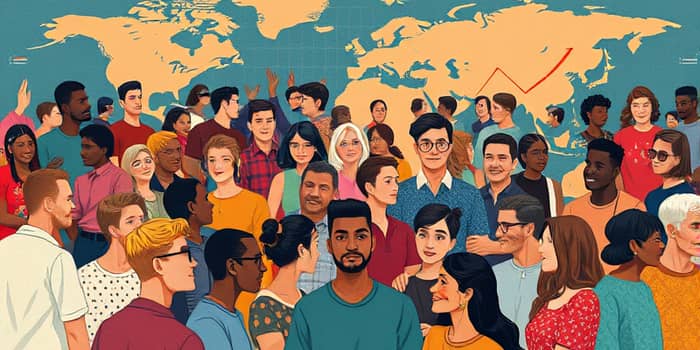
The past half-century has witnessed profound changes in human populations—aging societies, declining birth rates, and mass movements of people across borders. These trends are not abstract statistics: they shape growth, wages, and global influence. By examining key projections and policy scenarios, we can chart a course toward inclusive prosperity.
The Global Economic Landscape
Between 1975 and 2000, demographic change drove over 56% of GDP growth. Today, that contribution is estimated at just 9%. Regions once powered by expanding workforces now face dramatic shifts in economic activity. Eastern Asia and Europe are poised for slower or negative growth as populations age, while parts of Africa and Western Asia may see vibrant expansion.
Population declines will reshape trade balances, capital flows, and geopolitical influence. Younger, growing workforces attract investment, while aging societies contend with rising dependency ratios and pension costs. Countries that adapt policy—investing in skills, welcoming newcomers, and boosting productivity—will lead the next wave of prosperity.
Immigration and Labor Force Dynamics
In the United States, immigrants comprised 18.6% of the labor force in 2023, and projections indicate that immigration will account for essentially all population growth between 2025 and 2035. Without newcomers, the working-age population would stagnate or decline, challenging social safety nets and slowing GDP.
Unauthorized immigration also plays a role: a reduction in inflows is projected to subtract 0.8 percentage points from GDP growth in 2025. Yet, evidence suggests net gains from legal migration outweigh short-term fluctuations, with immigrants contributing disproportionately to entrepreneurship and critical sectors:
- 23.6% of U.S. entrepreneurs are foreign-born
- 23.6% of STEM workers bring diverse expertise
- 15.9% of nursing staff help sustain health systems
As the native-born workforce contracts, policy-makers must weigh border controls against labour market resilience. Facilitating legal pathways can bolster growth while maintaining sovereignty and social cohesion.
Scenario Analysis of GDP Projections
Different immigration and deportation policies yield starkly varied outcomes for GDP growth. The Congressional Budget Office (CBO) baseline forecast calls for 1.83% annual growth from 2025 to 2035. Halving net immigration lowers that to 1.63%, and eliminating it drops growth to 1.47%.
This analysis underscores how policy choices ripple through growth, inflation, and labour dynamics. Even modest deportation increases can shave nearly a percentage point off growth—equivalent to hundreds of billions of dollars of lost output.
Demographic Shifts and Economic Consequences
Worldwide fertility declines are driving many nations toward population peaks followed by contraction. Two-thirds of humanity live in countries where populations will shrink this century. In the U.S., the population is projected to grow from 350 million in 2025 to 372 million in 2055, even as the median age climbs.
An older society brings new challenges:
- Rising dependency ratios pressure pension and healthcare systems.
- Labour shortages may push wages higher, benefiting workers but straining employers.
- Innovations in automation and remote work become ever more critical to sustaining productivity.
At a global level, regions with expanding workforces—sub-Saharan Africa, parts of Western Asia—could become engines of growth. Investment in education and infrastructure there not only benefits local populations but rebalances global economic power.
Policy Implications and Future Outlook
Navigating demographic transitions demands a blend of openness and strategic investment. Below are key policy levers:
- Encourage legal immigration pathways tied to labor demands.
- Invest in lifelong learning to adapt to changing skill needs.
- Promote family-friendly policies to support fertility rates sustainably.
- Leverage technology—automation, AI, remote work—to mitigate shortages.
Coordinating social safety nets with labour market flexibility can ease the burden of an aging populace. Robust immigration channels help sustain growth, while targeted training ensures new and existing workers contribute effectively.
Ultimately, demographic outcomes are not fate but choice. Societies that embrace change, harness human capital, and invest in resilience will thrive. As populations shift, so too must our policies, institutions, and vision for shared prosperity.
Conclusion
Population shifts—aging populations, changing fertility, and migration—are at the heart of economic transformation. While some regions face decline, others stand poised for growth. By aligning immigration, innovation, and inclusion strategies, policymakers can turn demographic challenges into lasting opportunities.
Embracing diversity, investing in people, and fostering adaptability will ensure that demographics and dollars align to create a future of shared prosperity and dynamic progress.
References
- https://population-europe.eu/research/policy-insights/population-change-and-economy-results-global-comparative-project
- https://www.dallasfed.org/research/economics/2025/0708
- https://www.epi.org/publication/the-u-s-born-labor-force-will-shrink-over-the-next-decade-achieving-historically-normal-gdp-growth-rates-will-be-impossible-unless-immigration-flows-are-sustained/
- https://www.oecd.org/en/topics/sub-issues/economic-impact-of-migration.html
- https://blogs.worldbank.org/en/developmenttalk/what-do-demographic-changes-mean-for-labor-supply-
- https://cmsny.org/importance-of-immigrant-labor-to-us-economy/
- https://www.dallasfed.org/research/economics/2025/0107
- http://www.ers.usda.gov/topics/rural-economy-population/population-migration
- https://www.imf.org/en/publications/fandd/issues/2020/03/changing-demographics-and-economic-growth-bloom
- https://www.cbo.gov/publication/60569
- https://www.weforum.org/stories/2024/10/demographic-shifts-ageing-population-economic-growth/
- https://www.pewresearch.org/short-reads/2025/08/21/key-findings-about-us-immigrants/
- https://www.mckinsey.com/mgi/our-research/dependency-and-depopulation-confronting-the-consequences-of-a-new-demographic-reality
- https://www.epi.org/publication/immigrants-and-the-economy/
- https://www.cbo.gov/publication/60875
- https://www.fwd.us/news/immigration-facts-the-positive-economic-impact-of-immigration/
- https://www.dni.gov/index.php/gt2040-home/gt2040-structural-forces/demographics-and-human-development
- https://map.americanimmigrationcouncil.org/locations/national/
- https://pmc.ncbi.nlm.nih.gov/articles/PMC8393076/