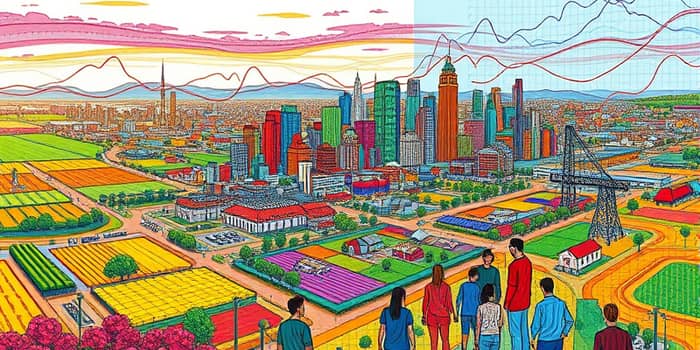
Gross Domestic Product, or GDP, is more than an economic statistic—it's a reflection of a nation's aspirations, struggles, and achievements. By exploring GDP, we uncover the story of progress that shapes our daily lives and collective destiny.
Understanding the Essence of GDP
At its core, GDP is a monetary measure of economic output that captures the total market value of all final goods and services produced within a country's borders over a given period. It guides policymakers and businesses as they navigate complexities and strategize for the future.
The roots of GDP trace back to the visionary work of John Maynard Keynes in 1939, who sought to quantify a nation's productive capacity during times of crisis. His pioneering efforts laid the foundation for modern macroeconomics and our continued quest to measure prosperity.
The Importance of GDP in Today’s World
From boardrooms to classrooms, GDP serves as the primary indicator of macroeconomic performance. When GDP grows steadily, opportunities rise—employment climbs, businesses expand, and communities thrive. Conversely, a contraction in GDP can signal the need for swift policy intervention and collective resilience.
- Economic Forecasting: Businesses adjust strategies based on GDP trends.
- Policy Design: Governments craft fiscal and monetary measures.
- Global Benchmarking: Nations compare progress and competitiveness.
By interpreting GDP, we gain insights into the health of labor markets, the vibrancy of consumer demand, and the efficacy of public investments—all vital to sustaining progress.
How Economists Calculate GDP
GDP can be determined in three complementary ways, each offering a unique perspective on economic activity.
- Production Approach: Sums the value added at each production stage, ensuring only final outputs are counted.
- Income Approach: Totals wages, rents, interest, and profits earned by factors of production.
- Expenditure Approach: Aggregates spending by households (C), businesses (I), government (G), and net exports (EX – IM).
Despite their different routes, all methods should converge to the same GDP figure—validating our measurement and reinforcing its reliability.
Nominal vs. Real GDP: True Growth Revealed
While Nominal GDP reflects values at current market prices, Real GDP adjusts figures to eliminate the effects of inflation, providing a clearer picture of genuine growth. This adjustment is made possible through the GDP deflator, a comprehensive price index encompassing all domestically produced goods and services.
Recognizing the distinction between nominal and real metrics empowers analysts to identify authentic economic expansion and avoid misleading conclusions.
Interpreting GDP Per Capita
Dividing GDP by the population yields GDP per capita—a average production of a person indicator that serves as a proxy for living standards. Although it does not capture every nuance of well-being, this metric remains widely used due to its consistency and accessibility across nations.
Real GDP per capita further refines this measure, showcasing improvements in output per person after adjusting for price changes. It offers a lens through which citizens and leaders assess the distribution of prosperity.
Limitations and the Need for a Broader Perspective
GDP, while invaluable, is not a panacea. It overlooks environmental degradation, income inequality, and social welfare factors that shape human experience. To cultivate a holistic understanding of well-being, we must complement GDP with measures such as human development indices, ecological footprints, and happiness surveys.
By acknowledging GDP's boundaries, societies can pursue sustainable growth that honors both economic ambitions and the planet's capacity to support future generations.
Applying GDP Insights to Drive Impact
Understanding GDP equips you to make informed decisions—whether as an entrepreneur seeking market entry, an investor evaluating risk, or a citizen advocating for responsible governance. Here are practical ways to harness GDP knowledge:
- Track quarterly GDP reports to anticipate market cycles and adjust strategies.
- Analyze sectoral contributions to identify emerging industries and innovation hotspots.
- Engage with community initiatives that link economic growth to social and environmental goals.
By turning data into action, you become a catalyst for progress, aligning personal objectives with communal prosperity and resilience.
Charting a Prosperous Future
GDP tells the story of collective effort, innovation, and adaptability. As economies evolve in an interconnected world, understanding this central measure empowers individuals and institutions to steer toward sustainable growth and shared well-being.
Embrace GDP not just as a statistic, but as a narrative of potential—one that invites us to contribute, innovate, and inspire positive change for ourselves and generations to come.
References
- https://en.wikipedia.org/wiki/Gross_domestic_product
- https://databank.worldbank.org/metadataglossary/world-development-indicators/series/NY.GDP.MKTP.KD.ZG
- https://www.imf.org/en/publications/fandd/issues/series/back-to-basics/gross-domestic-product-gdp
- https://www.ebsco.com/research-starters/economics/gross-domestic-product-gdp
- https://corporatefinanceinstitute.com/resources/economics/economic-indicators/
- https://www.bea.gov/data/gdp/gross-domestic-product
- https://blog.ons.gov.uk/2022/12/12/what-is-gdp-and-how-do-we-measure-it/