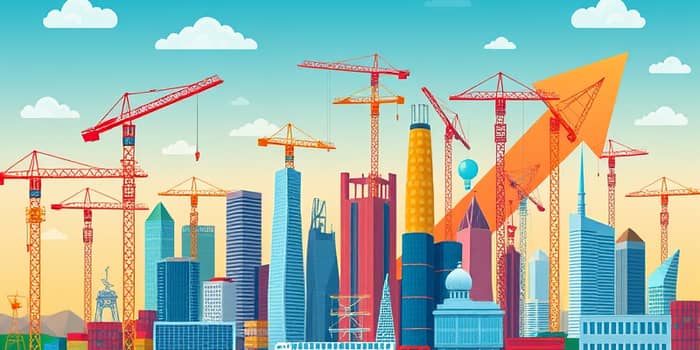
Investment is the lifeblood of dynamic economies, fueling innovation, infrastructure, and prosperity. From bustling city skylines to pioneering research labs, strategic capital deployment shapes our shared future. By understanding how different forms of investment intertwine with growth, stakeholders can unlock powerful levers that drive sustainable progress.
In a world beset by uncertainty, recognizing the transformative power of targeted spending becomes more crucial than ever. This article examines how public, private, and foreign investments catalyze expansion, explores historical lessons, and highlights actionable strategies for moving forward.
The Power of Investment: Foundation of Economic Expansion
Economic growth is often measured by changes in real Gross Domestic Product (GDP), reflecting the value of goods and services produced. Over time, capital accumulation—whether through factories, highways, or research facilities—becomes the primary driver of rising productivity and living standards.
For emerging market and developing economies, scaling up public investment by 1% of GDP can increase output by up to 1.2% over five years. In nations with ample fiscal space and efficient government spending, the boost can reach 1.6%. These multipliers illustrate how well-directed capital creates a ripple effect, benefitting society at large.
Types of Investment: Public, Private, and Foreign
Understanding the distinct roles of various investment streams helps policymakers tailor strategies for maximum impact. Each type carries unique advantages and challenges:
- Public Infrastructure Projects: Roads, bridges, and utilities lay the groundwork for all economic activity. History shows that underinvestment erodes competitiveness and productivity.
- Private Business Investment: Corporate spending on machinery, technology, and facilities fuels employment and innovation, with U.S. non-residential fixed investment growing at 4–6% annually since 2021.
- Foreign Direct Investment (FDI): International firms bring capital, expertise, and global linkages. While some research finds bidirectional causality between FDI and growth, overall evidence leans positive in the long run.
Mechanisms: How Investment Catalyzes Growth
Investment fosters expansion through multiple channels. By boosting public capital, governments can infrastructure investment is among the most efficient forms of fiscal support, especially in depressed economies, where debt-financed projects can crowd in private spending and ignite renewed demand.
At the corporate level, business investment introduces cutting-edge equipment and processes that raise total factor productivity. This private investment crowding in and boosting productivity creates a virtuous cycle: higher output generates more income, which funds additional investment.
Research and development (R&D) also plays a pivotal role. International companies spent $80 billion on U.S. R&D in 2022, accounting for 12% of all business R&D. Such spending not only drives technological breakthroughs but also attracts skilled talent and further investment.
Critical Conditions for Success
Not all investment translates seamlessly into growth. Effectiveness hinges on macroeconomic and institutional factors. Public investment effects depend critically on two conditions:
- Adequate Fiscal Space: Governments need budgetary room to finance projects without undermining stability. Overleveraging can lead to unsustainable debt burdens.
- Spending Efficiency: Transparent procurement, rigorous cost–benefit analysis, and sound governance ensure that each dollar delivers maximum returns.
Moreover, investments shine brightest when aggregate demand is slack. In downturns, well-targeted fiscal stimuli can kickstart activity, generating jobs and incomes that reverberate across sectors.
Historical Trends: Lessons from the Past
Decades of data underscore the link between public capital and productivity. From 1953 to 2007, U.S. public non-defense capital stock growth declined from 3.68% to 2.18%, mirroring shifts in private sector output and broader productivity trends.
This pattern highlights a simple truth: consistent capital replenishment and modernization underpin productivity gains that no single policy can fully replace.
The Paradox of Equity Markets
The relationship between stock market performance and economic growth is often described as an enigma. While some studies report a positive correlation between market capitalization and per capita GDP in high-income countries, others find a modest negative correlation between real equity returns and growth rates.
Factors such as speculative bubbles, regulatory shifts, and sectoral imbalances can decouple financial markets from underlying economic fundamentals. Investors and policymakers must recognize that buoyant markets do not automatically translate into broad-based prosperity.
Embracing the Future: Strategic Paths for Policymakers and Investors
As we navigate post-pandemic uncertainty and global headwinds, a few guiding principles emerge:
- Prioritize investments with clear social and economic multipliers, such as sustainable infrastructure, digital connectivity, and clean energy initiatives.
- Foster public–private partnerships to leverage resources and share risks, ensuring that large-scale projects combine governmental oversight with private sector agility.
- Enhance transparency and accountability through rigorous project evaluation, ongoing monitoring, and community engagement.
By adopting these strategies, governments can create the conditions for sustained growth, while businesses and foreign investors align their capital with long-term development goals.
Conclusion: Seizing the Investment Imperative
Investment is more than numbers on a balance sheet—it is a declaration of belief in tomorrow’s possibilities. Whether building roads that connect communities, funding laboratories that spark discovery, or attracting foreign expertise that bridges markets, capital deployment lays the groundwork for a more prosperous, resilient world.
By understanding the nuances of public, private, and foreign investment, and by ensuring the right institutional frameworks, stakeholders can harness the full potential of capital. In doing so, they not only spur economic growth but also craft a legacy of inclusive progress for generations to come.
References
- https://blogs.worldbank.org/en/developmenttalk/unlocking-the-power-of-public-investment-to-foster-economic-grow
- https://www.epi.org/publication/bp338-public-investments/
- https://focus.world-exchanges.org/articles/relationship-between-stock-market-development-and-economic-growth
- https://home.treasury.gov/news/featured-stories/us-business-investment-in-the-post-covid-expansion
- https://www.msci.com/documents/10199/a134c5d5-dca0-420d-875d-06adb948f578
- https://www.bea.gov/data/gdp/gross-domestic-product
- https://www.ssga.com/us/en/institutional/insights/the-global-trend-of-positive-stock-bond-correlation
- https://globalbusiness.org/new-data-prove-global-investment-boosts-economic-growth/
- https://blogs.cfainstitute.org/investor/2023/03/17/myth-busting-the-economy-drives-the-stock-market/
- https://www.oecd.org/en/publications/2025/06/oecd-economic-outlook-volume-2025-issue-1_1fd979a8/full-report/reigniting-investment-for-more-resilient-growth_99b36090.html
- https://www.rbcgam.com/en/ca/learn-plan/investment-basics/whats-the-relationship-between-the-stock-market-and-the-economy/detail
- https://jscires.org/article/6721