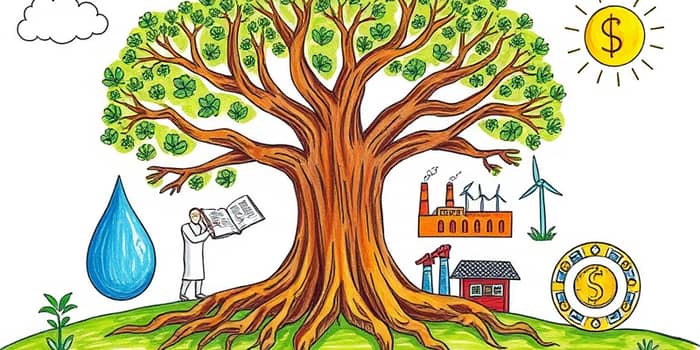
In a world where fleeting gains often eclipse long-term well-being, capital stewardship calls for a shift in how we perceive and manage the resources that sustain us. Beyond mere financial returns, stewardship invites us to honor interconnected forms of wealth—natural, human, social, manufactured, cultural, and financial. By embracing this holistic approach, individuals, investors, and institutions transform into active stewards, ensuring today’s choices build resilience for tomorrow’s generations and foster prosperity that endures.
Understanding Capital Stewardship
At its essence, capital stewardship involves the mindful, responsible management of diverse capitals to meet current needs while preserving or enhancing their abundance for the future. This ethic challenges the dominant short-term mindset, urging decision-makers to see each action—whether a purchase, an investment, or a policy vote—as an opportunity to regenerate or deplete multiple capitals simultaneously.
Stewardship reframes participants as custodians bound by intergenerational equity and collective duty. Every resource—from the air we breathe to the skills we cultivate—becomes part of a shared legacy. By acknowledging these enduring connections, we move beyond isolated gains toward contributions that strengthen the whole system.
Exploring the Six Forms of Capital
Capital stewardship reframes traditional notions of wealth into six interrelated domains. Each form underpins societal well-being and, when nurtured, fuels a virtuous cycle of innovation and resilience:
- Natural Capital: Clean air, water, fertile soil, biodiversity, and stable climate systems that sustain life and all other capitals.
- Human Capital: Skills, knowledge, health, and creativity developed through education, healthcare, and personal growth.
- Social Capital: Networks, relationships, and trust that enable collaboration, shared values, and collective action.
- Manufactured Capital: Durable infrastructure, tools, and technology designed for longevity and minimal environmental impact.
- Cultural Capital: Traditions, artistic expression, and knowledge systems that guide balanced and meaningful living.
- Financial Capital: Monetary assets and instruments that facilitate transactions and support investments across all other capitals.
Imagine a community garden: it enriches soil (natural), provides hands-on learning (human), fosters neighborly bonds (social), uses reclaimed materials (manufactured), celebrates cultural traditions around food (cultural), and may generate local revenue (financial). This real-world example illustrates how integrated stewardship can yield mutually reinforcing benefits.
Theoretical Foundations and Ethical Imperatives
Capital stewardship draws on ethics, economics, sociology, and environmental science. It champions intergenerational equity and collective responsibility, inspired by John Rawls’ veil of ignorance and Robert Solow’s sustainability models. These theories emphasize that present generations hold resources in trust, ensuring future well-being matches or exceeds current levels.
Behavioral economics reveals a central hurdle: hyperbolic discounting, which favors immediate gratification over long-term gains. To counteract this tendency, stewardship frameworks propose behavioral nudges and policy incentives—such as green defaults, transparent ecosystem service valuation, and community-based commons governance—that realign choices with lasting outcomes.
Operational tools like integrated reporting broaden corporate metrics beyond financial statements, capturing non-market values such as carbon sequestration and social cohesion. By embedding these metrics into decision-making, organizations can make more informed trade-offs and prioritize capital regeneration over depletion.
Investment Stewardship in Action
Within the financial sector, stewardship translates to the responsible allocation, management, and oversight of client capital to secure lasting value. Leading firms integrate environmental, social, and governance (ESG) factors to align portfolios with sustainable outcomes. The table below compares approaches among major asset managers:
Through issuer engagement, proxy voting, and transparent reporting, these firms exemplify how stewardship principles become tangible actions that respect both human and ecological stakeholders. Real-world successes include board-level climate risk disclosures and community impact partnerships that advance social equity.
Practical Strategies for Everyday Stewardship
Regardless of scale, stewardship begins with intentional steps that accumulate into meaningful change. Consider the following actions to amplify your impact:
- Cultivate new skills or volunteer for local initiatives to strengthen human and social capital.
- Support regenerative agriculture and renewable energy to restore natural capital.
- Choose durable, repairable products to extend the life of manufactured capital.
- Engage in cultural exchanges and heritage conservation to enrich community knowledge.
- Allocate part of your portfolio to ESG-focused funds to drive responsible financial growth.
Tracking progress can boost motivation. Use simple metrics—such as volunteer hours logged, waste diverted, or ESG ratings—to celebrate milestones and refine strategies. Collaborate with peers, local governments, or NGOs to scale efforts and share best practices.
Overcoming Challenges and Embracing Solutions
Implementing stewardship often encounters barriers. Valuing intangible assets like trust and biodiversity challenges traditional accounting. Short-term biases and competing stakeholder pressures can derail long-range initiatives. Moreover, balancing anthropocentric and ecocentric viewpoints calls for inclusive dialogue and continuous learning.
To navigate these complexities, adopt robust reporting frameworks that integrate non-market values, leverage digital dashboards for real-time transparency, and establish participatory budgeting or commons governance models that empower communities to set and enforce rules. Educational campaigns and workshops help shift mindsets from consumption to custodianship, fostering a shared commitment to long-term resilience.
A Call to Responsible Growth
Capital stewardship is more than theory or a corporate mandate: it is a guiding principle for sustainable prosperity. By aligning personal choices, institutional practices, and public policies with the goal of long-term value creation, we ensure that resources nourish both people and planet.
Your journey as a steward begins with a single decision: to view resources as legacies to protect and enhance, rather than commodities to exhaust. Embrace this transformative path, and together we will cultivate a future where growth, equity, and environmental harmony thrive in unison.
References
- https://lifestyle.sustainability-directory.com/term/capital-stewardship/
- https://am.landg.com/en-uk/institutional/responsible-investing/investment-stewardship/
- https://am.jpmorgan.com/ca/en/asset-management/adv/about-us/investment-stewardship/
- https://www.franklintempleton.com/forms-literature/download/Stewardship-principles-en
- https://lifestyle.sustainability-directory.com/area/capital-stewardship/