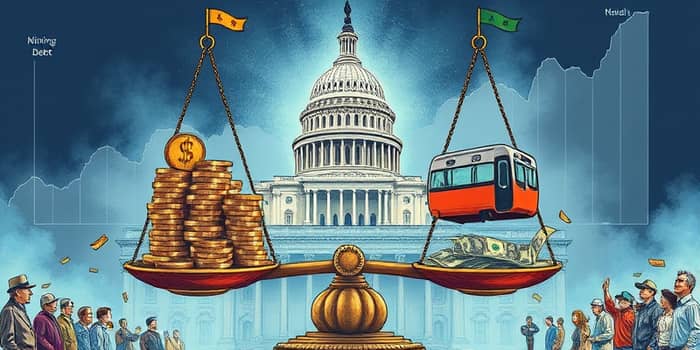
As the United States confronts a fiscal gap of nearly $1.9 trillion in 2026, it is essential to understand how and why governments spend more than they collect. This article explores the mechanics of deficits, the forces behind their rise, the dangers they pose, and practical steps to bring budgets back into balance.
Understanding Budget Deficits
A budget deficit occurs when government spending exceeds income—primarily revenues from taxes, fees, and tariffs. Unlike households, federal governments measure deficits in absolute dollars, as a percentage of gross domestic product (GDP), and cumulatively over time. A one-year gap adds to public debt, which in turn shapes borrowing costs and economic growth.
Today, U.S. federal debt stands at nearly $31 trillion—100% of GDP—double the fifty-year average. Projections by the Congressional Budget Office estimate debt will rise to 108% of GDP by 2030 and a record 120% by 2036, surpassing even post–World War II levels. These numbers reflect a pattern of persistent shortfalls that demand attention.
Drivers of Rising Deficits
Several key factors have propelled U.S. deficits upward in recent years. First, demographic change has increased mandatory spending on Social Security and Medicare as the population ages. Second, legislation like the 2022 budget package added $4.7 trillion in costs when including interest and macroeconomic effects. Third, immigration reforms contributed another $0.5 trillion. Simultaneously, policy decisions on tariffs and tax rates can introduce offsets—for example, proposed tariffs in the CBO baseline reduced deficits by an estimated $3 trillion.
The trajectory is striking: the deficit jumped from $1.8 trillion in 2025 to an anticipated $3.1 trillion in 2026, representing 6.7% of GDP. Early tracking in FY2026 shows year-to-date deficits of $600 billion—20% lower than the prior year due to robust revenue growth—yet still far above sustainable levels.
The Risks of Mounting Debt
Unchecked deficits pose significant risks. As debt climbs, interest payments claim a larger share of government spending, crowding out investments in infrastructure, research, and education. High debt ratios can lead to higher borrowing costs, undermine confidence in financial markets, and ultimately slow economic growth.
Moreover, excessive deficits reduce fiscal flexibility. In times of crisis—such as a recession or natural disaster—governments need room to maneuver. Without sufficient reserves or borrowing capacity, policymakers may face forced cuts to essential programs or abrupt tax hikes, triggering economic hardship.
Household vs. Government Budgets
It is tempting to equate government budgets directly with household finances, but key differences exist. Governments can issue bonds, influence monetary policy, and adjust tax codes—tools unavailable to families. A household that overspends risks bankruptcy; a government can sustain high debt ratios if lenders remain confident in its ability to repay.
Nonetheless, analogies are instructive. Families build budgets, track expenses, and set aside emergency savings. Governments, too, can adopt fiscal buffers for crises by maintaining contingency funds and stabilizing revenue streams. Just as a household might refinance a mortgage to lower rates, a government can restructure its debt over time—but only up to a point.
State and Federal Dynamics
Fiscal relationships between federal, state, and local governments add further complexity. In FY2021, state and local receipts totaled $2.5 trillion—half from taxes and 43% from federal transfers. Some states, like California and New York, are net contributors to the federal treasury, sending more per capita than they receive. Others, including Virginia, benefit from net inflows.
These intergovernmental flows can mitigate local budget pressures but also mask underlying structural gaps. When federal revenues decline, states may face balanced-budget rules that force immediate cuts.
Strategies for Balance and Resilience
While the challenge is formidable, practical steps can move the nation toward more sustainable finances. Policymakers and citizens alike can draw on household budgeting principles to guide reforms.
- Track and limit spending: Conduct regular audits to identify inefficiencies and eliminate waste.
- Increase income: Reform the tax code, close loopholes, and adjust tariffs strategically to boost receipts.
- Reduce debt: Commit to gradual deficit reduction plans tied to economic growth.
- Prioritize essentials: Focus on secure funding for infrastructure, health, and national security.
- Build reserves: Establish rainy-day funds to weather future downturns without drastic cuts.
In addition, lawmakers can explore bipartisan agreements on entitlement reforms and revenue adjustments. By setting multi-year targets, Congress can provide clarity and stability for markets and the public.
Global and Historical Perspectives
Relative to other advanced economies, the U.S. taxes and spends less as a share of GDP. Yet its debt trajectory is among the steepest. Globally, debt in developed markets is projected to rise by $4.4 trillion to $75 trillion in 2026, with the U.S. deficit at 6.7% of GDP—higher than France’s 5.4%.
Looking back, federal net outlays have trended upward since the 1960s, driven by expanded social programs and defense commitments. State and local per-capita spending doubled in real terms between 1977 and 2021. These historical shifts underscore the long-term nature of fiscal challenges and the need for strategic planning.
By understanding the forces at play and embracing responsible budgeting practices, governments can restore fiscal health, strengthen economic foundations, and uphold the social commitments that define a prosperous society.
References
- https://www.crfb.org/papers/cbos-february-2026-budget-and-economic-outlook
- https://duncangrp.com/government-budget-vs-your-household-budget/
- https://www.cbo.gov/publication/62105
- https://www.urban.org/policy-centers/cross-center-initiatives/state-and-local-finance-initiative/state-and-local-backgrounders/state-and-local-expenditures
- https://bipartisanpolicy.org/report/deficit-tracker/
- https://usafacts.org/articles/which-states-contribute-the-most-and-least-to-federal-revenue/
- https://www.cbo.gov/publication/61882
- https://taxpolicycenter.org/briefing-book/what-breakdown-tax-revenues-among-federal-state-and-local-governments
- https://flow.db.com/topics/macro-and-markets/the-world-outlook-2026-never-a-dull-moment
- https://www.pgpf.org/article/chart-pack-the-us-budget/
- https://www.deloitte.com/us/en/insights/topics/economy/global-economic-outlook-2026.html
- https://www.epi.org/explorer/international/
- https://www.fitchratings.com/research/sovereigns/developed-market-government-debt-to-continue-rising-rapidly-in-2026-23-01-2026
- https://fred.stlouisfed.org/series/FYONGDA188S
- https://www.oecd.org/en/data/indicators/general-government-deficit.html