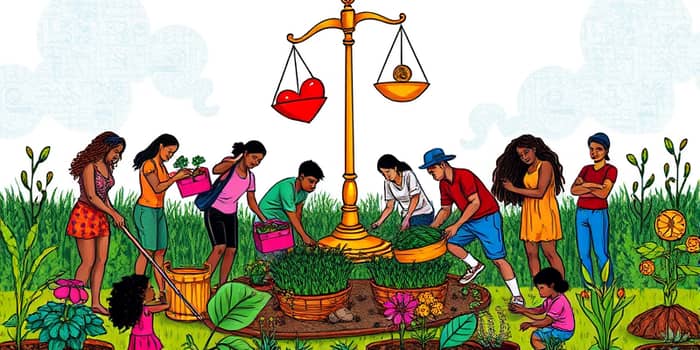
Every day, organizations and programs invest time, money, and skills in hopes of creating lasting change. But how do we know if that investment truly matters? Social Return on Investment (SROI) offers a lens to view outcomes not just in dollars, but in real human and community impact.
Understanding Social Return on Investment
At its core, SROI measures whether the benefits of a program outweigh its costs. By comparing the social, environmental, and economic value generated to the resources consumed, organizations can answer the essential question: "Is the world a better place because of what we're doing?"
Unlike traditional financial analysis, SROI captures a systematic way of measuring impact across multiple dimensions. It translates qualitative improvements—like boosted confidence or reduced loneliness—into monetary terms, creating a clear ratio of return to investment.
Why SROI Matters Today
In an era of tightened budgets and heightened accountability, funders and stakeholders increasingly demand evidence of real change. SROI fills that need by providing a transparent, quantifiable measure of value that goes beyond balance sheets and profit-and-loss statements.
Recent meta-analyses by leading economists revealed that many social programs, particularly those serving children and young adults, actually generate downstream savings for taxpayers. Programs achieving an SROI above 1.0 demonstrate that every dollar invested yields more than a dollar in social benefit, and top-performing initiatives can achieve ratios of 3:1 or higher.
- Reduced reliance on government assistance
- Increased personal income and tax contributions
- Improved health and safety outcomes
- Enhanced relationships and community cohesion
Real-World Success Stories
Across the globe, organizations are proving the power of social investment. From mentoring youth to renovating homes, these case studies highlight the diversity of applications and the robustness of SROI metrics.
These figures reveal more than efficiency—they unveil the broader societal impacts and economic value unlocked when communities rally behind purpose-driven initiatives.
Implementing SROI in Your Organization
Building a robust SROI model demands collaboration, data, and iterative refinement. Nonprofits and social enterprises can follow a structured approach to embed SROI into their strategic planning.
- Understand Your Costs: Collaborate with finance teams to capture direct and indirect program expenses accurately.
- Gather Impact Data: Leverage secondary research and historical SROI studies to estimate benefits relevant to your program.
- Choose the Right Tool: Evaluate platforms and frameworks—such as those offered by REDF—to model your unique value proposition.
- Build and Test: Assemble a cross-functional team to draft a preliminary model, then validate assumptions with stakeholders and funders.
- Refine Over Time: Update your calculations as new data emerges and ensure ongoing alignment with program goals.
Pairing SROI with rigorous evidence-based research or self-evaluation studies ensures that numbers reflect reality, not wishful thinking. This dual approach bolsters credibility and deepens understanding of program dynamics.
Embracing a New Investment Mindset
Social Return on Investment embodies a shift toward an inclusive, broader investment mentality—one that values not just financial gains, but human flourishing and community resilience. By quantifying outcomes, organizations transform narratives of charity into compelling cases for investment.
When SROI numbers exceed expectations, they become powerful catalysts for change. They inform policy decisions, guide funding priorities, and spark innovation in fields as diverse as early childhood education, environmental stewardship, and workforce development.
Ultimately, SROI empowers leaders to answer a simple yet profound question with confidence: What difference are we truly making? As more organizations adopt this framework, we move closer to a world where every dollar spent is recognized for its potential to uplift lives and strengthen communities.
By looking beyond the bottom line, we honor the full tapestry of human experience and channel resources toward the greatest shared good.
References
- https://socialimpactarchitects.com/sroi/
- https://www.ebsco.com/research-starters/religion-and-philosophy/social-return-investment-sroi
- https://out-scape.com/resources-archive/social-return-on-investment-case-studies/
- https://www.betterevaluation.org/methods-approaches/approaches/social-return-investment
- https://rebuildingtogether.org/social-return-investment
- https://scholarworks.indianapolis.iu.edu/bitstreams/50e30fb1-5f86-41e8-b5a1-e0db2d6aa9d4/download
- https://en.wikipedia.org/wiki/Social_return_on_investment
- https://nccs.org/publication/measuring-social-return-on-investment-for-community-schools-a-case-study/
- https://www.gsb.stanford.edu/faculty-research/case-studies/introduction-social-return-investment
- https://blog.upmetrics.com/social-returns-on-investment